Fedora Linux 45 ships after two delays, bringing GNOME 51 and a pile of breaking changes
Fedora Linux 45 has been officially released today, and it took a bit more than most people remembered for it to arrive. The Fedora Project released the distro across its full family, Workstation, KDE Plasma, Server, Cloud, CoreOS/IoT, the Atomic Desktops, and the Asahi Remix for Apple Silicon, though not without a couple of uncharacteristic hiccups along the way.
The announcement landed on Fedora Magazine, with release lead Aoife Moloney and Jef Spaleta walking through what shipped and what didn't quite make the cut. Fedora stays true to its role as the open-source vanguard here: bleeding-edge software, a tight six-month cadence, and a place for Red Hat to test RHEL ideas before shipping them. Fedora 45 is no exception.
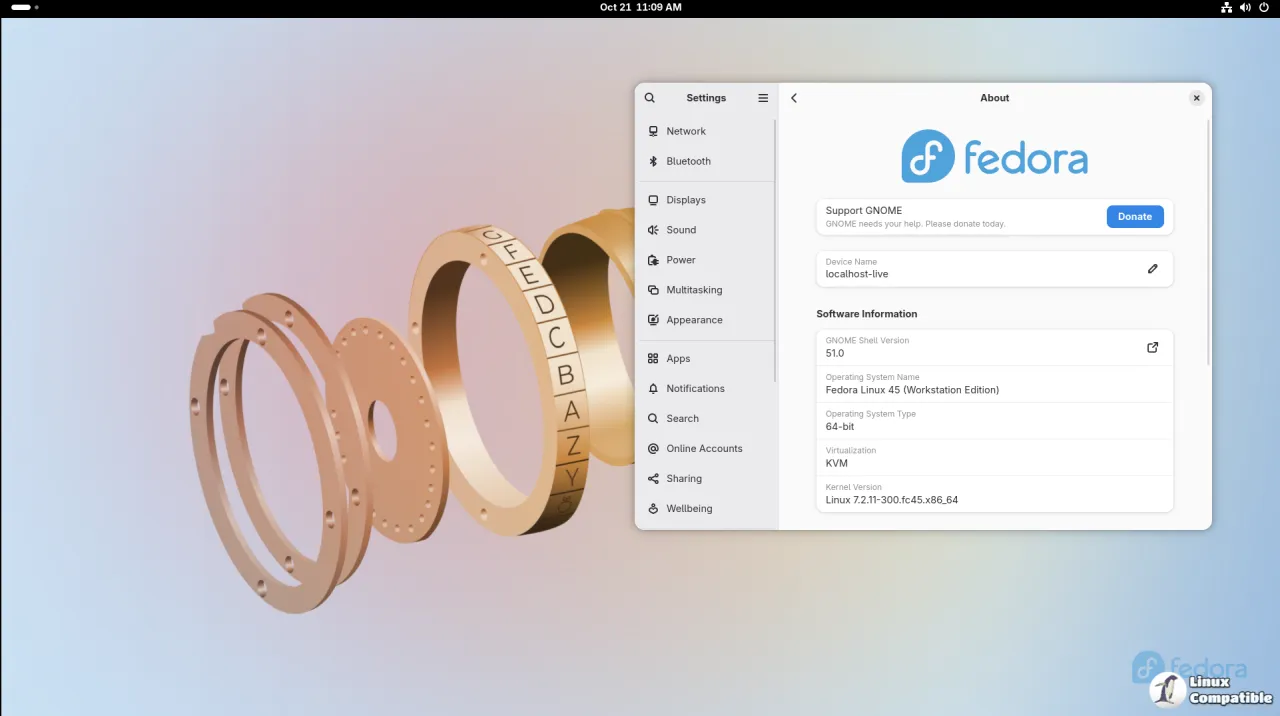
The release almost didn't happen
Fedora runs a strict Go/No-Go process. The final release candidate has to clear a specific list of blocker bugs before it ships. Fedora 45's got there, but not on the first try.
The original target was October 20. Two days early, the call came back NO-GO because no suitable final media had been published for QA to grade, testers had nothing to look at. A fallback date of October 27 was set, but that also failed, this time on two real blockers: an AArch64 server image that blew past its size limit and LVM auto-activation breaking after an upgrade on LUKS-backed storage.
The RC-1.4 compose finally cleared the bar. Moloney personally oversaw the vote in the #fedora-meeting room, and the install images declared stable are exactly what ended up mirrored on release day. Not bad for a project that otherwise treats its schedule like a religion.
What's actually under the hood
Workstation picks up GNOME 51, which hit upstream final back on September 16 and sits at 51.1 in Fedora's stable repos. The headline changes are about smoothness more than spectacle. Mutter's frame scheduling now holds a steady rate even when the CPU and GPU are chundering, NVIDIA proprietary interfaces get retired in favor of the standard GBM path, and the File manager gains a drag-and-drop counter so you can finally see how many items are actually being moved.
The Calendar got a rendering overhaul for slower scrolling, the File Previewer was rebuilt on GTK 4, and there's a new oo7 secrets backend — a from-scratch Secret Service provider designed to keep cached credentials out of reach of rogue apps. GNOME 51 also saves monitor brightness across reboots now, which is a small thing you'll only appreciate the first time your display doesn't snap back to full brightness at 9 a.m.
The KDE Plasma edition runs 6.8, which landed on October 14 for KDE's 30th anniversary. After roughly two decades of requests, per-screen virtual desktops finally exist. There's a built-in microphone volume test, a dwell-clicker for accessibility, and a new "Background Apps" tray section that'll finally tell you which Flatpak is eating your battery.
On the platform side, Fedora 45 runs the Linux 7.2 kernel with 7.3 coming soon, GCC 16.2, glibc 2.44 with shadow stacks on by default, systemd 262, and Podman 6. That last one is where things get interesting.
A few changes will bite you
Fedora 45 ships with Stratis support baked directly into the Anaconda installer, which is a genuinely nice touch. You get storage pooling, thin provisioning, snapshots, and encryption without the usual pain, launching the Cockpit storage module straight from the install screen. Btrfs with zstd compression stays the default on Workstation, and BIOS boot still works.
But not everything is forward-compatible, and some of these will trip up people following older tutorials.
Podman 6 drops slirp4netns, cgroups v1, and the BoltDB backend. If you're upgrading from an older install, you'll need to move to --network=pasta and migrate BoltDB databases to SQLite first, or the upgrade will complain loudly.
RPM signature checking is now enforced. rpm -i on an unsigned package stops instead of just printing a NOKEY warning and carrying on. Import the key, or use dnf.
Worth paying attention to: DNF 4 and yum are dead as package managers. Fedora's .repo files now live in /usr/share/dnf5/repos.d/ and signing keys in /usr/share/pki/rpm-gpg/. The old /etc/yum.repos.d/ directory still exists but ships empty. Any script grepping the old paths will break, and that includes a lot of the clever one-liners floating around on Reddit.
For the record, this isn't Fedora being needlessly hostile. It's the same discipline that keeps the distro a reliable testbed. But discipline and convenience are different things, and admins maintaining older tooling should budget some real time for this upgrade.
Fedora Asahi Remix 45
The Asahi version dropped a day earlier, on November 2. It supports Apple M1 and M2 as before, and this release adds out-of-the-box support for M3, M3 Pro, and M3 Max, which Asahi Linux upstream now officially backs. GPU drivers for 3D acceleration on the M3 chips aren't included yet and will come through a later Mesa update.
KDE Plasma 6.8 is the flagship, with a GNOME 51 variant, a Server image, and a minimal build. Fresh installs are straightforward; upgrades from 43 or 44 follow the usual process, though you'll skip GNOME's Software app and use Discover or DNF's System Upgrade instead.
Getting on it
Existing Workstation users upgrade in place:
sudo dnf upgrade --refresh
sudo dnf system-upgrade download --releasever=45
sudo dnf offline reboot
Fedora 44 goes straight to 45, and 43 users can skip a release with dnf system-upgrade, followed by sudo remove-retired-packages 43.
Silverblue and the other Atomic Desktops rebase instead of upgrading:
rpm-ostree update
rpm-ostree rebase fedora:fedora/45/x86_64/silverblue
Pin the current deployment first if you want a rollback option hanging around in GRUB, because you'll probably want one given the list above.
Fedora 45 itself is supported until December 8, 2027, though early build packages briefly listed November 24, minor version drift in the release metadata, nothing to lose sleep over. Fedora 43 should age out around December 16.
Head here to download. The Announcing Fedora Linux 45 post on Fedora Magazine is the best place to start.


