Fedora Linux 45 Final Declared NO-GO; New Target Slips to October 27
Fedora just failed to produce a shipable Final candidate for its upcoming release, and that single omission is enough to derail the whole schedule. Because nothing suitable was available to test, the project has declared Fedora 45 Final a NO-GO. The new target is October 27, 2026, which slides the GA date a week past the original October 20 plan.
That's a reason to raise an eyebrow. Most Fedora NO-GOs come with a list of blocker bugs to sort through. This time, there was nothing to look at at all.
The mechanics behind a NO-GO
Fedora's release cycle is tightly gated, and the Go/No-Go meeting is the choke point. QA verifies release criteria using the blocker bug process. If all appropriate validation testing is done and no accepted blockers remain, the release gets declared GOLD. Once that call is made, it can't be reversed. Mirror staging begins, and it stays staged even if worse bugs turn up later.
Miss the bar by a hair and the release slides by one week.
This is the path Fedora 45 took. Except rather than a pile of open blockers, the failure here is more fundamental: no suitable RC was published before the meeting rolled around. With nothing on the table, QA had nothing to grade, which produces a "NO-GO by default."
The announcement itself is remarkably terse. Aoife Moloney, the Fedora Operations Architect, posted to the devel-announce mailing list on Thursday, October 15, at 12:50 p.m. Her words: "Because no suitable release candidate (rc) was available, we do not have an F45 Final RC. As a result, F45 Final is NO-GO by default."
The phrasing "by default" is doing a lot of work here. It's not that QA found unaddressed blockers. It's that there was no candidate compose at all, so the meeting couldn't reach a positive determination. Not that it was surprising. Some aggregations carried a "CANCEL: 2026-10-12" marker earlier in the week, signaling that no viable candidate was expected well before the meeting even started. The actual announcement was pulled from the mailing-list archives via the Wayback Machine, since those archives sit behind a bot challenge.
Fedora has no shortage of NO-GO history. Fedora 30 slipped in 2018 partly because its RC was too fresh to evaluate. Fedora 43 in October 2025 carried real blockers, from an Anaconda dropdown bug to a linux-firmware wifi regression, before clearing on its second attempt. Fedora 44 slipped three times this spring, and at one point QA even canceled a meeting because there was zero indication the blockers would close.
Fedora 45 is different in one respect. Every prior NO-GO had an RC to argue about. This one had none.
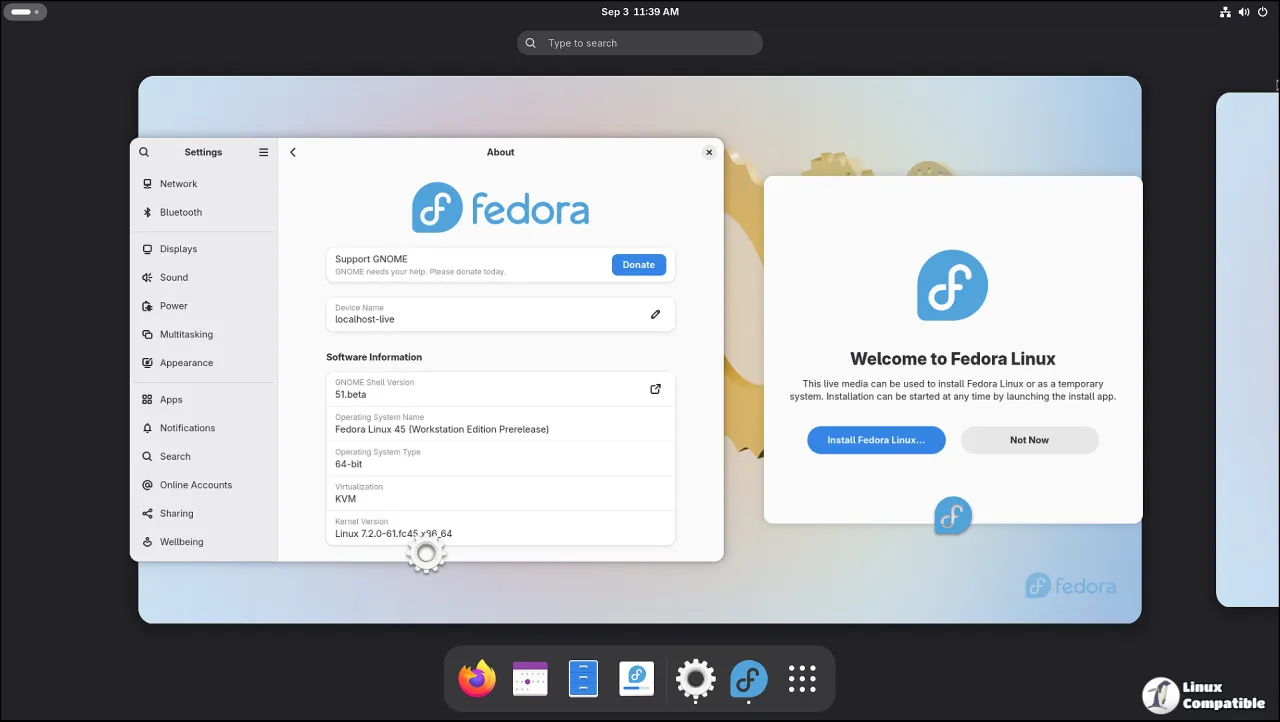
It's worth remembering what's actually in this release, which is more than usual. Fedora 45 brings GNOME 51, KMSCON swapping out the legacy fbcon console, strict RPM signature enforcement by default, and a Stratis storage path added to the Anaconda installer. The toolchain upgrades round things out with Python 3.15, GCC 16.2, and glibc 2.44. It shipped as a beta on September 15, and the team clearly expected the final media to land by late October. So the whole thing slipping on a missing candidate is a slightly uncomfortable position for a project that leans hard on its testing discipline.
What's next for Fedora 45
The next Go/No-Go meeting is set for Thursday, October 22, 2026, at 1700 UTC in the #fedora-meeting room on Matrix. The project is now chasing "target date #1," which is Tuesday, October 27. The original October 20 GA date has been dropped entirely.
If October 27 also slips, there's a contingency of November 3 already sitting on the schedule. Each NO-GO pushes things a week, so treat 27 October as a target, not a promise.
So what does this mean for you? Don't plan to install Fedora 45 on October 20. The earliest realistic GA is October 27, and that hinges entirely on a suitable RC getting composed and passing Go/No-Go a week from now.
If you need a reliable box, stay on Fedora 44. Fedora releases get roughly 13 months of support, and the support clock for F45 starts at GA, not at Beta. Fedora 44 still has a long way to go before it's anything but a safe bet.
Head here if you want to try out the beta in the meantime.


