XanMod ships synchronized 6.18.57 LTS and 7.2.11 mainline kernel builds
Two coordinated tuning-kernel drops landed on the same evening for Debian-based systems, and the changelogs carry a telltale sign of how open-source development is actually happening now.
The maintainer of XanMod just dropped two kernel builds on the same afternoon. That gives Debian-based users a clean fork in the road: the bleeding-edge mainline series or the long-horizon LTS tree, whichever you'd rather run.
On October 15, 2026, Alexandre Frade tagged 6.18.57-xanmod1, built from upstream Linux 6.18.57 LTS, and 7.2.11-xanmod1, built from the 7.2.11 stable mainline.
That's the headline. Both are drop-in kernels for x86-64 Debian-based systems, the kind of tuning kernels that promise a snappier box out of the box without making you maintain your own patchset.
What XanMod is, briefly
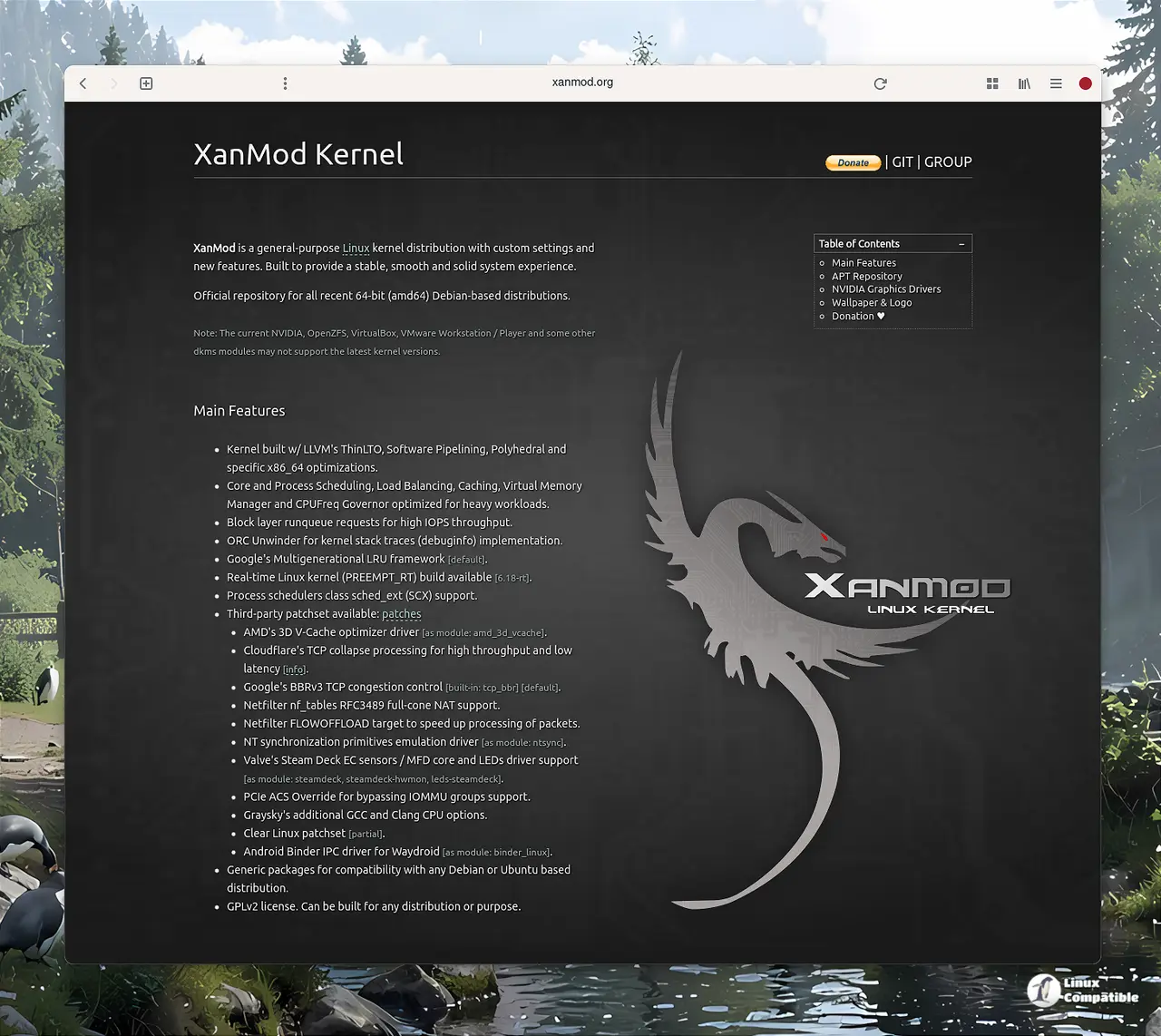
Created in 2015 and still run almost entirely by Frade from Catalonia, XanMod doesn't write much of its own code. It takes vanilla upstream Linux, layers on a performance patchset, and compiles with aggressive CPU-targeted optimizations: LLVM ThinLTO link-time optimization, software pipelining, and Polly loop transforms.
The result is marketed as a "stable, smooth and solid" system that feels faster under heavy load. Whether that actually shows up in your daily workflow is a separate question.
The interesting stuff lives in the third-party patches. XanMod ships Google's BBRv3 as the default TCP congestion control, Cloudflare's TCP collapse processing, Netfilter FLOWOFFLOAD, and even Valve's Steam Deck EC sensor drivers as loadable modules. You can also enable PCIe ACS Override for multi-GPU passthrough if that's your kind of thing.
CPU tiering is where it gets specific. You pick a build matched to your generation: x86-64 (LEGACY) for roughly 2003 silicon, v2 for around 2009, v3 for Haswell-era (2015) and newer, and v4 for AVX-512. The recommended default for anything Haswell or newer is the x64v3 build. Worth knowing that the v4 tier offers no kernel benefit, so there's no reason to install it just for the name.
Installation is a scripted APT dance: drop in the PGP key, add the repo, then install linux-xanmod-x64v3. The site openly asks for donations to hit a roughly $1,200 annual goal, which about describes the scale of an independent project this size.
The changelogs: bug fixes, not features
Here's the thing about point releases. 6.18.57 and 7.2.11 are stable point releases, which means bug fixes and hardening rather than shiny new features. The security flavor is strong in both.
For the LTS build, the standout is an XFS corruption fix. There's a bug in the XFS_IOC_EXCHANGE_RANGE TO_EOF flag where files could end up with shared blocks past the end of the file and reflink flags cleared incorrectly, letting an extending write corrupt a neighbor file's data. Fixing it means you stop that from happening. That one has picked up the affectionate name "refluxfs."
Other LTS items include a sched_ext queue-sequence correctness fix, a Steam Deck HID driver refactor, an ACPI button suspend regression, and some s390/zcrypt memory-exposure hardening. The latter pads CCA/EP11 messages with zeros so that up to 3 bytes of uninitialized kernel memory can't leak to crypto-card firmware.
The mainline 7.2.11 build has its own claims to attention. It reverts an io_uring regression that wrongly charged rings against RLIMIT_MEMLOCK, which had broken unprivileged io_uring_setup() for large rings. That's a real PostgreSQL developer pain point, not a hypothetical.
It also carries a fix for a corrupted right edge on certain JVC projectors pushing 4096x2160@60 through drm/amd/display. And it resolves a Raspberry Pi vc4 issue where binner slot allocation was failing on an idle GPU.
On NVIDIA drivers and timing
If you're running proprietary NVIDIA drivers, keep in mind that XanMod maintains a companion repository. As of this cycle the Production branch sits at 595.104.02 and the New Feature branch at 615.78.08.
There's a warning worth heeding. Recent DKMS modules for NVIDIA, OpenZFS, VirtualBox, and VMware can lag the newest kernel versions by a few weeks. If you've built any of those against XanMod, verify compatibility before you reboot or you might wake up to a box that won't load its display driver.
The real-time variant, 6.18.55-rt-xanmod1, already shipped a week earlier on October 3. It's LTS only, which makes sense, since low-latency scheduling is exactly the workload where people want stability rather than the bleeding edge.
If you want to try it, the APT repo and manual .deb downloads are on the XanMod GitLab and SourceForge release pages. The build details here are drawn from XanMod's official changelogs, the upstream Linux 6.18 and 7.2 release notes, and third-party reporting.
Head here to the XanMod website for more details.


