openSUSE released Leap 16.1 today, folding its former Leap Micro immutable line straight into the main distribution under a new Immutable Mode. The update brings transactional, snapshot-based updates with easy rollback, aligned its launch with SUSE Linux Enterprise Server 16.1 to close a long-standing support gap. Community support now spans 24 months, and the release adds visible desktop bumps like KDE Plasma 6.6 plus a new osdiff tool for checking exact package versions. It ships for x86_64, aarch64, ppc64le, and s390x, with downloads verified via SHA256 and GPG signatures.
openSUSE Leap 16.1 ships today, folding its former immutable line into the main distro
The new release merges Leap Micro into Leap through a new Immutable Mode, extends community support to 24 months, and lines up its launch with SUSE Linux Enterprise Server 16.1.
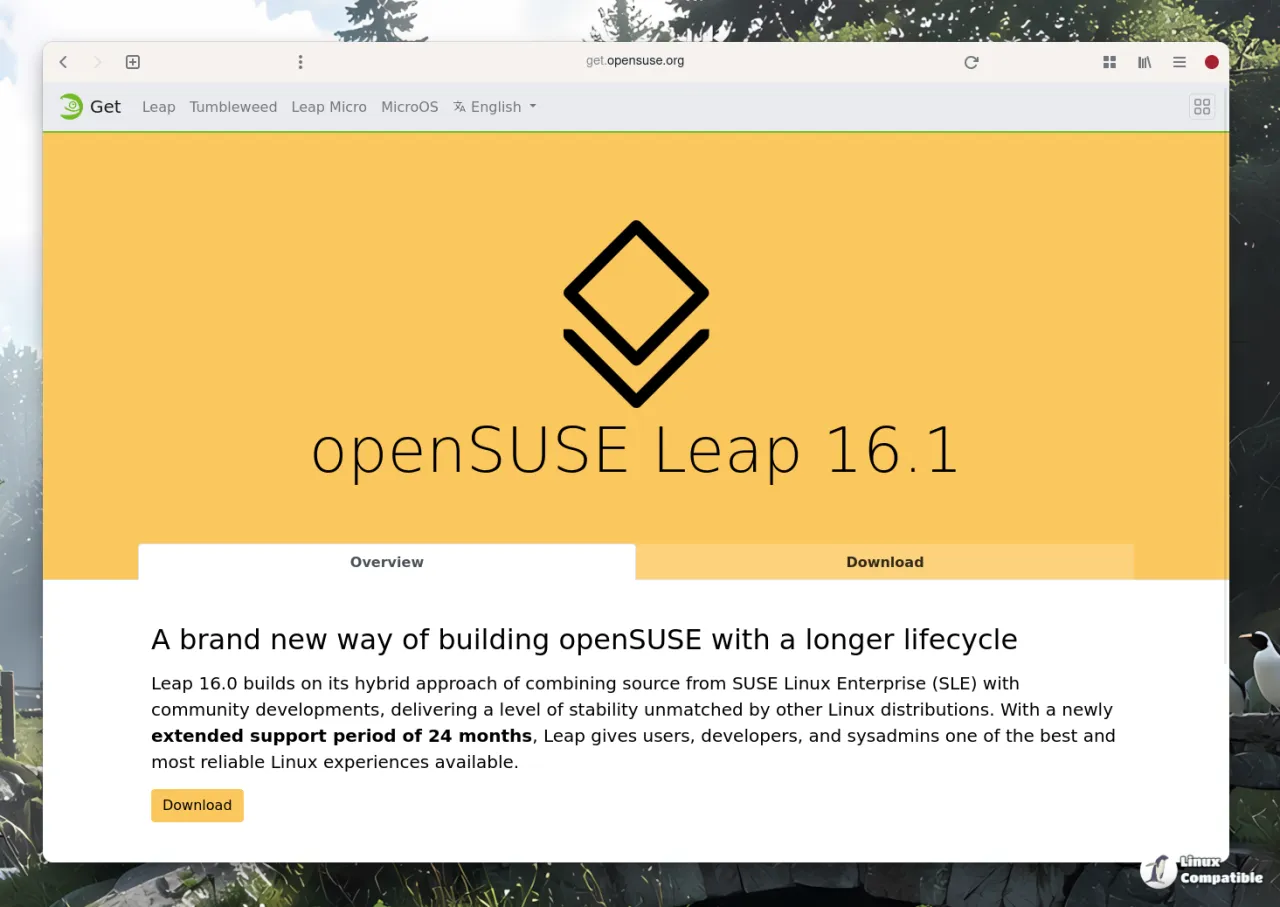
There's a new way to think about a Linux distro that has existed in some form since 1994. Today openSUSE released Leap 16.1 and, in doing so, folded the formerly standalone Leap Micro immutable line straight into the main distribution. No Leap Micro 6.3. No Leap Micro 7.0. SUSE has confirmed that outright. Instead there is one product you are meant to use for desktops, classic servers, containers, and edge hosts, backed by a 24-month community support window.
The release went public Tuesday at 12:00 UTC, deliberately lined up with the First Commercial Ship of SUSE Linux Enterprise Server 16.1. That timing is the result of the Leap 16.0 retrospective, where users kept flagging the awkward gap between a launch and its first maintenance updates. This release closes that gap. The maintenance updates now flow straight through from SLE.
One distro, a lot of jobs
The headline is genuinely the immutability piece. In Immutable Mode, Leap runs as a transactionally updated system with a read-only root filesystem. Every update lands as a whole new snapshot rather than a pile of file edits. Mess something up, and you roll back to the last known-good snapshot on the next boot.
This is the same atomic approach used by Fedora Silverblue, Android, and basically any smartphone in your drawer. openSUSE had already been shipping it as Leap Micro, a separate product aimed at container and VM hosts. Now it is folded in, selectable during a standard install via the Agama installer. You cannot switch modes after installation, so pick one up front.
In practice, updates go through transactional-update. That is a sudo transactional-update dup followed by a reboot, and if it all goes sideways there is a transactional-update rollback waiting for you. The openSUSE team recommends keeping additional software in containers like podman or distrobox, or via Flatpak on the desktop. For a quick package install you can still reach for sudo transactional-update pkg install <package>.
Existing Leap Micro 6.2 owners can migrate to 16.1 in Immutable Mode, but only with the experimental opensuse-migration-tool. The team is explicit about one thing: keep a backup.
I have been watching the immutable line grow for a couple of years now. Leap Micro, MicroOS, Aeon, Kalpa, a whole sub-family of near-identical point releases that confused anyone not already deep in the ecosystem. Folding them together is arguably the most sensible thing openSUSE has done this cycle. It trims the clutter that had built up around a "choose your flavor" menu that was starting to feel like too many flavors.
That said, the dedicated micro product is not gone. It has simply been absorbed. The migration path also still has rough edges, since the tool only takes Leap Micro 6.2 forward and ignores older installations.
What actually moved under the hood stays close to 16.0, which is the whole point of the hybrid model. The kernel stays at 6.12 LTS, systemd at 257, glibc at 2.40. Everything around that core moves a bit more. On the desktop, KDE Plasma gets the most visible bump, jumping from 6.4 to Plasma 6.6 with Qt 6.11 and KDE Frameworks 6.25. GNOME stays on version 48, though gnome-shell did get pushed from 48.4 to 48.8. That deliberate split of a big GNOME update across two releases mirrors how SUSE handles SLE service packs. LXQt moved to 2.4, and Xfce continues on Wayland at 4.20.
For server folks, the SLES 16.1 base brings a real-time kernel to standard installations for the first time, along with PREEMPT_LAZY preemption and Pressure Stall Information enabled by default. SELinux is now the primary security module over AppArmor, and HAProxy plus Keepalived moved into base SLES. distrobox is pre-installed, replacing the older toolbox. Keep in mind that several of these are enterprise features that arrive in Leap through the shared base, so organizations should verify which packages actually land in the community build versus the paid SLE subscription before going making procurement promises. Some require extensions or a plan.
The version tool, the support window, and the download
If you have ever tried to figure out what version of a package you would actually get on a given distro, the new osdiff tool is worth a look. It answers the perennial "what version of X am I running?" question with a single, auto-generated, timestamped page.
The latest run compared 17,532 source packages across Tumbleweed, Leap 16.1, and Leap 16.0 against the latest upstream versions from Repology. Every package falls into one of five buckets: Older-in-Leap, Newer-in-Leap, Same, Only-in-TW, or Only-in-Leap. Yes, Newer-in-Leap is a real bucket, and it is rarer than you would expect.
The tool pulls from download.opensuse.org, attaches maintainer names to rows, and offers open-data exports in JSON or CSV. It compares upstream source-package versions rather than RPM release numbers, a distinction it calls out explicitly. It removes much of the need to lean on stale blog posts to confirm what is actually inside a release.
Community support for Leap 16.1 runs 24 months, an "18 + 6" model that sits near the top for a community distro. The underlying SLES 16.1 stays under support until July 31, 2034, with Long Term Service Pack Support extending that to as late as December 2037. Leap 16.1 itself is expected to reach end-of-life around October or November 2028, once Leap 16.3 ships.
Four architectures are supported: x86_64, aarch64, ppc64le, and s390x. The recommended image is the Offline Image at roughly 4 GiB, though there is a leaner Network Image for low-bandwidth installs and a ~1.5 GiB Immutable Self-install Image for USB. Standard installs want a 2 GHz dual-core processor, 2 GB of RAM, and over 40 GB of disk space.
Head here to download Leap 16.1 and start your install.


