Fedora Linux 45 gets yet another Release Candidate as the distro races toward a November launch
Two candidate builds are in play today as Fedora 45 tries to clear a second straight round of blocker bugs.
Fedora 45 has a new escape hatch. QA shipped Fedora 45 Candidate RC‑1.4 today, as an alternative to RC‑1.3. Both builds are still on the table heading into a make-or-break Go/No‑Go meeting set for 17:00 UTC today. If RC‑1.4 clears the bar, the release is expected to hit its 3 November 2026 launch date.
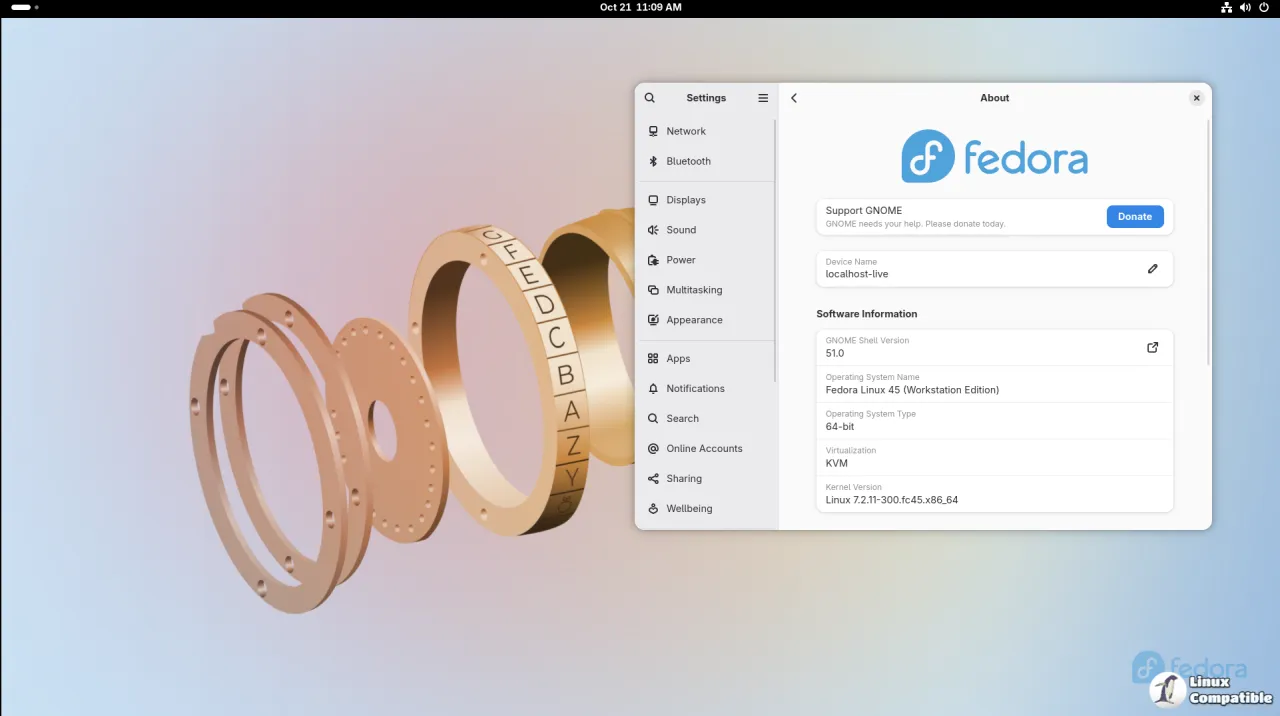
That would be a comeback for a version that has already stumbled twice. Fedora 45 was originally slated for 20 October, with 27 October parked as a contingency. Now the target sits at the first Tuesday of November. Fedora normally ships two major versions a year on a tight six-month cycle, so a second consecutive NO‑GO is unusual for a project that otherwise guards its schedule pretty hard.
The announcement itself was terse. "According to the schedule, Fedora 45 Candidate RC‑1.4 is now available for testing. Please help us complete all the validation testing," QA wrote, then pointed testers at the Release Validation Test Plan and a set of per-environment pages covering Installation, Base, Server, Cloud, Desktop, and Security Lab.
Here's the interesting part. RC‑1.4 differs from RC‑1.3 in exactly two ways: one extra patch in the stratisd series for multi-disk encrypted installs, and the "Cosmic" fix from RC‑1.2 that had somehow slipped through in RC‑1.3. That's the lot of it. Virtually every RC‑1.3 test result carries over to RC‑1.4, with the single exception of the Stratis tests, so QA can basically fold the two builds together ahead of the vote.
Keep in mind that not every change since RC‑1.2 is a fix. The build also picked up KDE 6.8.1, gedit 51.0, a dnsconfd installer-interference patch, several oo7 secrets-service updates, and a PHP security patch. But the ones that actually matter for today's vote point right at the bugs that sank the earlier attempts: the eMudhra certificate removal, the stratisd encryption fixes, and the oo7 changes.
Why the earlier NO‑GOs hurt
The path to RC‑1.4 has been uneven. On 15 October there was simply no candidate build ready in time, so QA had nothing to grade and the original 20 October GA date was scrapped. Two weeks later, on 22 October, a candidate existed but the blockers didn't clear. Release lead and Operations Architect Aoife Moloney announced that NO‑GO.
The bugs that held up the vote were a genuinely mixed bag. One was the still-open eMudhra certificate issue, a disputed CA that's still sitting in the system trust store. Another had the Fedora Server 45 AArch64 image running over its maximum allowed size. There was also LVM auto-activation failing after upgrading to Fedora 45 on a LUKS-backed physical volume, plus KDE Plasma Discover pushing outdated native RPM packages pulled from the Fedora 44 repository.
For what it's worth, RC‑1.4 looks like a direct response to several of those. The updated ca-certificates resolves the eMudhra problem, the stratisd patches touch the encrypted-pool failures, and yet QA still has to clear the oversized Server image and the LVM activation bug before anyone would call this GOLD.
Fedora 45 isn't a dud
Set the delay drama aside and Fedora 45 is carrying a genuinely large feature set. Fedora Workstation ships GNOME 51, codenamed A Coruña, with saved monitor brightness across reboots and SVG-based cursors. The KDE Plasma edition brings Plasma 6.8.1, the Linux 7.2 kernel arrives, and kmscon replaces the in-kernel fbcon console for a userspace text VT.
On the security side, RPM package signature checking is now on by default, and ptrace is restricted for unprivileged users. Stratis becomes a native installer target in Anaconda for the first time, while the Atomic Desktops move to the WebUI installer over HTTPS. The toolchain pile gets a big chunk too: Python 3.15, Go 1.27, Perl 5.44, GCC 16.2, glibc 2.44, and Podman 6, which drops slirp4netns and cgroups v1, so check the notes before pointing production hosts at it.
It's arguably a lot of new software for a version that spent most of its life in delay limbo. However, at the same time, after a launch this long in the making, most users will probably want just one thing above all: a stable install, plain and simple.
The final Go/No‑Go meeting lands today at 17:00 UTC in the #fedora-meeting room on Matrix. For Fedora 45 to hit 3 November, QE has to land an updated ca-certificates carrying the eMudhra fix in a fresh RC build, and QA has to verify it clean. Both RC‑1.3 and RC‑1.4 are still candidates, but the clock is already running. Miss the bar again and another postponement stays on the table.
If it goes GOLD, the Fedora Project is hosting a virtual Fedora Linux 45 Release Party on Friday, 30 October 2026, with contributors walking through the recent changes. Registration is free but required.
Head here to download the release.


