D7VK 2.4 ships resolution caps, Wayland fixes, and a Glide sibling
The "final" feature release for the early-Direct3D translation layer lands alongside a new 3Dfx Glide implementation that runs on Vulkan via DXVK.
D7VK's latest version went out on October 28, 2026, and it's officially the last time the project will pile on major features. Developer WinterSnowfall marked the moment with a bit of Halloween flavor, noting that even though D7VK is now in maintenance mode and "no new features were added," there were still "maybe two worthy additions overall, and one that Wayland users might be interested in, but it comes with a caveat."
There's one more than that, if you count the surprise. The release, tracked under commit 321d63a, also carries a longer list of fixes than the summary implies.
What D7VK actually does for games your GPU has never heard of
D7VK runs old Windows Direct3D 7, 6, 5, and 3 games on Linux and Wine by translating those APIs to Vulkan, the same trick DXVK uses for Direct3D 8 through 11. The catch is that DXVK's maintainers have said repeatedly they have zero interest in anything older than Direct3D 8.
So D7VK fills the gap. It's a fork of DXVK by WinterSnowfall, the same person behind D8VK, which got merged into mainline DXVK in 2024. Rather than build a fresh Vulkan backend, D7VK takes a pragmatic detour: it runs a minimal Direct3D 7/6/5/3 layer on top of DXVK's Direct3D 9 backend. A "D3D7-on-D3D9" approach, if you're into that sort of thing.
The downside is an extra translation pass. But it reuses battle-tested code and routinely beats WineD3D, the two-decade-old fallback most Linux users know to be sluggish.
The impact is real. The PC Gaming Wiki tracks over 400 Direct3D 7 titles, including Deus Ex, Unreal Tournament, Hitman: Codename 47, and Empire Earth. Before D7VK, most of them ran poorly or not at all. Per the developer, they now run "anywhere between decent to stellar in most supported games."
Two fixes, a Wayland compromise, and a sibling surprise
The first headline change in 2.4 is a return to the rules. Early Direct3D and DirectDraw had hard ceilings on surface and display dimensions: 2048 by 2048 pixels for Direct3D, 2048 by 1536 for DirectDraw. Many old games crash or bail out when handed a resolution they could never have used back in 1998. D7VK now enforces those limits and masks anything higher.
In practice, 1080p becomes the new top-tier "modern" resolution.
That's not usually a problem. Most of these titles only list 5:4 or 4:3 aspect ratios, which caps you at something like 1280 by 1024 or 1600 by 1200 anyway. If you really want the old unbounded behavior, the README explains how to push surface sizes up to 16K. Just don't expect it to work well, because the developer isn't making that promise.
The second change targets Wayland. Earlier versions stretched the back buffer to fill the screen by default, often leaving a tiny image spread across the whole display. D7VK 2.4 adds an aspect-ratio-preserving fit-to-screen mode enabled by default, while turning back-buffer stretching off entirely. That matters because games that copy between the DDraw and D7VK back buffers won't render correctly when the two surfaces differ in size. The developer chose to err on the side of caution.
No sharpening or filtering is applied during the fit, so a stretched image can look a bit blurry. And the developer thinks doing compositor work inside D7VK is the wrong call, so it recommends the stretch workaround only as a last resort.
The third, and arguably most interesting, change isn't a D7VK change at all.
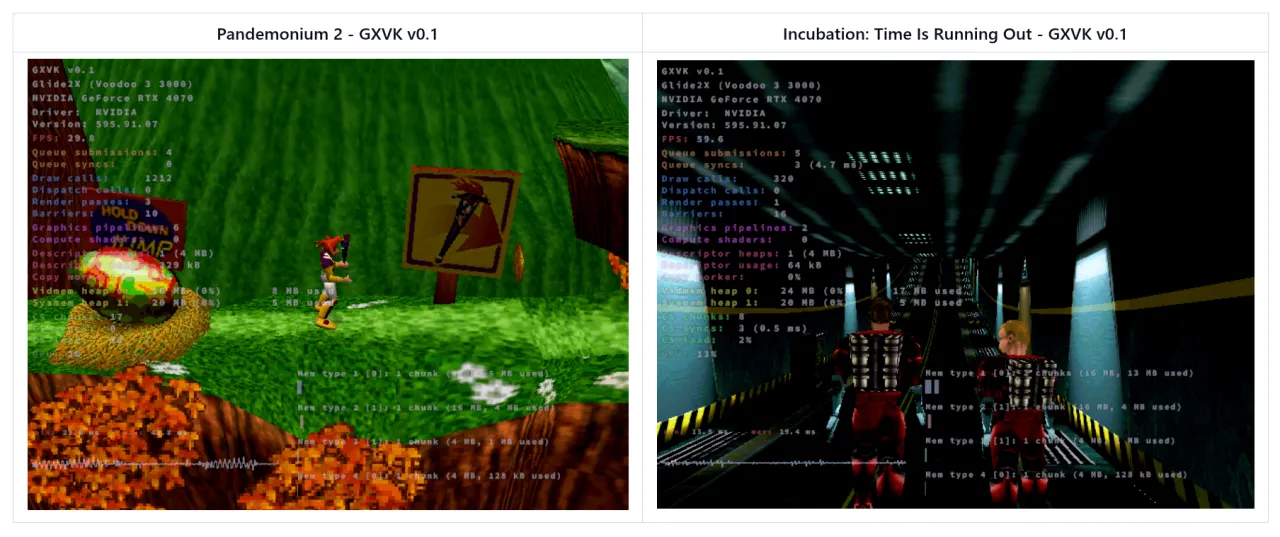
Bundled with this release is GXVK, an early-alpha implementation of the 3Dfx Glide API built on DXVK's Vulkan backend. Glide predates OpenGL and Direct3D dominance, powering the legendary Voodoo cards of the 1990s. For younger readers, the 3Dfx Voodoo was often the first dedicated graphics card a lot of us ever bought. CkNoSFeRaTU developed GXVK, the same contributor who added Direct3D 3 support to D7VK.
GXVK v0.1 can already run games, with work ongoing toward all three 32-bit variants of Glide and a focus on Wine and Linux. The two titles on display are Pandemonium 2 and Incubation: Time Is Running Out.
Glide and early Direct3D traded blows through the 1990s, with Glide nearly always edging out D3D5 and D3D3. That leaves a handful of Glide-exclusive games that would otherwise be unplayable on modern hardware, and an open-source Vulkan path makes them reachable again. A real preservation win.
It's a bit of a surprise, frankly. The project's own maintenance-mode declaration came just weeks earlier, and yet the developer keeps rolling out sibling projects that push into new territory.
That slowing pace is the new normal. D7VK moved into maintenance mode with v2.3 on September 29, 2026, meaning no new major features though bug fixes and minor additions will keep trickling in at a slower rhythm. Version 2.4 fits that model: it sharpens compatibility rather than expanding scope.
If your GPU can't hit the Vulkan 1.4 requirement for mainline D7VK, there's a fallback. Contributor pythonlover02 ported the early-Direct3D functionality back into DXVK-Sarek, which works on Vulkan 1.1-capable gear. It drops a few features like dynamic FSAA and 8-bit R3G3B2 surfaces, but it keeps older GPUs alive.
Getting D7VK running takes a couple of manual steps. You drop a ddraw.dll next to your game's executable, set a DLL override in winecfg to "native, builtin," and run it on Wine 10.1 or newer. No bitness headaches here, since DDraw has always been 32-bit exclusive.
D7VK 2.4 may be a "maintenance" release, but it reminds you why the project exists in the first place. It patches compatibility where old games actually break, fixes a batch of real crashes, and quietly announces that the frontier is still moving even as the main project settles down.
Keep in mind that the GXVK angle is the one worth watching. If Glide ships cleanly, it could resurrect a whole catalogue of titles that Vulkan had written off long ago.
Head here to the GitHub release page.


