Manjaro 26.1.3 ships with Linux 7.2, Plasma 6.7.5, and GNOME 50.5
Manjaro released version 26.1.3 on October 28th, the third point release of its 26.1 "Bian-May" feature series and the latest stable build across the three official desktop editions, KDE, GNOME, and XFCE. Point releases are not supposed to reinvent a distro, so there is no headline feature to get excited about. But this one still carries enough detail to make you look twice.
The most important change is under the hood. Manjaro now defaults to the Linux 7.2 kernel. The older 7.1 series reached end of life at 7.1.13, which means anything left on 7.1 is unsupported software. Manjaro explicitly recommends moving to 7.2 or one of the supported LTS branches. If you run older hardware or simply prefer long-term support, a 6.18 LTS build is still offered alongside the default.
The second change is the one the team spent the most words on. Community manager Yochanan announced that the project has "mostly migrated everything from GitLab to Forgejo," hosting its code on a new instance at code.manjaro.org. This is part of the broader "Manjaro 2.0 Manifesto," the same push that formalized governance through the Manjaro Project e.V. non-profit. In short, the German-founded distro is quietly taking control of its own infrastructure.
The German roots are worth pausing on, for what it is worth. Manjaro began in 2011 as a passion project among friends in Munich, and it still develops across Austria, France, and Germany. It is one of just two German-led distros that UK's PC Pro counts alongside openSUSE, with Linux Mint and Zorin rounding out the British-led pair. It has grown into a mainstream option, now eclipsing the popularity of the Arch Linux it is built on.
The desktops and key packages
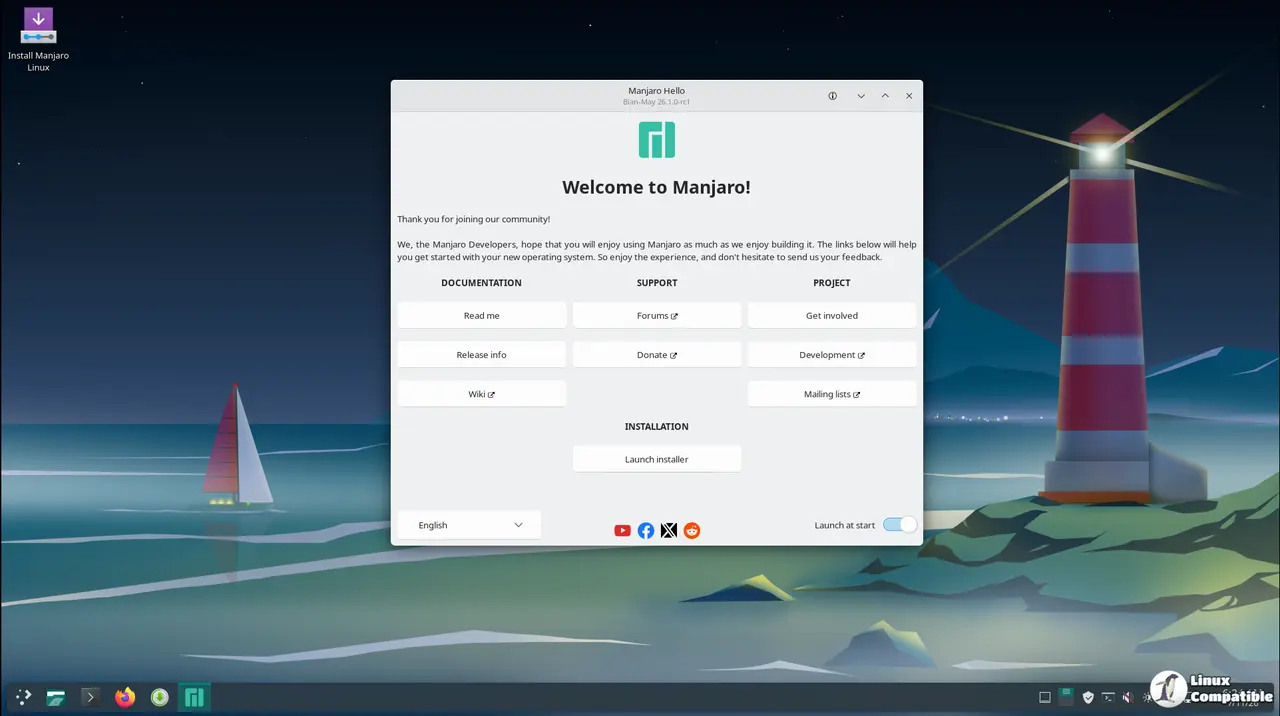
The KDE edition tracks Plasma 6.7.5, backed by KDE Frameworks 6.30.0 and KDE Gear 26.08.1. The genuinely useful upgrades are the quick light-and-dark theme toggle, background-app support in the system tray, and the new type-ahead search on the desktop. You can also drag favorites around the panel now, and notifications slide in from the nearest screen edge.
GNOME moved to 50.5. The most substantive addition is a proper parental-controls overhaul: screen-time monitoring, bedtime schedules, and automatic locking for child accounts. Manjaro even ships "Big Parental Controls 1.0" from its Brazilian sister project, Big Linux, to satisfy Brazilian law. There is also hardware-accelerated remote desktop streaming and a stack of NVIDIA stutter fixes aimed at smoother window animations.
XFCE landed at 4.20. It is the lightest of the three and gets the least flash, but Thunar still gains the ability to highlight individual files with custom colors, search recursively, and now measure its panel length in pixels instead of percentages.
One package deserves a closer look. COSMIC Epoch 1.9.0 appears in the stable branch, riding the momentum of the GNOME-derived desktop that is spreading across Pop!_OS, CachyOS, and Fedora spins. But note that COSMIC is not one of the three official ISO editions here. You can install it on top of an existing system, though there is no dedicated COSMIC media for this release.
The update also refreshed a broad swath of core software. Worth a glance: the NVIDIA driver at 615.71.09, Mesa 26.2.4, Firefox 159.0, Thunderbird 158.0.1, PipeWire 1.6.9, VirtualBox 7.2.20, and GRUB 2.16.
Two things you actually need to do
Not every update is trouble-free, and Manjaro flagged two items that need your attention before or right after installing.
First, Mkinitcpio has moved to version 42. The systemd hook now bundles systemd-pcrosseparator.service, which changes the PCR value measurements used for TPM2-based LUKS unlocking. If you unlock your LUKS partitions by PCR values, you must re-enroll your TPM2. The guidance lives in systemd-cryptenroll(1) or on the ArchWiki, and systemd-pcrlock(8) is the spot for custom-policy users.
Second, the move to Python 3.14 means any AUR Python packages linking against libpython3.13.so need rebuilding. Manjaro provides a one-liner to list affected packages, plus an overhauled manjaro-downgrade tool as a fallback for the older manual workflows.
As with every stable update, review your .pacnew files and watch the announcement thread for community-solved workarounds on things like CUPS restarts and libpcap conflicts.
The download data below is pulled directly from the Manjaro Linux SourceForge folders for 26.1.3, reflecting weekly download counts at time of writing. Each edition ships in Full and Minimal flavors, and in either the default linux72 kernel or the 6.18 LTS linux618 kernel. GNOME comes out ahead, with its default linux72 full build accounting for over 100 weekly downloads. KDE's folder totals roughly 20.7 GB across its 24 files, GNOME about 19.1 GB, and XFCE near 18.9 GB.
There is one caveat worth flagging. Open a SourceForge folder and the generic description still reads "full/minimal ships with 5.10 LTS kernel," listing a linux54 option. That is stale placeholder text dating back to an April 2021 README. Only the linux72 and linux618 variants are actually published for 26.1.3, so there is no linux54 build hiding in there.
You can grab the ISOs and their signatures from SourceForge or Manjaro's own CDN: KDE Plasma, GNOME, and Xfce


