Fedora Runs Final Kernel Test Week Before Fedora 45 Ships
Fedora's QA team is asking volunteers to install and stress-test the new Linux kernel 7.3 across a range of hardware before the Fedora 45 release lands. The "Kernel 7.3 Test Week" runs from November 1–7, and it deliberately ends on the same day Fedora 45 goes live: November 3. It's the last community checkpoint before one of the year's biggest Fedora releases, and the team wants real machines doing the real testing.
You're the intended audience if you've got a spare PC, a VM, or the urge to see exactly where a new kernel cracks. The event is organized by Fedora Quality, with Jaroslav Groman (jgroman) handling the sign-off. Testers install the kernel on either Fedora 45 or Fedora 44, run a standard regression suite, then report results and hardware details back to the team.
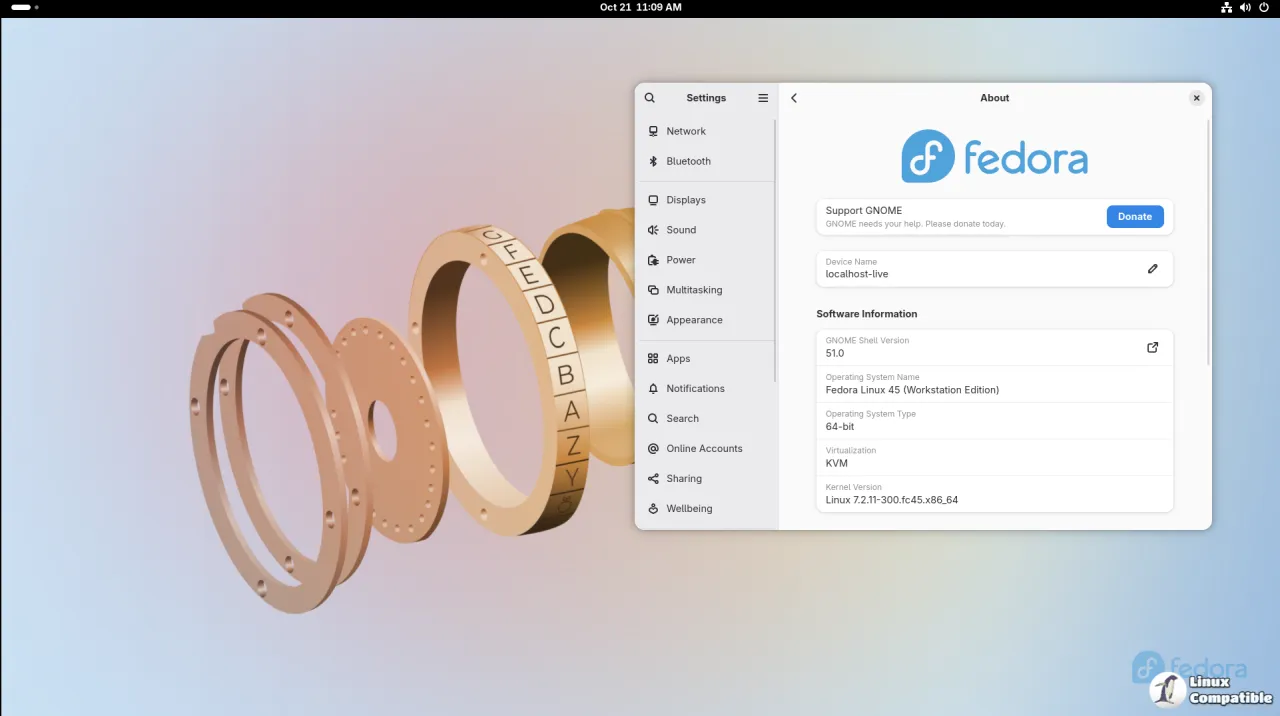
The kernel in question is already a record-breaker
Kernel 7.3 shipped upstream on October 18, 2026, and by the numbers it's the busiest release in the kernel's history. The merge brought 18,765 non-merge commits, beating the previous record of 17,284 held by Linux 6.7. It pulled in 3,021 developers, of which 807 were first-timers.
Linus Torvalds kept his release note suitably terse. He noted he'd somehow managed to track the day of the week well enough to avoid a random delay, mentioned that the final week was mostly "random fixes across the board," and headed off for his annual vacation while joking he might extend the 7.4 merge window.
Not worth losing sleep over, but worth flagging: the Maintainers Summit also voted to drop the "Assisted-by" tag that had previously identified AI-assisted contributions. It's a small but culturally loaded move for a community that has spent the last couple years debating exactly where AI fits in the kernel tree. The next release, Linux 7.4, is already in development.
Keep in mind that this is the mainline version. Fedora 45 won't launch with 7.3 on day one, Fedora typically starts on an earlier kernel and pushes the newer one out via updates. That's exactly what this test week is validating, and it's the same pattern Ubuntu 26.10 followed when it shipped 7.3 on October 15. Enterprise distros like RHEL 10 will sit on LTS kernels and backport selectively, as they always do.
What actually changes for users
There are a lot of features crammed into 7.3, but a handful will matter more than the rest. The one most people will feel is the improved VRAM management for low-end GPUs. It uses the dmem cgroup controller so that when video memory is squeezed, the kernel pushes out unprotected buffers to make room for protected ones instead of immediately falling back to slower system memory. That's a practical win for AMD GPUs around 9 GB and for gaming on modest hardware.
The extensible scheduler, sched_ext, is also finally complete, letting a cgroup run its own BPF-based task scheduler. Storage gets a notable boost too: Btrfs recovered Direct I/O throughput and dropped a 1-jiffy fsync delay, yielding roughly 5× throughput on non-SSD storage in some cases, while ext4 saw a jump from about 1.92M to 2.19M IOPS on fast NVMe in one sample workload.
There are newer, more niche additions as well. A sandboxing primitive called failfs paired with the fchroot(2) system call lets a process drop its entire filesystem state for stronger isolation. There's also an opt-in Apple Time Machine support path for SMB, more powerful binfmt_misc handlers backed by BPF, and expanded Rust-in-kernel support.
Not everything is rosy. Linux 7.3.1 landed on October 30 and carried a message that reads unusually urgent: "All users of the 7.3 kernel series must upgrade." If you run a freshly built 7.3 system, that's a sign the series had something worth patching fast.
How to get involved
If you want to help, you'll need a Fedora Account to submit results. Then pick your approach: a fresh install from the provided test-day image, or an update to an existing Fedora 44 or 45 system via a Koji build or the kernel-stabilization COPR by jforbes.
A strong warning comes attached to the instructions: don't do this on a production machine. The wiki explicitly says to assume the system might break and to make sure there's no important data on it.
For atomic desktops like Silverblue or Kinoite, you'll use rpm-ostree override replace and then remember to override reset when you're done so you can return to stable kernels. Otherwise run the standard regression cases and log your results in the test app. Anything that breaks should go into proper Bugzilla reports against the kernel component, not just a comment on the results page. The team wants exact reproduction steps, the system journal (journalctl -b > journal.txt), screenshots if applicable, and a full hardware description.
There's also a known bug worth watching: Bug 2441941, where graphics break while trying to type a LUKS password. The reproduction conditions are still murky, so the team wants testers to comment with their hardware configs.
Head here for more information. The test week runs November 1–7, and Fedora 45 officially ships November 3.


