XanMod 7.2.15 ships today, and its base kernel is already dead
The latest XanMod build tracks the final release of the Linux 7.2 stable series, which kernel.org has already marked end-of-life.
XanMod shipped 7.2.15-xanmod1 on November 1, the newest build in its MAIN branch and a straight pass through the upstream Linux 7.2.15 stable line. Good news if you run a desktop or push heavy workloads on x86-64. Not such good news if you expected this to kick off a long-lived stable cycle.
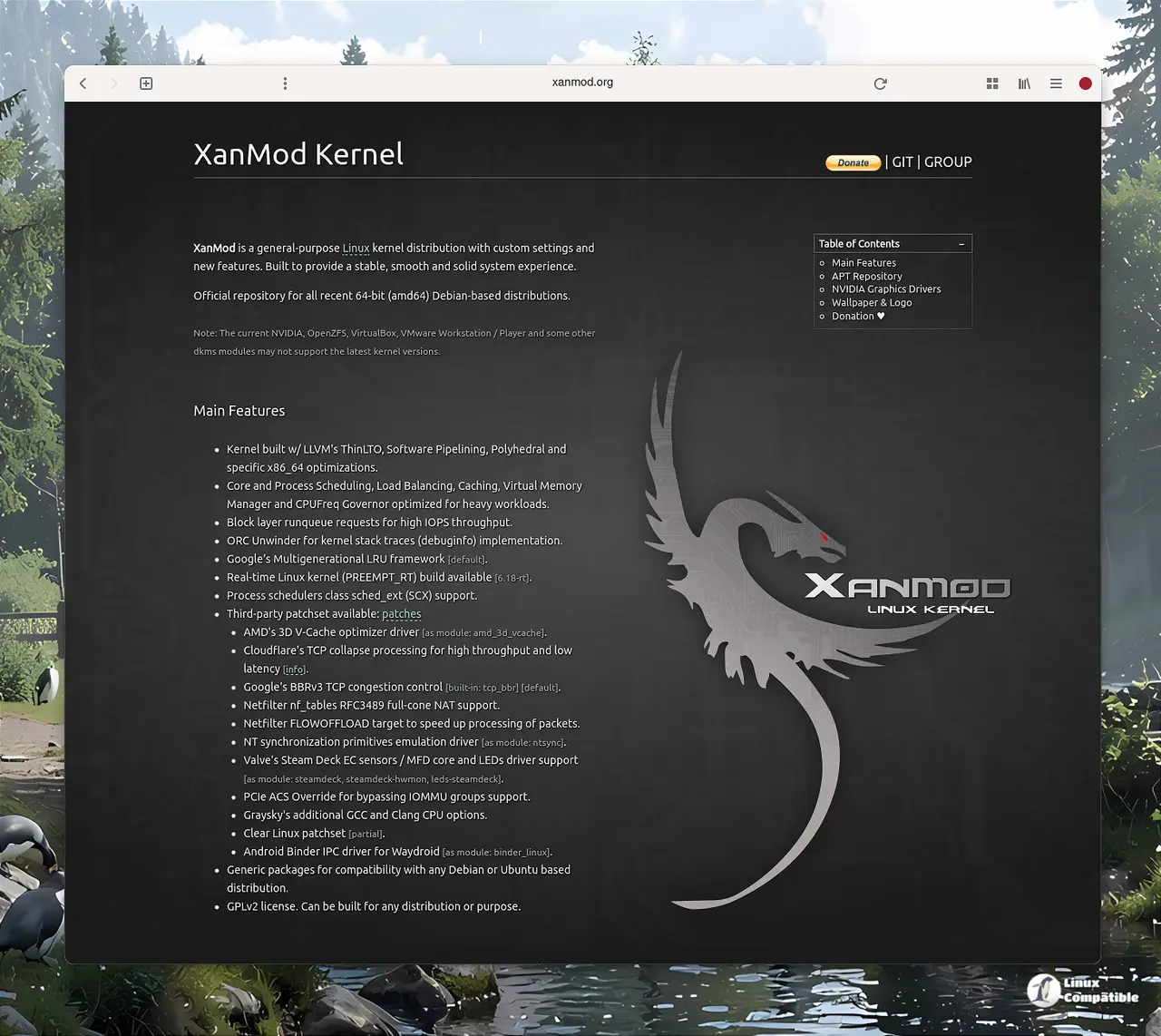
Here's the wrinkle. kernel.org already tags 7.2.15 as End-of-Life. It's the final point release of the 7.2 series, with upstream maintenance having shifted to the 7.3 line. So the MAIN branch is now built on a completed upstream cycle. You still get all the security and bug fixes from the last two months, but you aren't standing on fresh ground. Alexandre Frade built the package on a Sunday evening, per the GitLab commit, and it sits on top of a base that's been retired.
XanMod is the kind of project that exists precisely because the kernel your distro ships isn't always the kernel you want. Most distributions configure their kernels for broad compatibility, safe, well-tested, tuned to run on rather than to run anything fast. Custom kernel projects take the same upstream source and rework scheduling, memory management, and networking to favor responsiveness or frames-per-second. Liquorix, Zen, TKG, the CachyOS kernels, and the whole lot. XanMod is one of the oldest names in that crowd.
Per its own wording, XanMod calls itself a "general-purpose Linux kernel distribution." The operative word is general-purpose, since most competitors lean hard into either gaming or real-time work. XanMod wants to be an all-around faster kernel for desktops and workstations while still offering dedicated real-time and long-term-support builds.
How XanMod actually gets faster
The mechanism matters more than the marketing here. Rather than just flipping config flags, XanMod recompiles the kernel with LLVM and Clang using ThinLTO link-time optimization, plus software pipelining and polyhedral (Polly) tweaks. That's a meaningful chunk of the performance edge, and it's exactly why the entire project is x86-64 only.
The patchset is where the personality leaks out. You get Google's multigenerational LRU by default, Cloudflare's TCP collapse processing, Google's BBRv3 TCP congestion control, a block layer tuned for high IOPS, and sched_ext process scheduler support. Also folded in are the Steam Deck EC sensor driver, PCIe ACS override, and Canonical's Android Binder IPC driver. It's a lot to keep track of.
XanMod doesn't just publish one kernel, either. It runs four branches at once. MAIN tracks stable mainline, currently 7.2. EDGE follows the newest mainline, currently 7.3, for people who want bleeding edge and can handle a rough patch. LTS holds 6.18 for the long haul. RT is the real-time build for audio and industrial control, where timing has to be deterministic.
If you're keeping score, the 7.2 MAIN line is the sweet spot for most desktop users, balancing new features with stability. The EOL status does change the math somewhat, though. Users wanting continuous upstream fixes now have to decide whether to jump to EDGE or stay put.
Then there are the psABI tiers, which routinely trips people up. XanMod ships builds compiled for different x86-64 CPU microarchitecture levels. v1 targets pre-2015 hardware, v2 covers roughly 2009 onward, and v3 is for modern Zen and Haswell-and-newer chips. There's a v4 AVX-512 build too, though XanMod explicitly notes it offers "no kernel benefit," so there's your money-saving tip. A helper script called check_x86-64_psabi.sh tells you which tier your CPU actually wants before you install anything.
The community take on XanMod is, at best, mixed. Some users love the breadth of the patchset and cite benchmarks where it outsells Liquorix in non-gaming workloads. Others are less charitable. A widely read discussion ranking gaming kernels argued that "Xanmod nowadays does not much contain anymore," pointing to a broken ntsync and a thinning feature set. It's a fair criticism to weigh against the project's older reputation.
The honest read is that XanMod is a solid, well-regarded choice for Debian and Ubuntu desktop users, but enthusiasts with very specific gaming or real-time needs should look at the alternatives. And for someone just running their distro's stock kernel, the real-world difference may be nothing worth a reinstall.
Getting it and what to watch for
Installation is standard Debian-land procedure. XanMod maintains an APT repo covering Debian bookworm through Ubuntu's newer development cycles. You register the PGP key, add the repo line, and install linux-xanmod-x64v3 (v3 for anything modern), optionally pulling in dkms, libelf-dev, clang, lld, and llvm for external modules. A manual .deb route via SourceForge works too, if you'd rather skip the repo entirely.
Two caveats before you switch. First, proprietary DKMS modules can lag. XanMod's own site warns that NVIDIA, OpenZFS, VirtualBox, and VMware Workstation modules may not support the latest kernel, so you could boot into a broken graphics state until a matching version lands. Second, pick your psABI tier correctly. A v3 build on a 2013 machine won't help you, and might not build at all.
The whole project is a one-person effort, kept alive since 2015 by Alexandre Frade. The donation page lists an annual budget of roughly $1,200. One kernel. Coffee included.
Head here to the XanMod home page.


