2026-11-17
Rocky Linux 10.3 "Red Quartz" reached general availability, tracking RHEL 10.3 and AlmaLinux 10.3 on kernel 6.12.0-264.16.1. The release leans hard on post-quantum cryptography across VPN, SSH, email signing, and auditing, paired with a refreshed developer toolchain built around GCC Toolset 16, LLVM 22.1.8, Rust 1.97, and Go 1.27.3. It's also the first Rocky Linux release validated entirely within the new Testrarc platform, and it still requires an x86-64-v3 CPU. If you're upgrading, check things first, since WEP support and the ZBUD allocator are gone and Grafana dropped legacy alerting plus AngularJS plugins.
Today's reviews roundup covers nine products, and the standout finding is that local-AI performance hinges on software backend as much as specs, CUDA leads image generation while Intel Arc wins llama.cpp serving. Mini PCs like the CTONE AM23 and Minisforum M2 Air-304 earn quiet, compact praise but draw fire for inflated pricing and soldered memory. On the workstation side, the $11,999 Dell Pro Max Micro dominates CUDA work yet runs hot, while the $3,999 Corsair FlexPrime V20C offers smarter value, and the Dell Pro 7 2-in-1 trades sustained performance for a 64 GB convertible. Cooling and power supplies round out the batch, with the Chieftec 360 DARK and both Platinum PSUs earning points on features over raw chart numbers.
Valve shipped SteamOS 3.10.1 Preview on the Steam Deck's preview channel, just three days after 3.10.0 went out. The release fixes two 3.10 regressions: game-launch failures affecting titles like the Forza Horizon series, and an "invalid signal" display error on some external monitors.
Matomo 5.14.3 has been released as a routine patch with no major new features or database upgrade. The release hardens the AI machinery it launched in September, adding consent gates, per-request search caps, cost reporting, and usage metering to make AI tools safer and more billable. It also gives admins a documented escape hatch, letting them suppress the October PHP vulnerability alert via a new config setting. As a maintenance build, it polishes AI governance and compliance auditing rather than introducing anything flashy, with a 6.0.0 release candidate already on the horizon.
Bazzite Linux shipped stable build 45.20261117 today, just two days after its previous release. The update adds automatic HDR content detection for HTPCs and a built-in Punktfunk game-streaming app that streams to phones, tablets, and LG webOS TVs. Kernel bumps to the OGC 7.3.4-ogc8, and KDE Plasma 6.8.3. A key fix also restores the Steam brightness slider on handhelds like the MSI Claw 8 EX.
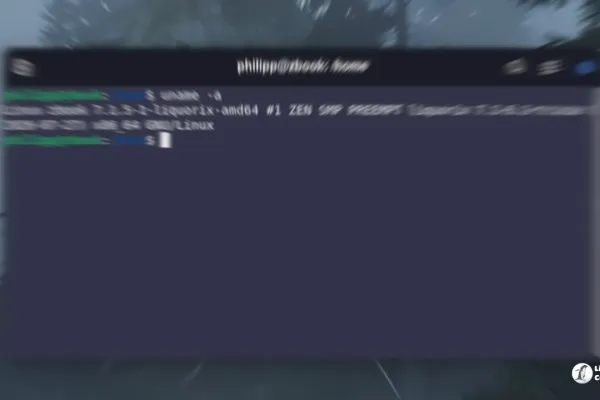
Kernel maintainer Steven Barrett released Liquorix Linux Kernel 7.3-5, adding more Project-C sleep-credit fixes to the custom PDS scheduler path so wake-up tasks get priority back instead of starved. Liquorix swaps mainline's default EEVDF scheduler for either the PDS or BMQ engine and layers low-latency knobs like a 1000 Hz tick rate, preemptible RCU, Kyber or BFQ disk I/O, and TCP BBR3 networking onto a hardened 7.3.4 base.
2026-11-16
AlmaLinux shipped AlmaLinux OS 10.3 "Mauve Lion" and 9.9 "Chartreuse Bobcat" today, capping a September beta cycle with what has become the distro's signature move. Its new kernels carry security fixes Red Hat dropped, 43 CVEs on the EL 9 line and 30 on EL 10, that AlmaLinux restored plus six more community-requested patches RHEL never had. Beyond the patches, both releases bring a shared toolset overhaul including GCC Toolset 16, LLVM 22, post-quantum cryptography, ModSecurity's return to EL 10, and a full Podman 6 container overhaul. Installation ISOs are live for all supported architectures, with a standard dnf upgrade -y path and full CVE tables available in the release notes.
Strata 0.2.15 is a bug-fix update for the inference engine that runs 177B-parameter models on cheap GPUs, and it keeps your models, chats, and settings intact. The release drops the external llama-server dependency so models load on Strata's own engine instead, removing a moving part that quietly drifted out of sync. It fixes drafting by skipping the roughly 5 GB MTP download when you turn it off, saving that choice across restarts, and repairing the Qwen3.6-35B-A3B first-run download that previously died after four seconds. The terminal tool now picks up AMD cards on hybrid NVIDIA plus AMD machines, remembers your drafter choice over multiple restarts, and names missing Linux libraries with the exact command to install them.
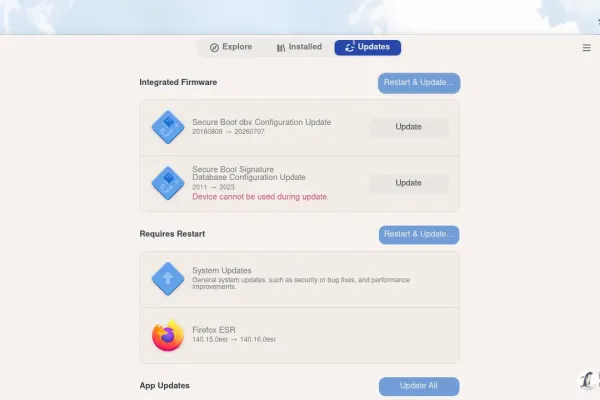
A new fwupd update has been released today, adding Synaptics 96F1 touchpad support and a fix that stops tampered XML files from spoofing metadata trust. The release closes memory-safety gaps like unbounded netlink reads and leaks in SREC and Aver HID handling, while patching crashes from empty HTTP bodies and misbehaving Jabra and Huddly devices. It lands three weeks after 2.1.9, continuing a 2.1 series focused on hardening Linux firmware updates against tampering. Update through your distro's stable repos and keep fwupd's metadata current so the trust chain stays valid.
AMD's sixth-generation EPYC "Venice," built at 2nm with up to 256 cores per socket, shipped this week with a surprise 5.3GHz clock bump and a bet to push Intel's x86 data-center share below 50%. StorageReview and ServeTheHome both broke the story, with Venice topping the leaderboard on a two-socket build though real OLTP workloads couldn't use most of its 256 cores. The rest of the week's reviews were thinner: APH gave the holographic TRYX HOLO AIO a middling 6.2, and Club386 praised the AOC Agon Pro QD-OLED while flagging its £849 price and weak 15W USB-C. Flight-sim fans got a pricey but authentic 737 CDU, and be quiet!'s silent Dark Mount keyboard rounded things out with a strong 9.0.
Today's Linux security roundup spans Debian, Fedora, Rocky Linux, and openSUSE Tumbleweed, with Debian's bookworm kernel leading the charge by clearing more than 1,200 CVEs in a single advisory. Fedora pushed fifty-two advisories across twenty-six packages, dominated by a zstd mass rebuild that swept in Rust compression packages you may not have manually updated. Firefox ESR stood out in openSUSE's build by absorbing 144 fixed vulnerabilities in one package, a volume usually tied to engine rebuilds. Meanwhile, Rocky Linux delivered nine advisories for version 10, complete with CVSS scores so admins can prioritize what actually needs a reboot.
Bazzite's stable weekly build upgrades the custom OGC gaming kernel from 7.3.3-ogc1.1 to 7.3.4-ogc6.1 after several aborted intermediate releases, while the Nvidia LTS kernel also climbs to 6.18.60-ogc1.2. The gaming stack picks up a fresh Epic Games Launcher entry for one-click installs, plus new versions of Gamescope, PowerStation, InputPlumber, OpenGamepadUI, and Bazaar, with dnf5 and Mesa moved along as well.
The third release candidate for Linux kernel 7.4 has been released with the largest merge window on record at 19,671 commits, though most patches this round are small bug fixes. The main change is a large but "fairly trivial" iomap calling-convention rework, while networking and GPU drivers made up the bulk of the activity. The final 7.4 is targeted for about 20 December and is expected to become this year's LTS kernel.
[ Archive ]