XanMod Drops Simultaneous Kernel Updates for Mainline 7.2 and LTS 6.18
Performance-tuned builds land on September 12 with Blackwell GPU fixes, BBRv3, and major memory management rewrites.
XanMod has pushed out fresh kernel packages for Debian-based Linux systems. The September 12 drop covers both the rolling mainline branch and the long-term support track, so you have options depending on how aggressively you tune your desktop. Alexandre Frade keeps the project running, and the builds arrive with upstream patches, LLVM-optimized compilation, and another round of gaming-focused tweaks.
Mainline 7.2.5-xanmod1
The rolling build is based on Linux Kernel 7.2.5, which upstream shipped just a day earlier. It brings roughly 558 commits to the table, and XanMod layers its usual compiler tricks on top. You are getting LLVM software pipelining, polyhedral optimization passes, and Graysky's x86_64 tuning flags baked directly into the kernel.
The upstream patch set includes several security fixes that matter. ksmbd leaks up to seven bytes of uninitialized heap memory on pipe reads. There is also a use-after-free race condition in the SMB oplock break path, plus a preemption bug in BPF stack tracing that could corrupt memory. XanMod applies those upstream hardening patches before recompiling.
GPU fans will probably notice the NVIDIA section first. The upstream 7.2.5 fixes vblank interrupt routing, HDMI infoframe signaling, and display state readback for the new Blackwell-generation GB20x chips in the open-source nouveau driver. AMDGPU gets firmware version bumps for gfx11 and gfx12, along with queue management tweaks that should quiet some TLB flush warnings.
LTS 6.18.51-xanmod1
If you prefer a kernel that stays stable longer, the LTS track lands at 6.18.51. It has been through more than 50 stable updates since hitting mainline back in December 2025. The build author lists the same maintainers, and the optimization pipeline stays identical to the mainline branch.
Memory management gets the heaviest treatment here. The HugeTLB vmemmap optimization cleanup removes what upstream calls "fake heads," which tightens memory savings across workloads. THP folio split logic gets a cleaner accounting path, and the codebase moves RMP_ flags over to the TTU_ flag namespace to keep the interfaces consistent. ZRAM picks up several correctness fixes, including an overflow in the write-back limit and an out-of-bounds access bug in the block state reader.
Networking isn't left behind. Cloudflare's TCP collapse patch stays active, and Google's BBRv3 congestion control remains the default. XanMod also carries Netfilter nf_tables RFC3489 for full-cone NAT, which helps gamers and self-hosters who run symmetric port mapping. The real-time variant, linux-xanmod-rt, continues to ship exclusively with this LTS branch. It targets eSports server hosts, live production crews, and anyone who needs deterministic scheduling latency.
For what it's worth, the real-time patchset isn't a silver bullet for every low-latency use case. You will still need to tune your userspace and disable CPU frequency scaling to get the most out of it.
What actually changed for your desktop
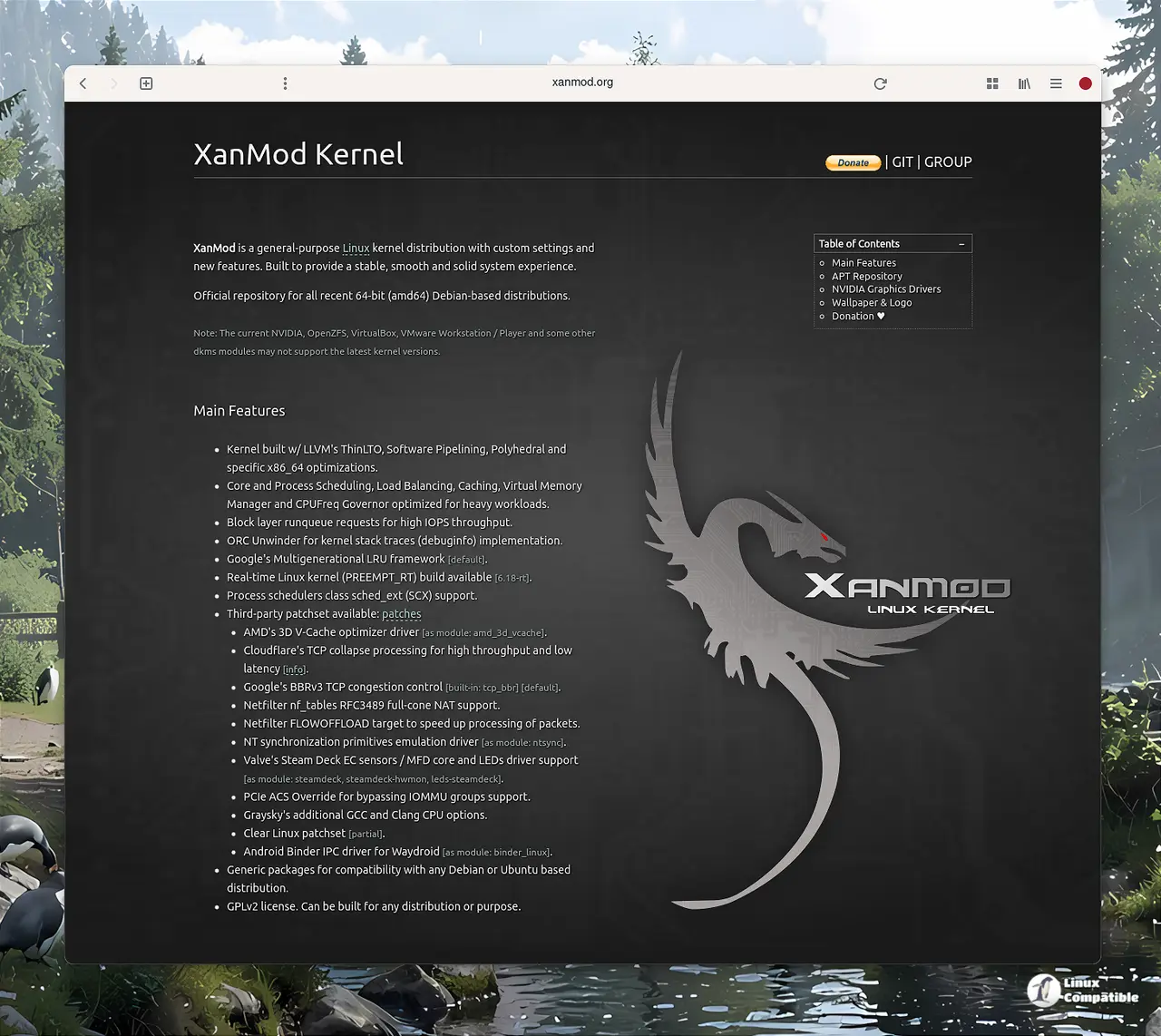
XanMod kernels are never just vanilla upstream releases. The project pulls in a custom patchset that includes Cloudflare TCP collapse, Google BBRv3, full-cone NAT support, Steam Deck EC sensor modules, PCIe ACS override, and Firelzrd's memory pressure page protection. Clear Linux performance patches are folded in where they apply, and the binder_ipc driver from Canonical lands as a loadable module.
You will also find sched_ext support enabled by default, which opens the door to custom class-based schedulers if you want to experiment. The build ships with CFS, BMQ, PDS, PDS-MQ, MUQSS, and XanMod's own CAKULE and CACULE CPU schedulers queued up in the kernel config.
XanMod has been quietly building up its scheduler portfolio over the past few years. You might remember that the project dropped sched_ext support back in the 6.12 cycle, and it has been a steady source of benchmark chatter ever since. Keep in mind that DKMS modules do not always keep pace. NVIDIA drivers, OpenZFS, VirtualBox, and VMware Workstation have all historically lagged behind XanMod releases by a few days to a couple of weeks. If you rely on those, you will want to check the upstream module repos before you reboot.
How to get it
XanMod runs a straightforward APT repository. You pull the GPG key, add the deb line matching your release codename, and install the right variant for your CPU. Older processors should grab linux-xanmod-x64v2. Anything with AVX2 and FMA support, which is most desktop chips since around 2013, gets linux-xanmod-x64v3. The repo also carries llvm-toolchain-21, dkms, and the scx-scheds package if you plan to swap schedulers.
The project ships source archives, patch files, and full change logs on SourceForge and GitLab.
Head here to the official XanMod website.


