OSY ships Triton v0.5, the DirectX 11 driver that might finally fix Windows VM graphics
The developer known as osy, the lone author behind the free UTM virtualization app, has released Triton v0.5 today. The update pushes open-source DirectX 11 support for Windows guests in QEMU past its earlier rough edges, adding Unreal Engine 5 games, 32-bit titles, multisampling, and a stack of fixes aimed at making the whole thing usable on a daily basis.
Keep in mind that Triton isn't brand new. osy introduced it on July 24, and it's been climbing the release ladder ever since. v0.4 landed on October 15 as the first version not stamped a prerelease. Today's v0.5 is nonetheless the one that gets it closest to something you'd actually leave running.
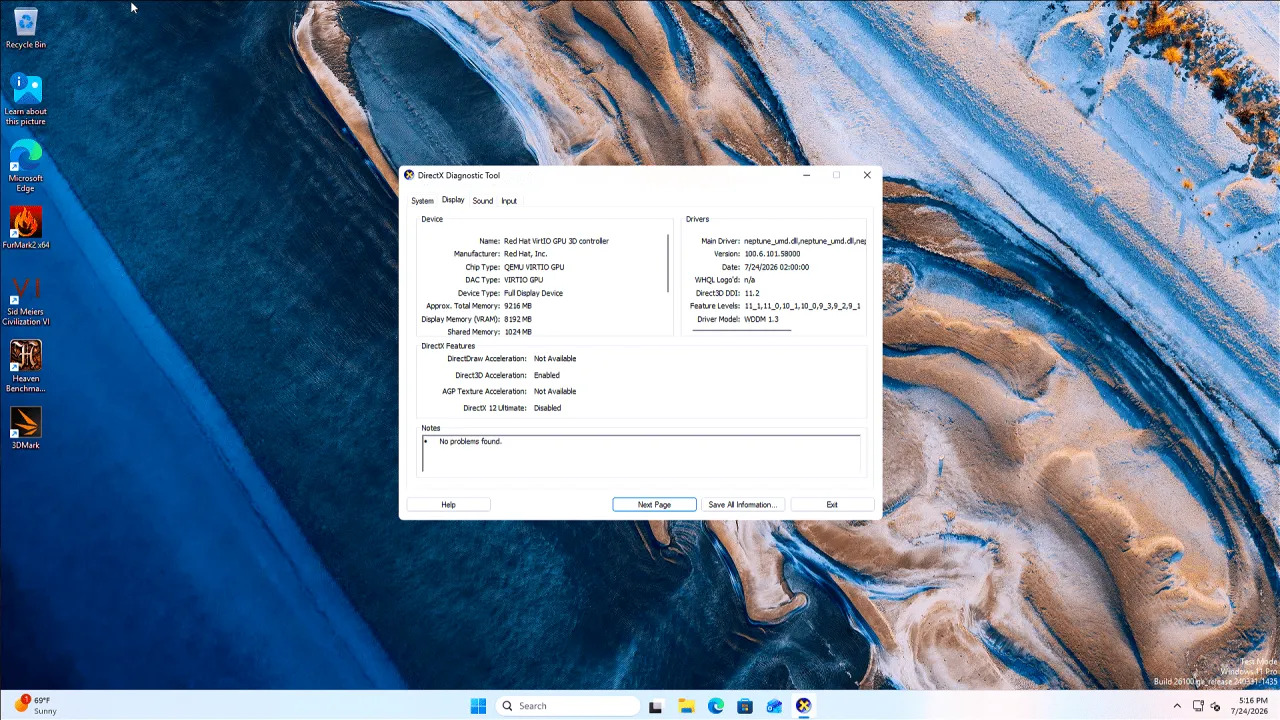
What makes it different
Before Triton, real 3D acceleration in a Windows VM on Linux or macOS meant picking your poison. You could drop a translated d3d11.dll next to each game executable, or go with full GPU passthrough, which wants spare hardware, an IOMMU-capable motherboard, and an afternoon of fiddly config.
The DLL workaround worked often enough to become a de facto standard, but it's per-app, fragile, and easily caught by anti-cheat that flags modified system files. Passthrough gives real performance but demands real hardware. There wasn't a clean third option, until now.
Triton is a genuine Windows display driver. It implements the DirectX Device Driver Interface, the low-level contract Windows shares with an actual GPU vendor, rather than intercepting calls at the API layer. That makes it the first fully open-source, anti-cheat-friendly path to real D3D11 acceleration inside a VM, needing neither a swapped-out DLL nor a physical GPU.
The clever bit is that Triton speaks the DDI, then flips those calls back into standard D3D11 API calls inside the guest before handing them off. That removes the host-side interpreter VirtualBox relies on, which cuts the places where compatibility can quietly break. It's arguably matching a far more heavyweight approach on pure cleverness alone. osy will tell you the trickiest chunk is shader-container reconstruction, calling it "the weakest and most error-prone part of our implementation," a piece mostly solved through trial-and-error the AI handled.
How much of it was AI?
If you've been following the AI-assisted coding conversation, this is the interesting part. osy published an unusually candid accounting of the human-to-machine split, framed around Claude Opus 5 and Claude Fable 5. The blog post even carries a joint byline, "osyclaude-opus-4-8."
The numbers, as osy tallied them, are big. 208 AI sessions, 51,900 API turns, roughly $14,760 in Claude costs. The models spooled out about 1.84 million words. osy typed just 59,443. That's a machine-to-human ratio of roughly 31 to 1, or about 480 hours of machine work against 65 hours of human effort across the nine-week build.
But the bottleneck didn't disappear. It moved from typing to seeing. The nastiest bugs were the visual kind: black screens, missing UI, a frame that flashes then vanishes. osy logged 139 messages devoted purely to conveying what he saw, since the AI can't just look.
Notably, osy never once asked the model how to use its own tools. No "grep for this" or "open that file." The models made their own roughly 29,000 Bash calls and 6,300 edits while osy stayed one level up on commits, DDI entry points, and the bigger architectural trade-offs. A use-after-free reference-counting bug got pinned to Claude Opus 5; a blob-window mapping fix went to Fable 5.
What actually changed in v0.5
Today's release is mostly a compatibility and stability pass. Windows 11 drop shadows now render under both host backends, and apps that build a render-target view every frame no longer stall for multi-second spells after dropping framerates.
The Unreal Engine 5 fix is worth singling out. UE5 titles used to quit at launch with a blunt "RHI D3D12 is not supported on your system" message, so Triton now reports the host's 64-bit atomic capabilities, which UE5's renderer demands. 32-bit games and 32-bit D3D9 titles no longer lose the GPU and crash seconds after launch. Antialiasing stops crashing the GPU, and display resolution and scaling now behave as you'd expect through a resize or a restart.
Can you actually run it?
The constraints are tight, and worth knowing before you start. You need either Linux with KVM or macOS on Apple Silicon, plus a Windows ARM64 guest. That ARM64 requirement is a deliberate call, since it plays to Unified Memory on Apple Silicon, though it does put most Windows x64 guests out of reach for now.
You'd assemble the stack from osy's own forks: a modified QEMU, a Rosetta-fused virglrenderer, a host backend of DXVK on Linux or DXMT or D3DMetal on macOS, and the Triton drivers themselves. Signed prebuilt drivers ship as GitHub release assets, so you don't have to compile the Windows side.
One caveat, though. The developers are blunt about it: the drivers are still very unstable, so don't install them on a VM you care about. Keep that in mind before pointing it at anything with actual data on it.
The demos do the talking, at least for capability. Triton has run Crash Bandicoot: The Trilogy in a Windows 11 ARM64 guest on macOS, and it completed a full 3DMark Fire Strike benchmark with the desktop compositor compositing correctly. No prior QEMU effort reached that mark.
Let's be straight about performance, though. Community reports put per-frame scanout latency near 5 milliseconds, versus roughly half a millisecond for a native AMD GPU. That's an order of magnitude slower than real silicon, which is about what you'd expect from driver-level emulation through a VirtIO pipe. The bar osy set is functional, not competitive.
Signed prebuilt drivers are available today as GitHub release assets. Head here to grab the v0.5 release,


