Fedora 45 Is GO. It Ships November 3 After a Twofold Delay
Fedora Linux 45 is official, and it will hit mirrors on Tuesday, November 3, 2026. Fedora Operations Architect Aoife Moloney confirmed that the final release candidate passed every shipment bar. RC-1.4 of Fedora 45 is the build that ships.
For context, that "GO" is a relief more than a surprise. The release was delayed twice already. An early-October target slipped because a candidate compose wasn't finished in time, then a second date of October 22 died to a cluster of open blocker bugs. Over the following week, those issues got resolved, and Fedora 45 finally cleared the finish line.
The Go/No-Go meeting, stripped down
The verdict came out of a public meeting in the #fedora-meeting Matrix channel, running from 18:02 to 19:28 UTC. That's the Fedora ritual: Release Engineering, FESCo, and QA each get polled on whether a build meets four criteria. The compose has to exist. There can be no remaining blocker bugs. Test matrices need to be complete. Fedora CoreOS and Fedora IoT must both be ready.
QA lead Adam Will walked the room through the last handful of candidate blockers. The results were a mixed bag, honestly. Two were rejected as blockers because they didn't meet the bar, one was accepted and then resolved, and one had simply been fixed.
The SSH passphrase case (#2558595) is worth a look. The issue is that your SSH passphrase doesn't auto-unlock at login after upgrading from Fedora 44. It was rejected as a blocker because the core function still works, and the fix is already in the release candidates. The selinux-policy SSH port-forwarding break was also tossed out, with the vote landing at +0 for and −4 against treating it as a true blocker.
"All blockers have been addressed. RC-1.4 is the compose that will be reviewed for F45 Final," Will said.
The Stratis encrypted-pool boot failure (#2543511) is the one that actually mattered for the build. It was 80 percent fixed in RC-1.3 and fully fixed in RC-1.4.
The delays that made the story
The two back-to-back NO-GOs drew real attention, and at one point the story was simply that Fedora 45 had been "delayed again." The first miss was a media-publishing problem. The second was a list of genuine bugs, including an AArch64 server image that ran over its size limit and LVM auto-activation failing after an upgrade on a LUKS-backed setup.
There's something almost comforting about the process. Fedora deliberately prioritizes criterion-completion over hitting a calendar date, which is exactly why the GO carries weight. It's a distribution that'd rather ship late and right than ship on time and broken. The meeting minutes, log, and blocker tracker are all public records, so you can watch the whole machine at work.
What's actually new in Fedora 45
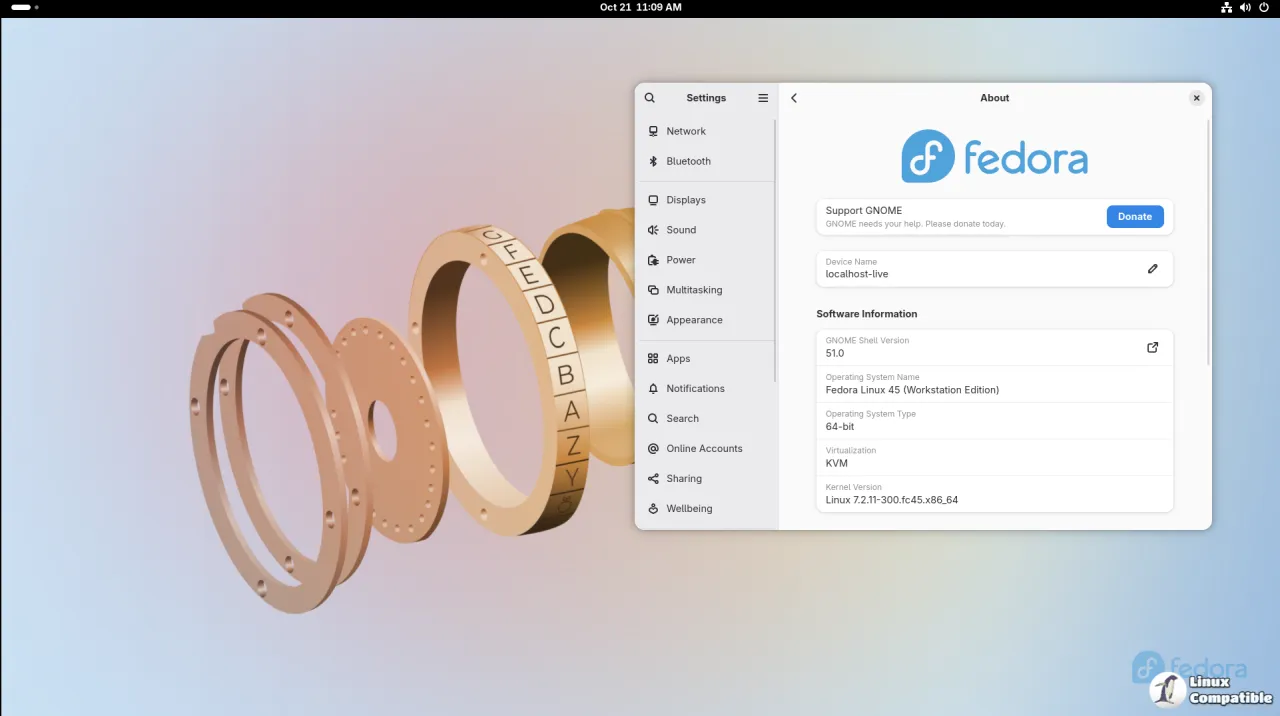
Fedora 45 ships GNOME 51 on Workstation, KDE Plasma 6.8.1 on its KDE edition, and the Linux 7.2 kernel. That's the usual upstream snapshot, but this cycle also brings some platform-level changes worth knowing about.
KMSCON replaces the in-kernel fbcon as the default virtual-terminal console. It's a userspace solution that's generally more capable and more secure. Fedora is also restricting ptrace by default, which keeps unprivileged processes from inspecting each other in ways malware likes to exploit. Full functionality comes back system-wide via a sysctl once you install debugging tools, so the day-to-day impact is modest.
Signature checking becomes enforced by default in RPM too, following upstream RPM 6.0. Packages need a verified signature to install unless you explicitly override it. Builds are now fully reproducible, which strengthens supply-chain trust if you actually care about that sort of thing.
The installer gets Stratis storage support, including Kickstart automation and partitioning through Cockpit Storage. Fedora Atomic desktops get a new WebUI installer replacing the old GTK-based Anaconda, plus web-based remote installation over HTTPS using pin-based authentication.
The toolchain is appropriately current. You're getting GCC 16.2, Python 3.15, Glibc 2.44, LLVM 23, RPM 6.1, and Go 1.27. MySQL 9.7 and MariaDB 12.3 become the defaults. It's a lot of moving parts.
Not cheap on resources, but worth noting: Fedora relocations RPM repository configs out of /etc and into /usr, and oo7 becomes the default Secrets Service provider, which pulls Fedora desktops away from GNOME Keyring.
Getting it
The simplest path is to wait for November 3. The final ISOs get mirrored and announced once the GO is formalized on the target date.
If you can't wait, the RC-1.4 install images are already declared stable and are exactly what will be mirrored on release day.


