Arch Linux has published its tenth monthly install image of the year, 2026.10.01, a 1.5 GB x86_64 snapshot built around the Linux 7.2.7 kernel. Because Arch is a rolling release, the image is really just a dated capture of the project's repositories, so existing users are told to stay current with a simple pacman -Syu rather than reinstalling. The same ISO bundles archinstall 4.5, which adds aarch64 bootloader support and fixes some long-standing installer annoyances. It arrives as a 24-year-old project with re-elected lead Levente Polyák and a package ecosystem spanning over 64,000 official and AUR entries.
Arch Linux releases 2026.10.01 installation image built on the Linux 7.2.7 kernel
The tenth monthly install image of the year ships kernel 7.2.7 in a 1.5 GB ISO, and it's a reminder that existing users don't actually need it.
Arch Linux has published its October install image, 2026.10.01. It's the tenth monthly snapshot the project has shipped this year, and honestly its most useful quality is that most people should leave it alone. Loaded into a 1.5 GB x86_64 ISO, it runs the Linux 7.2.7 kernel. There's no codename, no feature checklist, and no deadline. It's just a point-in-time capture of Arch's repositories, which is exactly how the project has worked since it launched in 2002.
Keep in mind that this is what "rolling release" actually means in practice. For a fresh install, the ISO is a handy launchpad. For the millions of people already on Arch, reinstalling would be a rather pointless way to spend a weekend. As the download page itself reminds you, an existing system "can always be updated with pacman -Syu."
What's actually in the box
The headline package baked into this image is the 7.2.7 stable kernel, released September 21 by Greg Kroah-Hartman. It carries somewhere around 737 backported commits. Most of them are networking changes. That's roughly a third of the whole thing, followed by core kernel work, other drivers, and filesystems.
There's also a stack of security fixes riding along. Among them: a remotely exploitable SMB client heap overflow, an SMB1 out-of-bounds read, and an IPv6 use-after-free that Nebusec flagged.
But the part that's more interesting than the bug count is what's happening inside those commits. Somewhere around one in five now carries an "Assisted-by:" line, crediting tools like Claude, GPT-5/Codex, DeepSeek, Gemini, and Copilot. Google's AI reviewer, known as "Sashiko," shows up in dozens of Reported-by tags. It's a pretty concrete data point on how thoroughly AI-assisted coding has wormed its way into the kernel by late 2026. And it's only going to grow.
At the point 7.2.7 shipped, mainline had already moved on to 7.3-rc4. That's the bleeding-edge posture in a nutshell. Arch tracks the latest stable kernel within days, so this image boots onto one of the freshest you can get right now.
The ISO has grown steadily over the years. The first 64-bit image in 2006 weighed around 500 MB. A decade later it sat near 570 MB, then crept past a gigabyte by 2024. Now it's 1.5 GB.
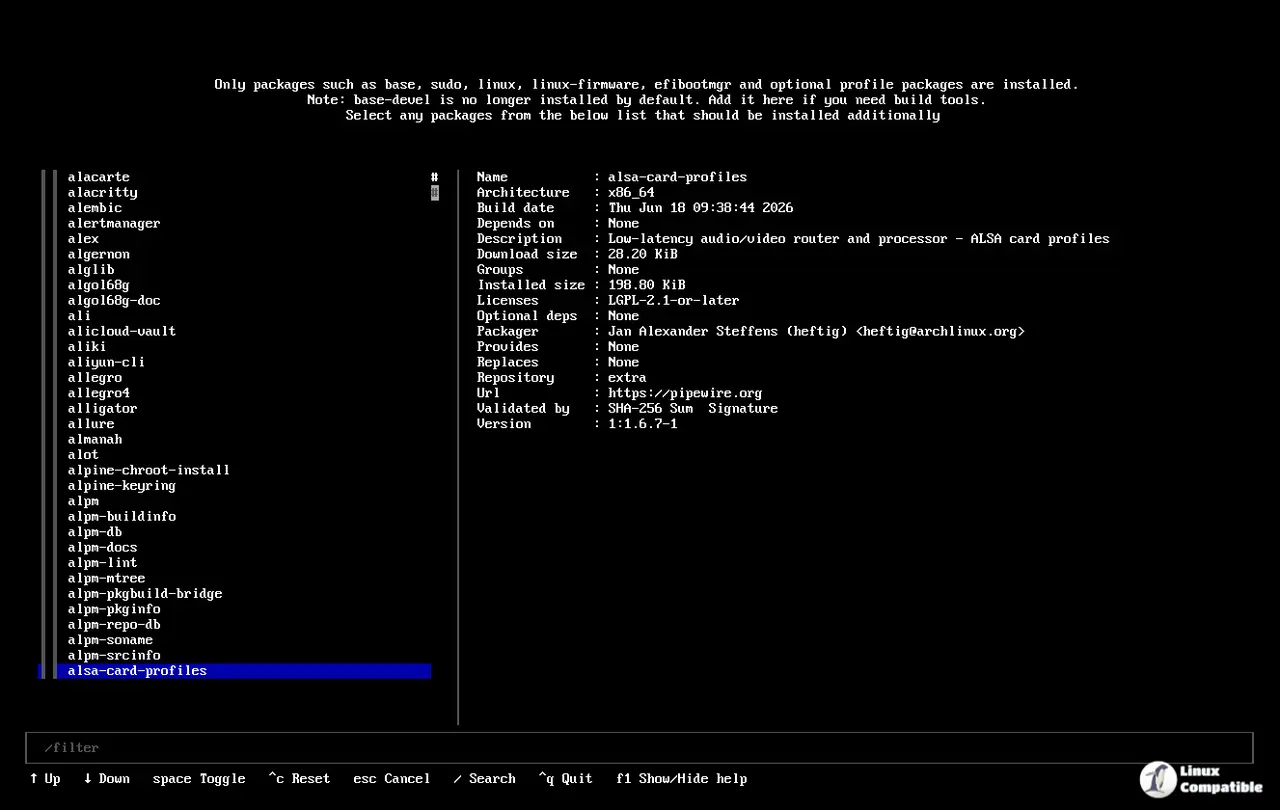
Not everyone wants to hand-edit config files in a dark terminal at midnight. The 2026.10.01 image ships Archinstall 4.5, the guided installer that walks you through partitioning, bootloaders, desktops, and networking. Maintained by Torxed (Anton Hvornum), it landed just days before the ISO on September 29, pulling in 19 contributors along the way.
The tool has grown into something of an institution for anyone who wants a working Arch system without memorizing partition tables.
A few things stand out in 4.5. ARM support got a real push: aarch64 now works with both GRUB and Limine EFI bootloaders, and there's a new AArch64 root-partition GUID. That matters for Raspberry Pi setups and other ARM64 machines. The Wayland compositors hyprland, labwc, niri, and sway switched from polkit to systemd-logind, which lines up their sessions with how login actually works these days.
It also squashed a couple of genuinely annoying bugs. Wi-Fi SSIDs with spaces used to vanish from the scan list, which is its own special flavor of misery for anyone installing over wireless. Intel GPU users past Generation 12 finally get the vpl-gpu-rt and libvpl packages they need for ffmpeg and OBS to work out of the box.
A 24-year-old project, freshly re-elected
Arch is now 24 years old, founded in March 2002 by Judd Vinet. Levente Polyák, who goes by anthraxx, won re-election as Project Lead on June 4, 2026. He's now serving a second consecutive two-year term, which means he's the one who breaks ties when the community can't reach consensus, enforces the Code of Conduct, and handles the money through the Software Freedom Initiative.
The ecosystem behind all of it is large. Arch's official repositories hold somewhere around 15,770 packages, and the community-run AUR sits past 49,000 PKGBUILD scripts. Valve leaned on Arch developers in September 2024 to help with build infrastructure, a move that quietly cemented the distro's place in gaming through SteamOS.
Tracking upstream this closely has a cost, though. Arch rode the front row of the xz backdoor, dealt with an active AUR malware wave in June 2026, and posts a steady stream of manual-intervention notices. The most recent one, from September 22, asks people to do something by hand when upgrading to Mkinitcpio 42 for TPM2-based LUKS unlocking.
That kind of friction would send most casual users running. It's also precisely what lets Arch stay ahead of most other distros. Both are true at the same time.
If you do want the image, BitTorrent is the way to go. The download page recommends it and asks that you seed afterward. HTTP direct works fine too, pulling from a mirror network that stretches from Fastly's global edge to a spread of university mirrors across Germany, China, and Brazil. There's also a Docker image, official WSL support, and VM images if you'd rather not touch a USB stick.
Head here to the official download page.


