Triton v0.6 Now Ships: A Real DirectX 11 Driver for QEMU That Isn't a DXVK Trick
The latest release of Osy's open-source Windows display driver adds out-of-the-box Vulkan and fixes a pile of stability bugs, moving QEMU's GPU acceleration from a proof of concept toward something you might actually run.
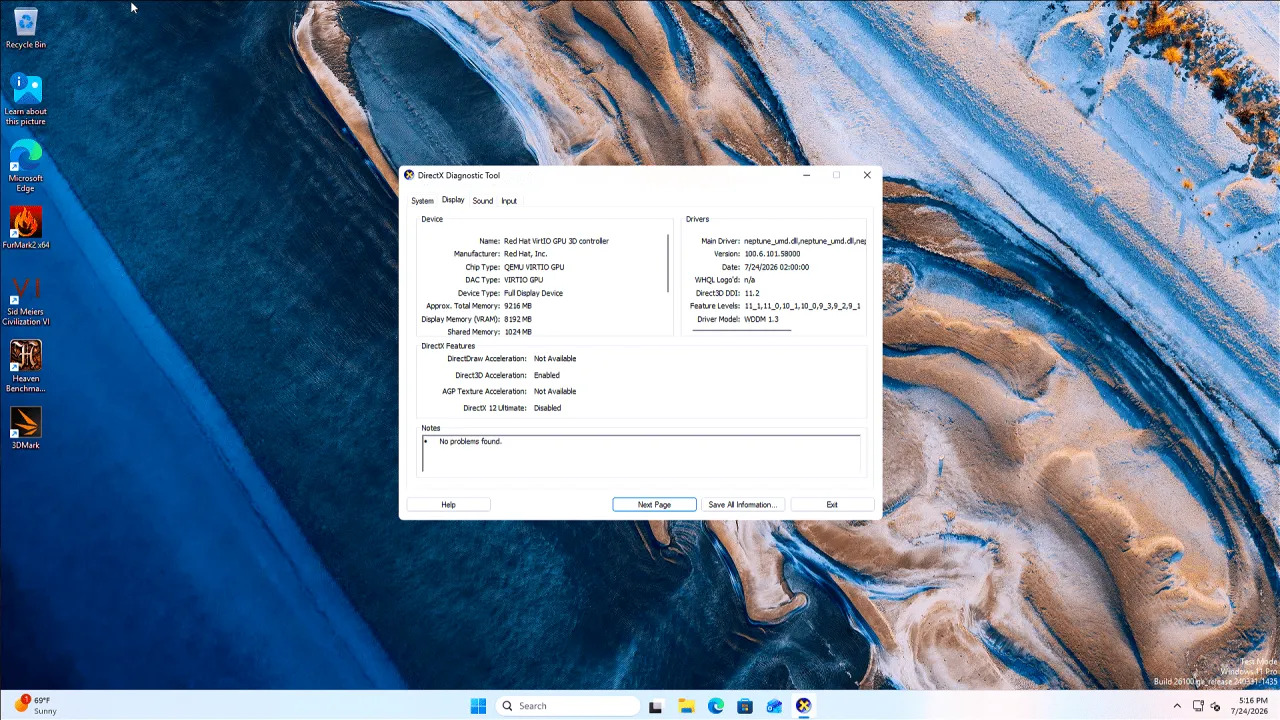
Triton, the open-source Windows display driver that makes QEMU feel like it has a real GPU, just got its most capable version yet. v0.6 shipped today, and for the first time it does Vulkan out of the box. No toggles. No overrides. No VK_DRIVER_FILES fiddling on your part.If you've been following Triton's slow crawl through 2026, you know that's a weirdly big deal.The driver has shipped in stages from developer Osy (who also makes the UTM VM manager at getutm.app), and each release has quietly removed one more thing you'd otherwise have to hack around by hand.The rest of this covers what actually changed in v0.6, why it matters, and the head-scratchingly strange story of how the whole thing got built.
What Triton is (and why anti-cheat stops caring)
Here's the thing that trips people up. Triton is not DXVK all over again. It doesn't drop a fake d3d11.dll next to your game and hope for the best. It goes one layer lower, all the way down to the DirectX Device Driver Interface, and implements that for real.
When a game renders on Windows, it calls into d3d11.dll. That library does some state tracking, then sends a sanitized stream of DDI calls to the user-mode driver. That driver talks through DXGI to the kernel-mode driver, which pushes against actual silicon.
For most of the past decade, the QEMU workaround was, frankly, a wince-inducing hack. Drop a DXVK-derived DLL here, another there, forward the API calls to a Vulkan implementation on your host machine, and call it a day. It worked. Often enough to be worth doing, as one UTM post put it. But it was also a mess.
Triton replaces what that DLL talks to. It ships a legitimate WDDM driver, user-mode and kernel-mode alike, and Windows' own system libraries stay completely untouched. You don't copy DLLs into game folders. Every app in the guest gets acceleration automatically.
And that's where anti-cheat stops being a problem. The DLL trick had a fatal flaw for multiplayer games: you can't replace core system files without breaking Windows, so you had to repeat the trick per game, per folder. Any title with a serious anti-cheat driver, BattlEye, Vanguard, the rest, notices an unfamiliar d3d11.dll sitting beside its executable, and reacts exactly the way you'd expect. A real driver sidesteps all of that. Nothing suspicious appears next to anything.
The clever bit is what Osy calls an "inverse transform." Instead of inventing a fresh serialization format for DDI commands (VirtualBox does exactly that), Triton turns the DDI calls back into standard DirectX 11 API calls inside the guest, then hands them to Neptune's existing transport. Most D3D11 DDI functions have direct API equivalents, so the mapping is mostly handle lookups and enum translations. One fewer transform step. One fewer place for compatibility to quietly break.
The full pipeline runs eight steps, from application to screen. The game calls into the system libraries, those call Triton through the DDI, Triton reconstructs shader bytecode, Neptune serializes it into a ring buffer, the kernel driver pushes it across the hypervisor via VirtIO, QEMU hands it to virglrenderer, the host module deserializes and forwards it to a DirectX renderer, and that renderer draws the frame for the VM window.
The hardest part, and this comes as no surprise, is shader bytecode. Microsoft's HLSL compiler spits out DXBC, a raw intermediate format. When a game creates a shader, the system library strips away all the surrounding metadata before passing only the raw bytecode to the driver. Triton has to reconstruct that metadata from nothing. It synthesizes a container it never actually looked at. Osy calls it "the weakest and most error-prone part" of the whole implementation.
You might ask why DirectX 11 and not DirectX 12. Osy's answer is pure pragmatism: DX11 is by far the most-used 3D API on Windows, with thousands of games versus a few hundred for DX12. It's higher-level too. DX12 is shockingly similar to Vulkan, low-level, explicit, unforgiving, which makes it far harder to emulate through a driver abstraction. On bang-for-the-buck terms, DX11 wins decisively.
v0.6 and the strangest build story
The headline feature is Vulkan that just works. Install Triton and your Vulkan apps find the "Virtio-GPU Venus" device with no overrides. Before this, the Vulkan driver failed to load from the driver store and couldn't start its command ring. The fix covered two things: the driver-store loading problem, plus a ring-buffer initialization problem on the WDDM 2 kernel driver.
It also packages the Vulkan driver as ARM64X now, so x64-emulated and ARM64EC Vulkan games get Venus too, not just native ARM64 ones. That means most Steam games, Quake II RTX included, can use it on Apple Silicon.
There are 10-bit display modes as well. Each resolution now comes in 10-bit, and fullscreen 10-bit output renders at full depth instead of being downconverted to 8-bit. This fixes FORSPOKEN, which used to show "0 x 0" in its Display Settings with no way to change resolution. Requires UTM 5.0.9 or later, though; on older UTM, 10-bit fullscreen shows wrong colors.
The rest of the release is a pile of fixes that read a lot like a support-ticket queue:
Smoother frame pacing. Vsync now ticks at the display's exact refresh rate. It previously ran 4 to 15 percent slow, meaning a significant chunk of vsync'd frames never actually showed up.
Boot screen fixed. The Windows boot spinner now stays up until the Welcome screen instead of flashing a black "Display output is not active" frame during startup.
Swap-chain recreation. Apps that rebuild swap chains frequently no longer lose the GPU. Closing and reopening windows over time no longer exhausts memory, which the desktop compositor used to hold onto until it restarted.
There's also fixes for strict Control Flow Guard, descriptor-pool over-allocation, and creating devices from session 0 services. A few Unreal Engine D3D11 games that used to stop dead with a "GPU required" error now run.
Head here to the release announcement.


