Mesa 26.2.4 ships with 103 commits and exactly zero new features
The latest Mesa bugfix release patches crashes, frame corruption, and memory leaks across nearly every open-source Linux GPU driver and brings nothing new on purpose.
The Mesa 3D graphics library just got a bugfix update, and its release notes state plainly that it ships with "New features: None." That's not a typo in the changelog. Release manager Eric Engestrom announced Mesa 26.2.4 on the mesa-announce mailing list October 1. It's the fourth point release in the 26.2 cycle, assembled from roughly 103 commits by 41 contributors. There's nothing new here by design. The entire goal is to stop your existing drivers from crashing, corrupting frames, or quietly eating memory.
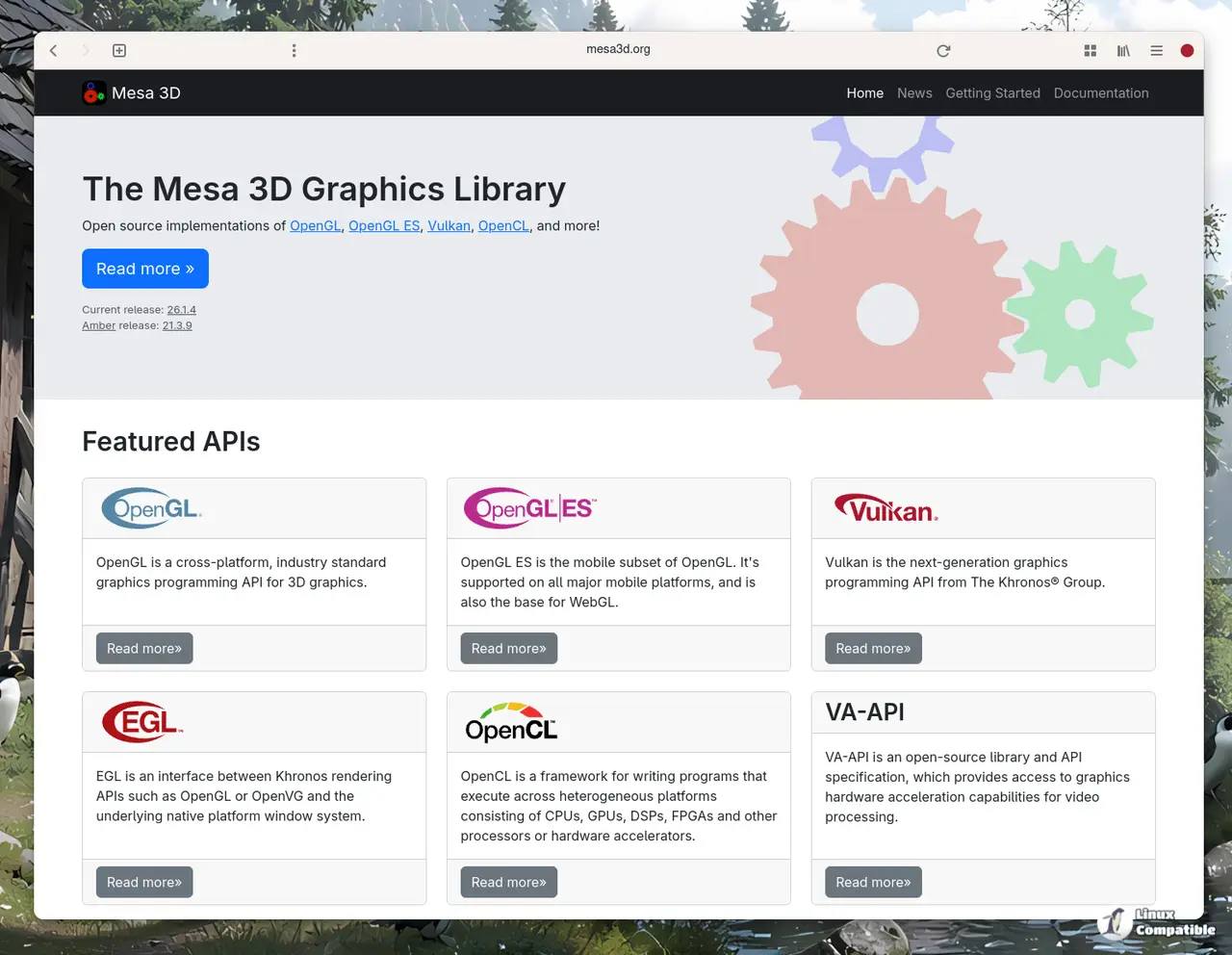
Mesa is the software nearly everything draws through on Linux. OpenGL, Vulkan, OpenCL, EGL, plus the video-acceleration layer stacked on top. If you move a window, watch a movie, or launch a game, it's all passing over Mesa. It's the only Vulkan and OpenGL option for AMD, Intel, and Qualcomm GPUs, and Intel has relied on these open-source drivers almost since day one. That's why a quiet point release like this quietly reaches millions of machines.
If you've followed Linux graphics before, you know the shape of this. A feature drop ships, someone reports a crash, and the next fix release patches it. This is exactly that rhythm. Not the most exciting kind of news, but the kind that keeps a session alive past its third hour.
What actually got fixed
AMD's RADV, radeonsi, and ACO stack took the largest share of the work, which makes sense given how much AMD leans on these drivers. Samuel Pitoiset led the release with 12 patches. His focus landed on DCC, AMD's Delta Color Compression. Get the math wrong and you'll see texture bleeding, black patches, or full-frame corruption, usually under specific shader loads only. He also added a radv_disable_binning_gfx11 toggle, which is switched on specifically for Sunset Overdrive. That's a targeted workaround for a game people actually play, and it tells you who's really benefiting from this release.
Matt Turner came up next with 11 patches. His work is less flashy but broader in reach. He made several texture-format codecs independent of host byte order, covering R11G11B10_FLOAT, R9G9B9E5_FLOAT, ASTC, FXT1, and a Z32 clear value. Historically these codecs assumed little-endian hardware, so they'd hand out wrong colors or crash outright on big-endian or mixed-endian systems. The software back-ends lean on this too, so it isn't some niche concern.
David Rosca handled the video side with an 8-patch batch covering H.264, H.265, and AV1. His changes sit right at the overflow boundaries of bitstream parsing. Fixing coding ue() for large numbers and relocating an overflow check means a malformed video stream stops writing past internal buffers. That's a direct hit on a recurring media-player crash, and it doubles as a memory-safety improvement that will never make a keynote.
Keep in mind that the named-app pattern repeats across the whole release. Lionel Landwerlin's Intel work disabled DRM_XE_DEVICE_QUERY_ENGINE_CYCLES with UnrealEngine 5.8, and Joe Wang applied a HiZ workaround to DiRT 4's native port. Those are probably the clearest signals of what end users actually gained.
Georg Lehmann spent 4 patches on the ACO shader compiler, while Mike Blumenkrantz kept the software render path and the Zink translation layer healthy with 9. Boris Brezillon also fixed a large-address-space problem in the ARM Mali drivers by stopping a compute-shader address from being downcast to a 32-bit range. That's the sort of hardening that matters once GPU address spaces grow past 32 bits, and you won't feel it until it stops a fault cold.
Where the cycle stands
26.2.4 sits near the end of a feature cycle that opened August 5 with the 26.2.0 release. The two-week bugfix cadence has held firm, and Engestrom has the next one, 26.2.5, targeted for October 14. API levels stay put at OpenGL 4.6, OpenCL 3.1, and Vulkan 1.4, though the exact features exposed still depend on your particular driver.
The bigger movement is happening just past this snapshot. Mesa 26.3 is expected around November and turns on the "Jay" shader compiler by default for modern Intel GPUs. Led by Alyssa Rosenzweig, Jay has been brewing for about a year and runs roughly 10 percent faster than the older BRW compiler, which is meaningfully better for open-source Intel shading, if the benchmarks hold. There's also "Shiva," a new Vulkan framework modeled on Gallium3D, plus the slow retirement of the decades-old TGSI. The 26.2.x line is the stable branch that soaks up all this before handing off.
It's not exactly the kind of release to cheer about, though the crashes it prevents add up. And for what it's worth, a bug avoided is still a bug avoided.
If you build from source, the tarball is signed and checksummed. Head here to grab it under the Git tag mesa-26.2.4, with SHA256 (bce5f7fbebb934373b86c999a064d52fb5065878dc57f287f95346648ec832e9) and PGP signatures posted alongside. Distribution users will usually get this through the normal package manager, though the exact timing still depends on your distro's release schedule. Head here to the Mesa GitLab issue tracker to file a regression.


