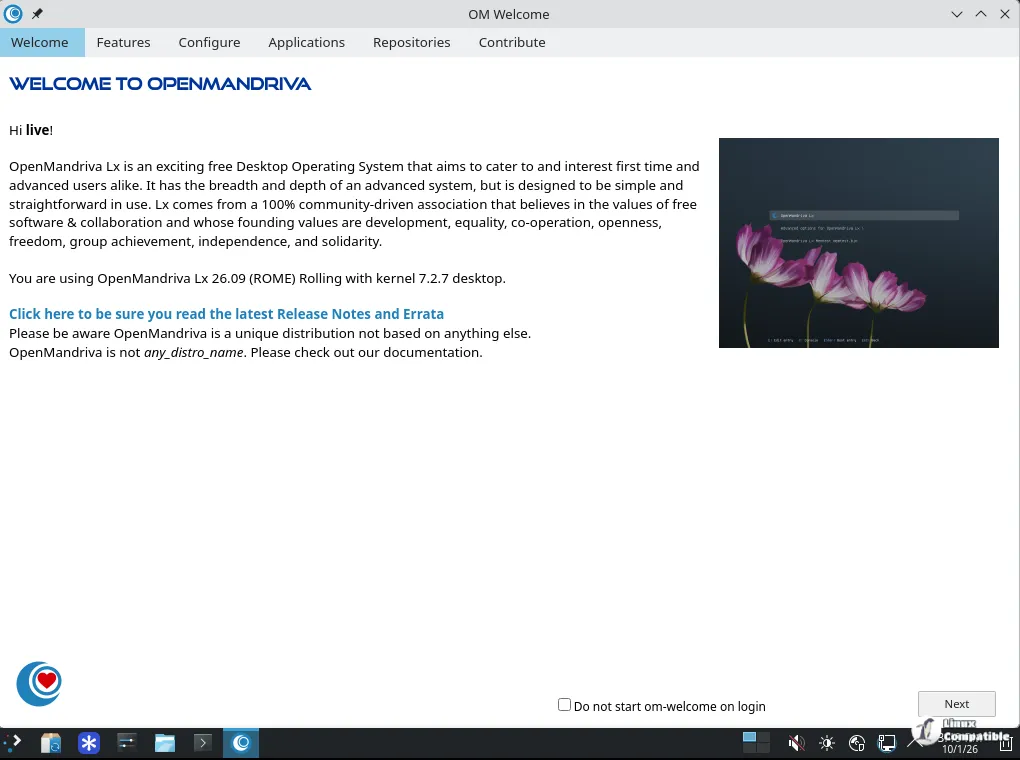
OpenMandriva Lx has released its September 2026 rolling-release snapshot, ROME 26.09, with ISOs dated 2026-09-27/28. The release ships in KDE Plasma 6 (Wayland and X11, plus generic x86_64 and AMD Zen "znver1" builds), GNOME, and a release-candidate LXQt edition. Maintainers say the ISOs passed QA across VirtualBox, QEMU/KVM, and bare-metal hardware, calling them "probably the best ROME Isos we have made in a long time" and safe to upgrade on existing systems.
OpenMandriva Lx ships ROME 26.09, its September rolling-release snapshot
The community-run Linux distro posts fresh KDE Plasma 6, GNOME, and LXQt builds, and maintainers call them "probably the best ROME Isos we have made in a long time."
OpenMandriva Lx has published its latest up-to-date install media for the ROME 26.09 cycle, the September 2026 edition of the project's rolling-release branch. The ISOs now live in the project's SourceForge release area. QA teams tested them across VirtualBox, QEMU/KVM, and bare-metal hardware. In other words, this might be a good moment to try a fresh install.
The rolling ROME branch is OpenMandriva's answer to people who want current open-source software without waiting for a fixed-point release. You pull it straight from the continuous "Cooker" development tree, then hold off during the occasional major upgrade and run a distro-sync to catch up afterward. Not for the faint of heart, but it rewards those who stick with it.
What you actually get in 26.09
The headline is that this remains a genuinely multi-desktop distro. The default edition is KDE Plasma 6, offered both as a Wayland session and a traditional X11 ISO, and you can pick between generic x86_64 images and AMD Zen-optimized "znver1" builds. There is also a full GNOME spin and a release-candidate LXQt edition. That is a lot of desktops to juggle on a single independent distribution.
OpenMandriva has pursued this multi-desktop strategy since its 2024 cycle, and 26.09 keeps it going. The znver1 images are worth a mention if you run AMD Ryzen or Athlon desktop hardware, since they are compiled and optimized for those Zen microarchitectures and can deliver a real performance bump. Older AMD or Intel chips should just grab the generic x86_64 builds.
Versions matter for a rolling release, so here is some context. The February 2026 snapshot in this same cycle shipped KDE Plasma 6.5.5, KDE Frameworks 6.22.0, Qt 6.10.2, and Kernel 6.19.0. The September builds carry newer Cooker-derived packages still, though the exact figures shift as Cooker keeps moving.
The editions also carry OpenMandriva's own tooling, like OM-Welcome, plus a few community-flavored choices. Recent Plasma builds include an ungoogled-Chromium browser called "Helium" alongside patched Firefox and Chromium with telemetry disabled. Past cycles even added proton repos so Windows games run outside of Steam.
The available ISOs
The files sit under OpenMandriva's SourceForge release area, and the sizes and build IDs come straight from the listings.
For the Plasma 6 edition you have four choices. The generic x86_64 Wayland build (4765) and the X11 build (4767) both land at 3.8 GB. The AMD-optimized znver1 variants (4760 and 4768) are 3.9 GB each. Every one ships with a .sha256sum file for integrity checks, so verify before you install.
The GNOME spin (OpenMandrivaLx.rolling-rome-gnome3.x86_64.iso) is 3.6 GB and is kept alive by community maintainer @AngryPenguin. It is described as well supported, which is more than you can say for every spin in the wild.
The LXQt edition comes in as a release candidate, with both x86_64 and znver1 builds at 2.6 GB. Note that LXQt is a community spin here, not an officially prioritized one. XFCE and MATE exist too, though they sit at similarly lower priority.
Upgrading without breaking things
If you are already on ROME, do not just run dnf upgrade. OpenMandriva wants a full distribution sync, recommended as:
sudo dnf clean all
sudo dnf --refresh --allowerasing distro-sync
You can also use sudo dnf dsync --allowerasing. One large transition in this range touched over 1,500 packages, which is exactly why the project pushes a full distro-sync rather than an incremental bump.
Keep a few things in mind while you do it. Use --allowerasing with caution and watch what gets removed. Renamed and moved packages are usually the only things dropped, but it is worth watching. Logging the transaction to a file buys you an audit trail if something goes sideways.
Never overwrite the default /etc/passwd, /etc/shadow, /etc/group, or /etc/gshadow files during the sync. Keep your existing versions and you will keep your users, groups, and passwords intact. Config-file prompts usually default to the safe choice, and a plain dnf autoremove can tidy up a few dozen now-unused dependencies.
The bigger picture
OpenMandriva keeps hammering home that it is a fully independent, volunteer-run distribution, no corporate parent and no upstream distro riding coattails. It builds its own packages through the ABF build farm, tracks issues on GitHub, and hosts the chatter on its forum and Matrix channels.
Not everything has been smooth lately, though. The project put out an official statement in July 2026 about an "attempted distribution sabotage," a reminder of what a small volunteer team faces when it refuses to lean on a bigger vendor. Resilience looks like a feature at this point.
For users who want stability instead of the latest everything, the fixed-point Rock branch is the alternative. The latest is OpenMandriva Lx 6.0 "Rock The Spring," shipped back on 2025-04-22 with KDE Plasma 6 by default. ROME is the pick for anyone comfortable with a rolling model and the occasional maintenance chore.
Head here to download the KDE Plasma 6 builds, here for the GNOME release, and here for the LXQt release candidate.


