Canonical ships Ubuntu 26.10 "Stonking Stingray" beta, targets Oct. 15 final release
The OS maker's first fully-Rust coreutils and official RISC-V support headline the penultimate release before launch.
Canonical just opened the final stretch toward Ubuntu 26.10. Codenamed "Stonking Stingray," the beta shipped today, and the company is already looking at Oct. 15 for the final release. That's a little under two weeks out.
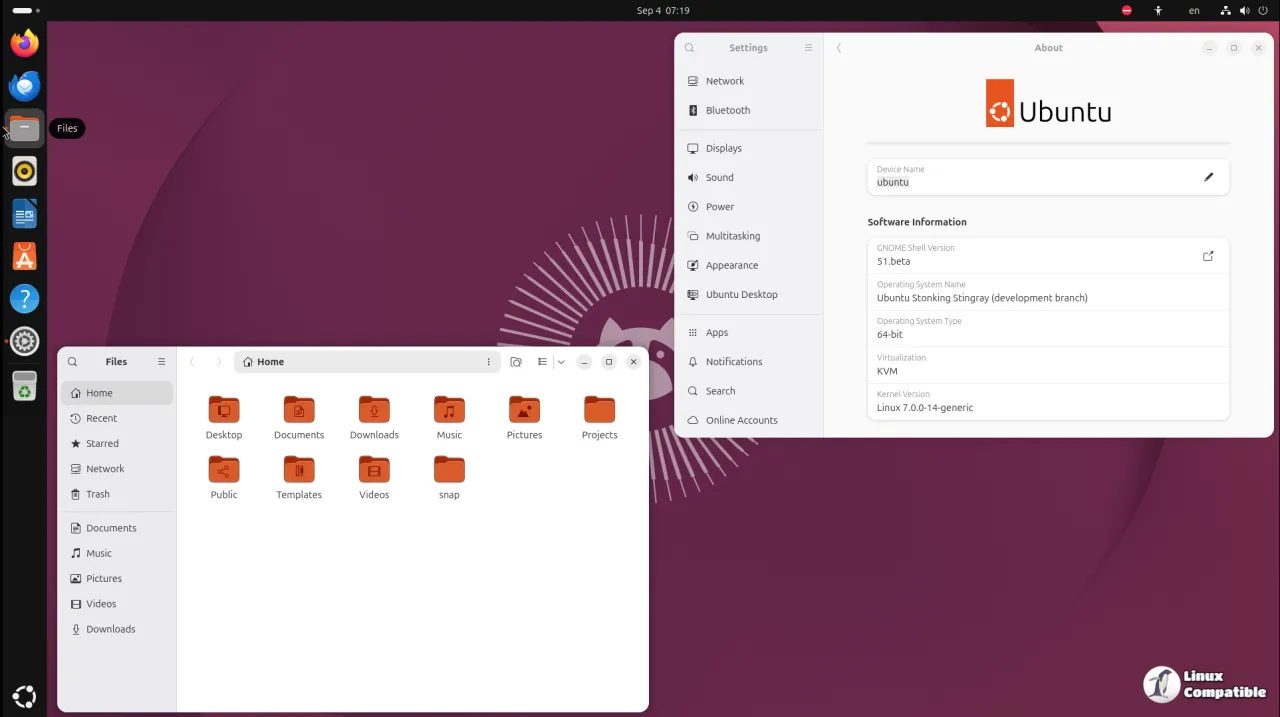
Per Ubuntu convention, the beta is "a very recent snapshot" that "should be representative of the features intended to ship with the final release." Canonical also claims it is "known to be reasonably free of showstopper image build or installer bugs." That's not a hard guarantee. It's close enough for you to install it tonight, though.
The build carries a Linux 7.3-rc kernel and "updated versions of most of our core set of packages," per the announcement posted by Utkarsh Gupta on behalf of the Ubuntu Release Team. Let's get into what's actually different.
A coreutils that's now entirely Rust
The big story is that Ubuntu's core utilities now run on the Rust-based uutils implementation. All of it. That makes 26.10 the first 100% Rust coreutils tree the distro has ever shipped.
The three holdouts were cp, mv, and rm. Those GNU staples finally got migrated this cycle, which closed the loop.
Rust for rm? Sure, why not. The argument is sound, at least in theory. Fewer memory-management bugs in C means fewer exploitable holes in the exact tools you run a thousand times a day.
Security-first, sort of
Canonical is layering a couple of memory-safe moves under the security umbrella. The first is Sequoia PGP. This Rust-based OpenPGP implementation enters the main archive as an officially supported choice, giving you sq and sqv as stand-ins for the traditional gpg and gpgv.
Canonical frames it as a step toward "a more maintainable and memory-safe foundation." The older gpg and gpgv stay in main for now, so nobody's being forced out of their old habits.
OpenSSH gets split in Server 26.10. It breaks into two source packages: openssh, which ships binaries without GSSAPI or Kerberos, and openssh-gssapi, which adds the Kerberos-enabled client and server. Fresh installs default to the non-GSSAPI variants. Only the upgrader auto-selects -gssapi, and only when it detects existing Kerberos use.
There's also a folded-in ccache patch so forwarded credentials honor default_ccache_name in /etc/krb5.conf. Minor detail. People who actually run Kerberos will notice.
On the hardware side, 26.10 adds official support for RVA23 RISC-V platforms. That covers the SpacemiT K3 (Pico-ITX and CoM260 kit) and the SiFive BigSky. Ubuntu Desktop and Xubuntu Minimal RISC-V images ship with SpacemiT K3 and QEMU support, and install docs for the K3 are already up on ubuntu.com/hardware.
Not cheap, though that's not really a price thing. RISC-V support landing on a mainstream release is still a notable milemarker.
The toolchains
26.10 bundles a fresh set of developer toolchains. GCC lands at 15.2.0 with C++ modules support. Go ships 1.27 for generic methods. Python settles on 3.14.7, the seventh maintenance release of the 3.14 series. Rust itself reaches 1.97.1 with LLVM miscompilation fixes.
Then there's LLVM 22.1.6, .NET 10.0.112, OpenJDK 25.0.4, and Zig 0.16. If you specifically care about LLVM, keep an eye out for early C2y named-loop support plus expanded SSE/AVX/AVX-512 intrinsics.
Core products and flavors
All ten community flavors shipped too. You've got Edubuntu, Kubuntu, Lubuntu, Ubuntu Budgie, Ubuntu Cinnamon, UbuntuKylin, Ubuntu MATE, Ubuntu Studio, Ubuntu Unity, and Xubuntu. Tacked on top of the four core products: Desktop, Server, WSL, and Cloud.
Canonical says it will keep shipping fixed images between now and launch, so testers should pull daily cloud images dated 20261001 or later.
What you can download
The four core products all ship at beta, and they come in four shapes. The 64-bit Desktop is a 5.9 GB ISO. The 64-bit Live Server is 2.8 GB. There's a 105 MB netboot tarball, and a 419 MB WSL image. All were built Sep. 29 except the netball, which came together Oct. 1.
Head here for the primary downloads.
One thing to clock. The official schedule had the beta landing Sep. 24. It slipped to Oct. 1, and the images were built Sep. 29 anyway. Slightly behind the clock, but Canonical did say it would fold fixes into new images up to launch, so the lag isn't exactly alarming.
Worth a shot
It's a meaty beta. The Rust coreutils are the kind of change that quietly shows up in production systems for years to come. However, at the same time, Rust-in-coreutils is exactly the area where you're likely to catch bugs while the migration settles in. The whole point is memory safety, but new implementations always take a while to mature.
The OpenSSL-style OpenSSH split and the Sequoia switch do suggest Canonical is steering toward a security-first foundation rather than chasing shiny features.
Keep in mind that 26.10 is an interim release. You get roughly nine months of free support, with end-of-life landing around July 2027. If you want the long haul, 26.04 LTS "Resolute Raccoon" runs until May 2031.
The final release is set for Oct. 15. The beta images are live now. For reporting bugs, file against the relevant packages, or the cloud-images project on Launchpad if you're not sure where they belong.


