Archinstall 4.5 Adds ARM64 Bootloader Support, More Languages, and a Security Upgrade
The official Arch Linux installer gains AArch64 GRUB/Limine EFI support, swaps polkit for systemd-logind, adds three languages, and turns on TLS verification.
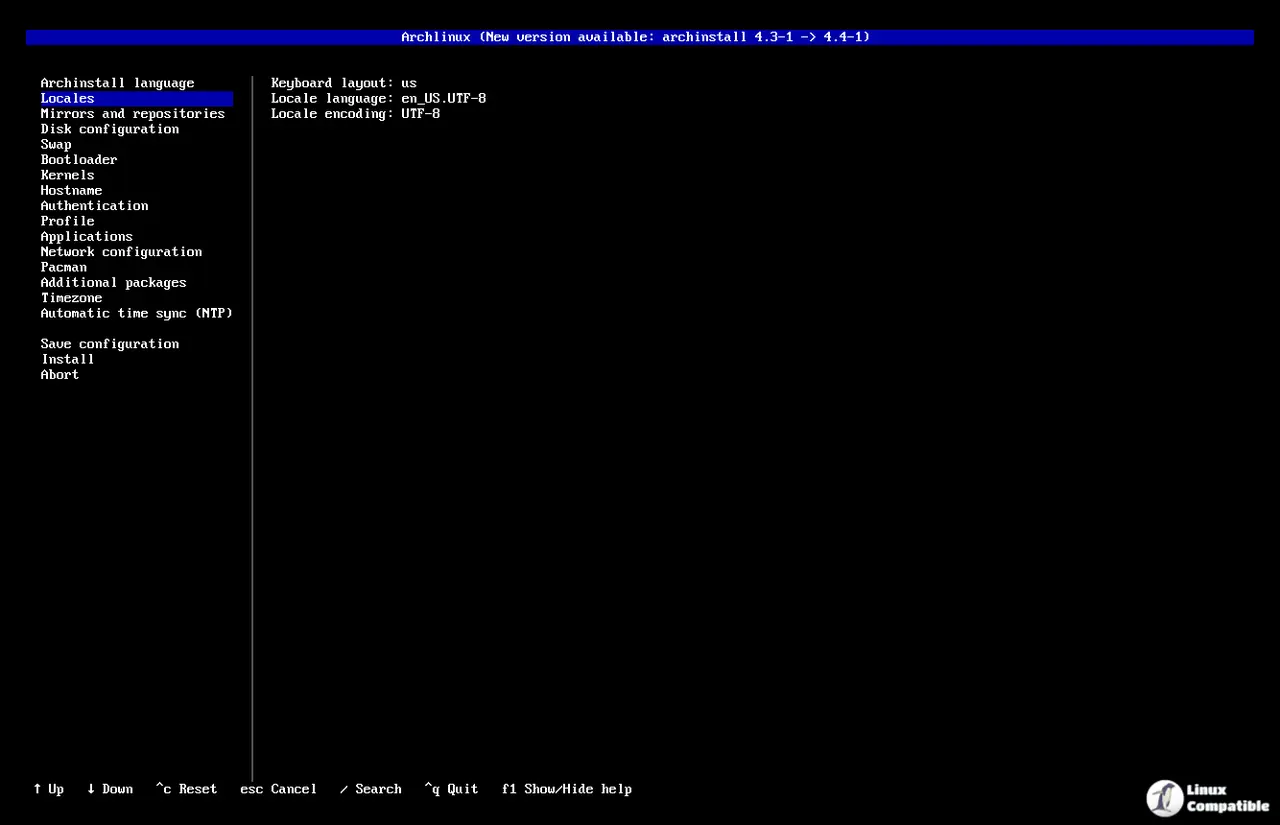
Archinstall, the guided installer that makes installing Arch Linux tolerable for a crowd that usually thrives without a hand to hold, just reached version 4.5. It landed today, roughly three months after 4.4, and packs 131 commits of change into a single release.
The work was tagged up by Anton "Torxed" Hvornum, a committer on the Arch Linux project, directly on the master branch. That's a lot of code stacked on top of the June 28 release in a short window.
Archinstall lives under the official archlinux GitHub organization and has quietly become a pillar of the distro's accessibility drive. It now sits past 8,400 stars and nearly 780 forks, which is no small feat for a Python script that renders a plain-text menu.
The ARM story
The headline change is aarch64 support for GRUB and Limine EFI bootloaders, arrived at in PR #4641 by @steev. Until now, the installer kept its bootloader logic firmly in x86_64 territory and left ARM64 users to patch the gaps by hand. That gap is now closed. A 64-bit ARM machine can run the same guided flow you'd use on a laptop.
A companion PR (#4671, by @codefiles) handles the AArch64 root partition type GUID, so disk layouts on ARM hardware get tagged in a way boot managers will actually recognize.
Build further and you'll find real-time kernel variants landing in PR #4711 by @h8d13. RT kernels target low-latency work like audio production, industrial control, and real-time networking. They aren't for everyone, but for anyone scripting Arch onto specialized gear, it's a genuinely handy option.
The desktop logic gets a cleanup
For desktop installs, the installer now leans on systemd-logind instead of polkit to turn on session and privilege features for hyprland, labwc, niri, and sway. That's PR #4753, also by @h8d13. It lines Archinstall up with where modern Arch actually heads, since logind handles session tracking and udev access more cleanly than a standalone polkit agent sitting in the corner.
On top of that, PR #4712 makes the installer honor the optdepends of linux-firmware, so preview text and package picks reflect what each machine actually wants.
Security catches up
Three changes here are worth your attention. First, TLS verification is now enabled (PR #4790, by @svartkanin). Network fetches including mirror data retrieval now check certificates properly, which shuts down a man-in-the-middle window that opened whenever the installer pulled package or mirror metadata with validation turned off.
Second, the EFI System Partition now mounts with fmask=0177 (PR #4715, by @AnouarMohamed), tightening permissions on the boot partition. Third, credential encryption only triggers when credentials will actually be saved (PR #4720, by @NWuensche), sparing you a confusing prompt for something that wasn't going to happen anyway.
Bugs, fixed
The fix list is long, and most of it is the unglamorous but necessary kind of work. WiFi SSIDs with spaces used to simply vanish from the scan list. That's resolved in PR #4634 by @nmarley.
Intel GPU acceleration past Gen12 now pulls in the vpl-gpu-rt and libvpl packages (PRs #4705 and #4713, both by @h8d13), so ffmpeg, OBS, and similar tools can actually use Intel's video processing APIs. The Cockpit profile switches to cockpit-storaged instead of the deprecated udisk2 path, and Ghostscript joins the print-service set.
Keep in mind that the sample JSON config file was corrected and is now wrapped in an automated test round-trip (PR #4709 by @VictorZaca). A disk-menu import cycle bug got squashed, systemd-python was downgraded to dodge a dependency failure, and the pointless reflector.service wait was cut.
Languages, because locality matters
Three new languages round out localization. Norwegian Bokmål (nb) landed in PR #4599 by @arvindfroi. Serbian shows up in PR #4642 by @KsanDjordje. Vietnamese joins in PR #4582 by @BlackCatOfficialytb.
Nepali got a meaningful nudge too, adding 52 previously untranslated strings across disk encryption, partitioning, mirrors, and profiles (PR #4800). Ukrainian got some love as well.
The boring part, which is the good part
A big chunk of this release's churn is internal hardening, driven mainly by @codefiles, @correctmost, and @svartkanin. Ruff linter rules got enabled. mypy and Pylint got stricter in the test_tooling directory. Core models got refactored: MirrorStatusListV3, CPUVendor, the default PartitionTable, meminfo, and a few others.
Dependencies shifted to rolling "latest" versions (PR #4695 by @C0rn3j), and a new three-day cooldown on dev-dependency updates (PR #4725) keeps automated bots from turning every dependency bump into a shouting match.
The release process gains a backbone
Two behind-the-scenes changes quietly make the pipeline more predictable. The Arch packaging recipe now lives in the upstream GitLab packaging repo (PR #4789), so there's a single source of truth instead of duplicated PKGBUILDs drifting apart. And as @h8d13 noted, the intended cadence is a minor bump on the 27th of each month, gated by GPG key rotation from a trusted maintainer. In other words, expect scheduled releases instead of whoever happened to push first.
Why this actually matters
Twenty-one contributors touched 4.5. Fourteen of them made their first-ever contribution, which is a strong signal that the project keeps drawing in new hands.
Archinstall 4.5 isn't about flashier menus. It's about maturity. The AArch64 bootloader support closes the installer's most glaring platform gap. TLS verification and tightened EFI permissions fix real security holes. The shift to systemd-logind keeps the installer in lockstep with Arch itself. The heavy refactoring and standardized release cadence point to a project investing in its own backbone as its feature set grows.
For actual users, the practical upside is simpler ARM64 installs, more secure network fetches, better Intel GPU support out of the box, and a cleaner experience for people who don't speak English.
Grab it
Archinstall 4.5 ships as a signed release asset on the GitHub releases page, and it's also installable from the official Arch Linux repositories as the archinstall package. The full diff between 4.4 and 4.5 is posted on GitHub for anyone who wants to sift through the 131 commits.
Head here to the release page to grab it.


