Valve just announced Steam Machine pricing that ranges from $1,049 to $1,428. Storage capacity and controller bundles do the heavy lifting while every model packs a semi-custom Zen 4 processor and RDNA 3 graphics inside a sealed chassis that trades upgradability for console-like simplicity. Pre-orders open June 25 for past Steam purchasers only, and randomized invites will ship starting June 29.
Steam Machine Pricing Breaks Down The Cost Of Valve’s SFF Living Room PC
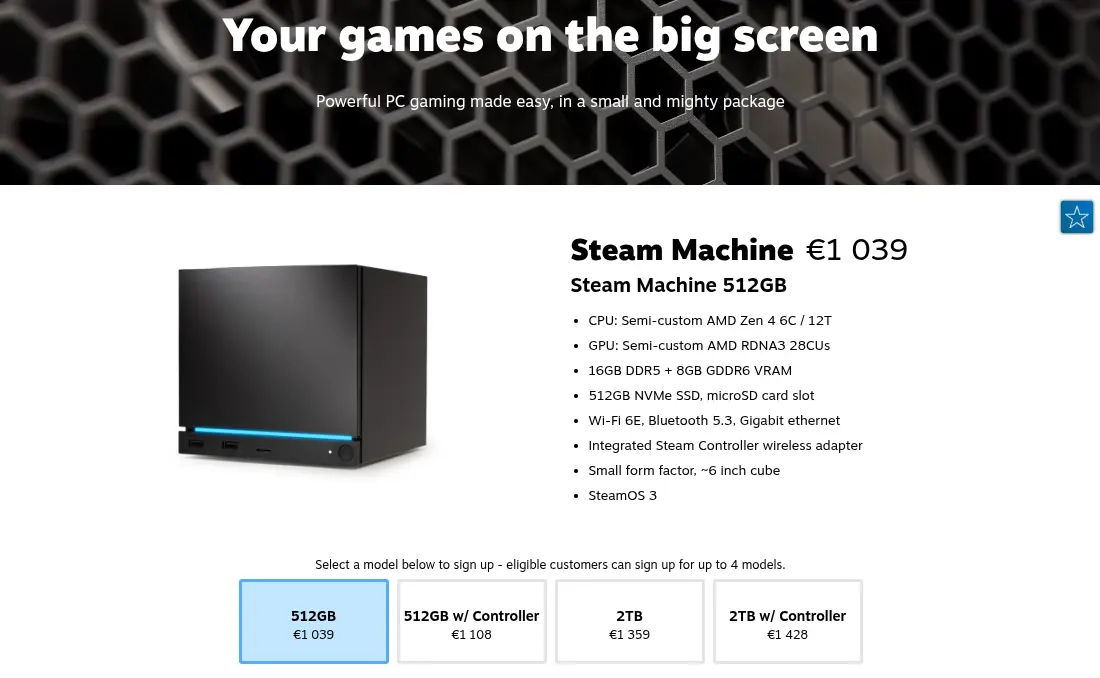
The wait for Valve’s living room PC is finally over. Valve just dropped the official Steam Machine pricing, and the numbers immediately separate the casual experimenters from the dedicated console farmers. The base model sits at $1,049 or €1,039. The top-tier bundle climbs to $1,428 or €1,428. All variants pack a semi-custom AMD Zen 4 processor with six cores and twelve threads, an RDNA 3 graphics chip with 28 compute units, sixteen gigabytes of DDR5 RAM, and eight gigabytes of GDDR6 VRAM.
Buyers get the Linux-based SteamOS out of the box. The small form factor chassis arrives with the exact same connectivity across the board. One gigabit Ethernet. DisplayPort 1.4. HDMI 2.0. A USB-C port. Four USB-A jacks. The microSD slot sits there for expansion. Pushing full games into a card slot feels like a compromise in 2026.
How The Storage Tiers And Steam Machine Pricing Work Together
The lineup splits along two axes. Storage capacity and controller inclusion. The entry-level $1,049 or €1,039 configuration strips out the Steam Controller entirely and drops a 512 gigabyte NVMe drive. It serves as a functional starting point for anyone who already owns peripherals. Stepping up to $1,128 or €1,108 adds the controller back into the package while keeping that same 512 gigabyte storage ceiling. For folks who actually want to install multiple AAA titles locally, the jump lands on $1,349 or €1,359. That tier doubles the NVMe capacity to 2 terabytes. It omits the controller again but throws in two extra faceplates for the standard black model. Buyers receive the red fabric and solid walnut covers. The final $1,428 or €1,428 option wraps everything together with both the drive space and the controller.
Valve is charging a premium here. The company openly points to ongoing silicon shortages and memory module price hikes as the reason. That explanation lands harder when looking at the standalone controller pricing. Buying it separately costs $99 or €99. Picking a bundle drops that number to $79 or €69. The math quietly forces purchasers into the mid or high tiers.
The Hardware Claims Versus The Real World Performance
Valve is pushing the Steam Machine as a desktop replacement. The company claims it delivers six times the performance of the Steam Deck and can sustain 4K gaming at sixty frames per second using FSR. Those numbers look respectable on paper. The Zen 4 and RDNA 3 silicon actually backs them up when running the benchmarks. The catch comes when opening the chassis. The machine does not play nice with third party upgrades. Buyers cannot drop in a different GPU or swap out the processor. It fails miserably if someone plans to rotate hardware every eighteen months. The microSD expansion slot serves as a nice gesture, but relying on external media for heavy game libraries introduces latency that FSR cannot fully mask. The machine operates as a sealed ecosystem. It behaves exactly like a modern console. That matches Valve’s design goal.
Bazzite Linux And The Self Built Workaround
Valve locked the hardware into a sealed chassis. That choice works for people who want a single living room box. It leaves everyone else staring at existing desktops or building a custom rig. Bazzite Linux fills that gap. It is an immutable Fedora based distribution built specifically for the Steam Deck interface. Users install it, reboot, and the system boots straight into a desktop mode optimized for game streaming and local playback.
Reservations are open right now. Valve moves the hardware to actual pre-order status on June 25. Shipping kicks off June 29. Access is not open to the general public though. The system restricts pre-orders to customers who have made a purchase on Steam before April 27, 2026. Invites will roll out in a randomized queue. The cutoff date feels arbitrary, but Valve has never operated on an open ticket system for limited hardware. Those outside the window will have to wait for a secondary refresh. Watch the secondary market closely when units start landing. The fixed silicon will make these machines behave more like current generation consoles, not traditional PCs.


