Shelly ALPM v3.3.0 arrives with a fresh "Pearl" look
Its new release restyles the Arch package manager to match Seafoam Labs' Pearl desktop, fixing a couple of bugs along the way.
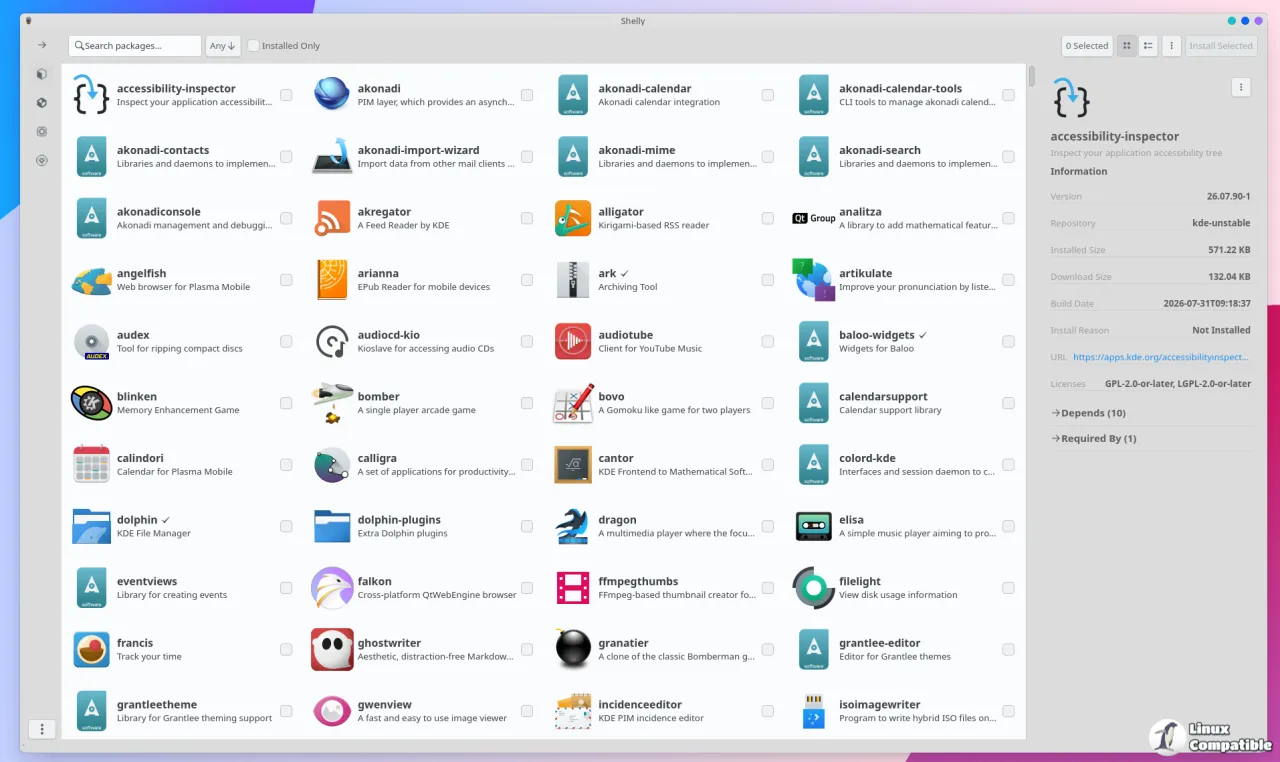
Shelly ALPM v3.3.0 shipped today, and its entire premise is that its desktop package manager should finally look like the rest of the Seafoam desktop. The release carries the nickname "A Little More Pearl," which, honestly, pretty much is the story.
A polish release with real fixes
This is a design and UX release, not a capability bump. There are no new package-management features or engine changes hiding in here. Shelly's creator, Zoey Erin Bauer, left just one commit ahead of the master branch when she cut this release.
One commit. That's the entire update, basically.
What you do get is a restyled GTK4 app. Windows are rounded now instead of sharp-cornered, and the window-control buttons are circular. Selected items pick up your desktop's accent color, toolbars sit in card containers, and page titles got a bit taller.
The sidebar grew too. Settings and Utilities now nest under a System grouping, so Shelly's chrome echoes Pearl's rounded, card-based look. Use it with the Pearl desktop and everything blends in. Use it elsewhere, and it still reads fine.
Light and dark control is finally native. Under Settings and Look and Feel you can pick Follow System, Light, or Dark. Theme changes apply immediately, no restart required. The older System GTK option stays available if you'd rather defer to your desktop's own styling.
The Updates page got a redesign. It shows per-source filters with live package counts, a download-size summary before you commit, and per-package selection for AUR and Flatpak updates. Native system updates remain one atomic upgrade, and the upgrade button updates to match your selection.
Two fixes ride underneath the cosmetics. Update checks can now recover from a race with the tray service after an upgrade. Restart logic also now recognizes display-manager aliases, most importantly the Plasma Login Manager. It's a safety tweak: rather than blindly restarting a login manager and potentially yanking you out of your session, Shelly reports the service instead of restarting it.
Shelly was born in a C# and .NET codebase not too long ago. The full rewrite to Zig for v3.0.0 felt like a gamble. It held up, and the language choice stuck hard enough that the C# variant barely gets attention anymore.
Why the velocity question hangs over it all
The bigger story is that Shelly stopped being a hobby tool. It became the default graphical package manager on CachyOS in its April 2026 release, dropping Octopi. That puts Shelly in front of hundreds of thousands of people who receive it out of the box. It also ships inside Devario, Seafoam Labs' own distro built around the Pearl desktop.
The reach is a genuine win for adoption. However, at the same time, it sharpens the velocity critique. On the CachyOS forums, some users wore out the rewrite cycle. One commenter counted three major versions, including separate rewrites just to change the GUI framework and the base language. "I simply want something stable that works reliably," they said.
People have also raised eyebrows at the code volume. Reports of massive weekly contribution spikes have led some to wonder how much AI-generated code is flying through the repo and whether any human still holds genuine oversight over it.
Technical skeptics have their own worries. As Arch developer C0rn3j put it in one thread, a from-scratch libalpm reimplementation "makes me afraid to use it," and others point out that PKGBUILDs are really bash scripts with arbitrary code baked in, which is a real hazard for any native AUR builder.
For what it's worth, the project stays candid about the gaps. The notes admit RLPM, its from-scratch Zig reimplementation of libalpm, lacks full parity, and that its record recovery isn't a true package rollback. Every missing piece goes into a public ledger. For a tool now running on hundreds of thousands of machines, that kind of honesty matters more than usual.
Shelly ships signed prebuilt tarballs with SHA-256 checksums for x86_64 Linux. The full package is about 8.57 MB, while the CLI-only build is roughly 1.89 MB.
The easiest route is through CachyOS itself:
sudo pacman -S shelly
Or lean on an AUR helper:
yay -S shelly
You can also build from source, but that means pinning Zig 0.17.1 and installing libalpm. An RLPM-only build drops the pacman dependency entirely.
Keep in mind that RLPM is not the default backend, so if you want the tried-and-true path you stay on libalpm. RLPM is where the unfinished frontier lives, and that's the one caveat worth carrying.
Head here for the full release notes if you want every detail.


