KDE Plasma 6.9 Closes Out Its 30-Year X11 Crutch
The next major desktop update makes XWayland load lazily, quietly finishing the transition to a Wayland-only experience ahead of its February 2027 launch.
KDE just published the latest installment of its "This Week in Plasma" development blog, and the headline is deliberately unglamorous. As of today, Plasma is loading XWayland only when you actually launch an X11 app. It stops again once those apps close. For the uninitiated, XWayland is the compatibility layer that lets legacy X11 software run inside a modern Wayland session, and up until now it was effectively always running in the background even if you never touched a single X11 program.
That's a waste of memory and GPU resources, and KDE clearly wants to stop wasting them. The change, tracked as "True Xwayland on demand," is headed into Plasma 6.9, which is slated for stable release on 18 February 2027. The work came from Vlad Zahorodnii, David Edmundson, and David Redondo, and KDE's own framing of it is that removing the forced-start paths makes startup "ridiculously fast."
Killing the zombie server
The tricky bit here is that "launch it only when needed" sounds trivial until you read the work item. KWin already knew how to start and stop XWayland. The problem was that Plasma itself demands an immediate X server at boot. A scattering of core services proactively spawned plasma-setup-xwayland at startup, which clobbered KWin's lazy logic before it could ever kick in.
Those spawners lived everywhere. ksmserver was the worst offender because it sets environment variables that have to be ready before anything else launches. The Fonts and Cursor Theme settings modules, the Look And Feel subsystem, the kaccess accessibility daemon, application menu and xembed proxy daemons, and a GTK color-sync module all joined the party.
The fix was substantial surgery rather than a one-line patch. The team ripped legacy X11 support out of ksmserver and recast it as a lightweight QCoreApplication. They added initfd support to KWin's XWayland launching for a race-free start, sidestepping the classic problem of an app connecting before the server is ready. Individual spawners were either plumbed cleanly or removed, including a new dedicated kded-x11 module to handle the GTK and menu responsibilities.
The upside for you is mostly about the common case. If you run a Wayland session and never fire up an X11 app, you'll pay less memory and GPU overhead, get a cleaner boot, and still be able to launch X11 software transparently. It just waits to be asked.
That said, the performance gains for a single app launch are arguably not going to make or break your day. The real point is architectural. This is KDE methodically lowering the cost of keeping a 30-year-old dependency alive while it works toward a genuinely Wayland-only future. Plasma 6.8, released in mid-October 2026, already killed the ability to start an X11 session outright. The X11 window manager got its final sendoff with 6.7.7. Roughly 95 percent of users were already on Wayland before any of this.
Features and polish
Away from the plumbing, 6.9 brings a few things you'll actually notice. You can now forget a Wi-Fi network straight from the Networks widget's right-click menu instead of digging through System Settings. System Monitor gains a physical CPU core counter to complement its existing logical-core and utilization readings.
Bigger still, heading in from earlier in the cycle, are a reworked weather widget with a cleaner layout and more forecast data via Open-Meteo, and a re-engineered on-screen keyboard. That last one adds a full-size layout, a Japanese flick-input option, and distinct layouts no longer pinned to the system locale. For touch and mobile interfaces, it's a genuinely meaningful usability bump.
The rest of the release is mostly polish, and a lot of it is the ongoing migration of System Settings pages from C++/Qt Quick KCM code into QML. The Task Switching settings page got ported and now folds in the Overview effect's own settings. The Date & Time page was redesigned as a simpler single layout. Wallpaper configuration got more preview space by moving its combobox to a dedicated Layout page. There's a fix for a "huge size gap" in desktop icon sizes, a fade-in capture overlay for Spectacle, and grouped Task Manager attention indicators that now reveal which specific window is flashing.
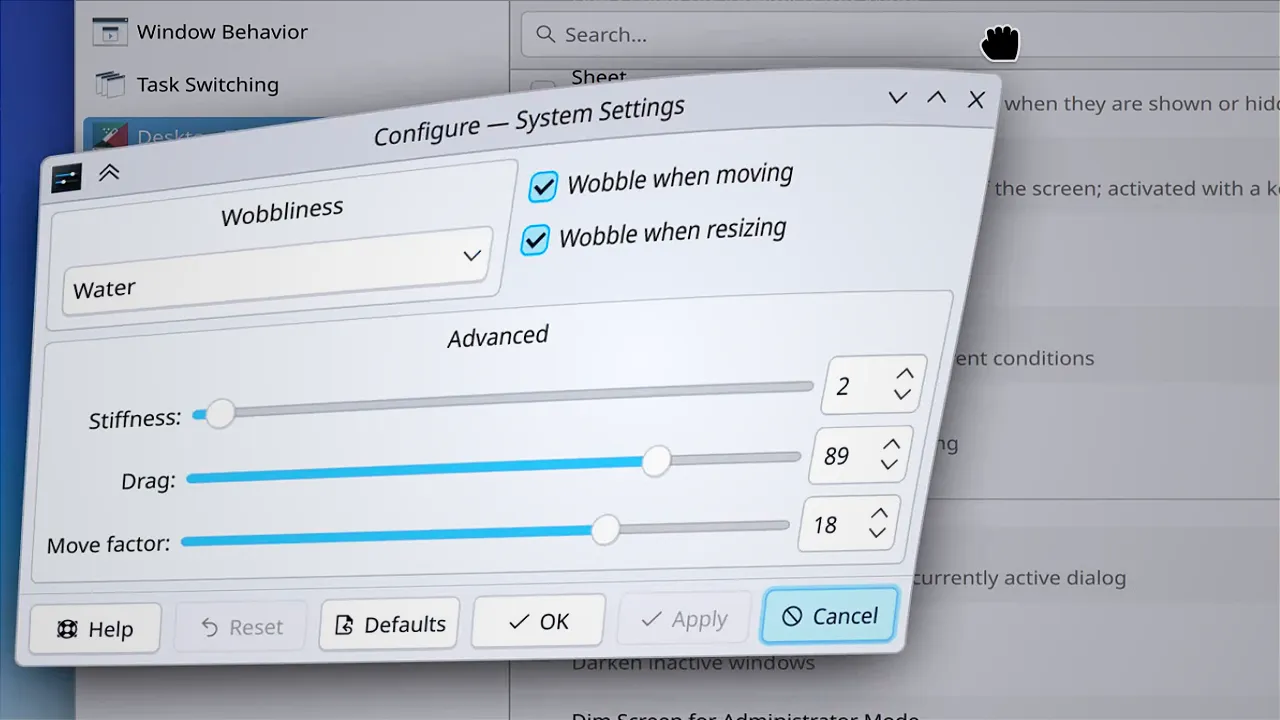
There's even a lighthearted touch. The Wobbly Windows effect finally gets named presets for different levels of wobbliness. Not everything has to be existential.
The surrounding stack
Plasma 6.9 itself builds on KDE Frameworks 6.34 and Qt 6.12, but a couple of related tweaks are landing alongside it. In Kirigami 6.33, text buttons stop showing a hover tool tip that just repeats the button's own label, which Kai Uwe Broulik wryly called "silly." In Qt 6.13, clicking a QtWidgets app's hamburger menu now updates the whole window's colors to their focused state immediately instead of waiting for the menu to close.
The bug-fix list across the current LTS and stable lines (6.6.8, 6.7.7, 6.8.3, and 6.8.4) is the usual mix. Right-to-left language support was corrected for the Task Manager's textual list popup, screencast pointers on fractional scaling got un-jagged, and a screen-locker crash on display disconnect during sleep was patched (no security implication, since the system was never unlocked). KWin was also hardened against crashing when a game like Elden Ring sent invalid HDR data, and a Plasma freeze tied to a vertical panel wider than 144 px got fixed.
For 6.9 specifically, the notable fixes include the Plasma Browser Integration plugin no longer breaking screen sharing in Microsoft Teams, and an Alternate Calendar plugin no longer forcing the Digital Clock's events panel open.
Performance tweaks round it out. Spectacle launches faster after paralyzing its startup path, the "Add Widgets" sidebar opens substantially faster, Task Manager thumbnails no longer regenerate as you move the pointer, and a safer Login Manager now drops you to a terminal if the greeter ever fails instead of strand you at a black screen.
The timeline
Per KDE's official Community schedule, 6.9 follows the standard cadence. Beta 1 branches on 19 January 2027, Beta 2 lands on 2 February, and stable arrives on 18 February. A 6.9.1 bugfix follows on 2 March.
The 6.7.7 release lands just before the 6.9 branch, and it marks the formal end of support for the X11 window manager. That sequencing isn't accidental. "XWayland on demand" is part of a deliberate multi-year sunset of X11 rather than an isolated optimization, and watching the dates line up like this makes that clear.
Keep in mind that this is still development software until February. If you're the type to run a bleeding-edge desktop on your work machine, you have a few months to decide whether the leaner footprint is worth the risk. For most people, 6.9 is worth a look when it stabilizes.


