Ubuntu Linux 27.04 "Tenacious T-Rex" daily builds went live today, kicking off the public testing phase for Ubuntu's 46th release. Right now those images are just Ubuntu 26.10 "Stonking Stingray" with a fresh name, running Linux kernel 7.3 and GNOME 51. Headline features on the horizon include a Rust-based ntpd-rs default time-sync client and the revived, all-Snap Ubuntu Core Desktop. The stable version is set for April 22, 2027, offering roughly nine months of support before handing off innovations to Ubuntu 28.04 LTS.
Ubuntu Linux 27.04 "Tenacious T-Rex" Daily Builds Are Now Live
Canonical published the first test images today, November 14, 2026. Here's what they run and when the stable version arrives.
Canonical just pushed the first test images for Ubuntu 27.04. The daily-build ISOs are live today, giving early adopters and developers something to break before the stable version ships on April 22, 2027.
For those keeping score, this is Ubuntu's 46th release and it lands as an interim (non-LTS) drop. That means roughly nine months of support, running until around January 2028. It targets people who want the newest kernel and desktop, not a five-year LTS commitment. Last year's Resolute Raccoon (Ubuntu 26.04) is the LTS of choice for anyone who'd rather not migrate before the next release.
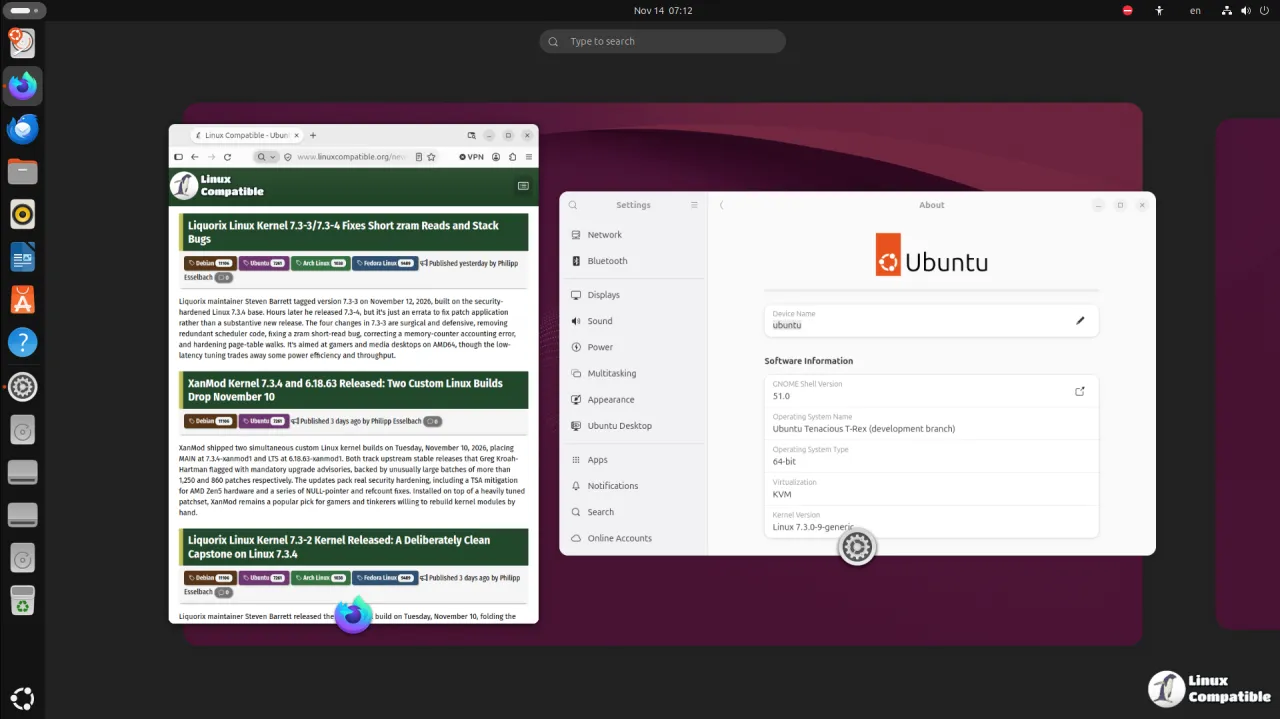
Right now the daily builds are essentially Ubuntu 26.10 "Stonking Stingray" wearing a new coat of paint. The images boot Linux kernel 7.3 and GNOME 51, the same stack that came with last month's release. Canonical's daily-dangerous folder shows a modification timestamp of today, which at least confirms builds are still being pushed out on schedule.
Keep in mind that "daily" is doing a lot of heavy lifting here. You're downloading something that gets rebuilt every single day. Over the next six months you can expect newer kernels, the Mesa 26.3 graphics stack, GNOME 52, GCC 16.2, Python 3.15, and GNU Binutils 2.47 to trickle in piece by piece. By freeze time Canonical wants to ship the latest upstream kernel that cleared its merge window, which points to Linux 7.6.
Don't install one of these as your only OS. Pop it into a virtual machine or on hardware you can wipe without a second thought. That's the standard warning, and it's a good one.
Codename: Ubuntu's First Prehistoric Mascot
Ubuntu's codenames have climbed the alphabet steadily since "Noble" in 24.04. Noble Numbat, Jammy Jellyfish, Plucky Puffin, Stonking Stingray. Each has ticked forward exactly one letter, so the alphabet basically handed Canonical the letter T and left the rest to a guessing game.
Fans floated Tiger, Tortoise, and Tapir during the "Guess the release" campaign on Ubuntu's Discourse forum, which ran under the theme letter T. Then Mark Shuttleworth dropped the official announcement. It read exactly as you'd hope for a Tyrannosaurus: "Hear that roar? ... Make way for Tenacious T-Rex!" Jon Seager, Canonical's VP of Engineering and lead release manager, backed it up.
This is a genuine break with tradition, since Ubuntu has spent its roughly 23 years favoring living creatures, usually endangered ones picked to raise awareness. Mythological beats show up occasionally, as with 9.04's Jaunty Jackalope, but a truly extinct, prehistoric mascot is a first. A proper apex predator for an operating system. And the community will absolutely lean into jokes about dinosaurs going extinct.
The Stuff That Actually Ships
Canonical hasn't published a formal feature list yet, so most of this rests on engineering updates and the release schedule. Two threads stand out.
First, the Rust transition keeps gaining steam. The headline is ntpd-rs, Canonical's memory-safe rewrite of the time-synchronization client and server. It's slated to eventually replace chrony, linuxptp, and gpsd. Seager announced it in March 2026, and Canonical says it's already proven at scale by Let's Encrypt. If it ships as the default for 27.04, Ubuntu would be the first major distro to do so.
The second is bigger still: Canonical is reviving Ubuntu Core Desktop. This is an immutable, read-only OS where everything runs as a Snap. A dedicated team formed after a 2023 preview "fell short" of the vision, and the 27.04 cycle aims at browser-centric machines, developer workstations, and gaming machines. Canonical says daily images of Core Desktop should land sometime during this cycle.
Seager framed it as a long-term bet rather than a quick win: "Ubuntu Desktop in its present form is not going away... My long-term mission is to make Ubuntu Core the de facto target for Linux applications and workflows, and the default Ubuntu experience on the desktop." The old problem remains, though: apps in Snap form are still not everywhere.
The smaller changes are sensible enough. dbus-broker is replacing the decades-old dbus-daemon message bus, and authd plus Microsoft Entra ID brings enterprise logins with password and multi-factor authentication baked in. The installer's TPM-backed full-disk encryption keeps maturing. You'll also get a format-agnostic App Center that unifies deb, snap, and flatpak, plus "Myna" (Talk-to-type), a local speech-to-text dictation tool shipped as a removable snap so you can opt out.
Why the Interim Cycle Matters
Here's the thing: interim releases are where Canonical stress-tests the innovations that eventually flow into a supported LTS. The Rust transitions, Ubuntu Core Desktop, the local-AI desktop features, and enterprise identity. Most of it is expected to mature and land in Ubuntu 28.04 LTS down the line. Breaking your way through these daily builds is the public's chance to poke at Ubuntu's near future before it goes live.
Want to try it yourself? Head here for the GNOME image, or browse here for the flavors: Kubuntu, Xubuntu, Lubuntu, Ubuntu MATE, and others. Download the ISO, verify the checksum, and boot from a USB to try before committing to an install. Find something broken? Report it through Ubuntu's testing process and watch the Release Team for milestone updates.
The milestones worth tracking: Feature Freeze hits February 25, 2027, with the first mandatory Beta on April 1. The stable release is set for April 22.


