Shelly ALPM 3.1.4 ships with AUR cache cleanup and stronger native builds
A slice of builds. That's the codename Seafoam-Labs chose for Shelly ALPM v3.1.4, a deliberate wink at the 3.14 in the version number. The release went up on September 13th, a scant six days after v3.1.3 and a full 81 commits ahead of it. For a project with roughly 1,100 stars, that's a hard-working cadence.
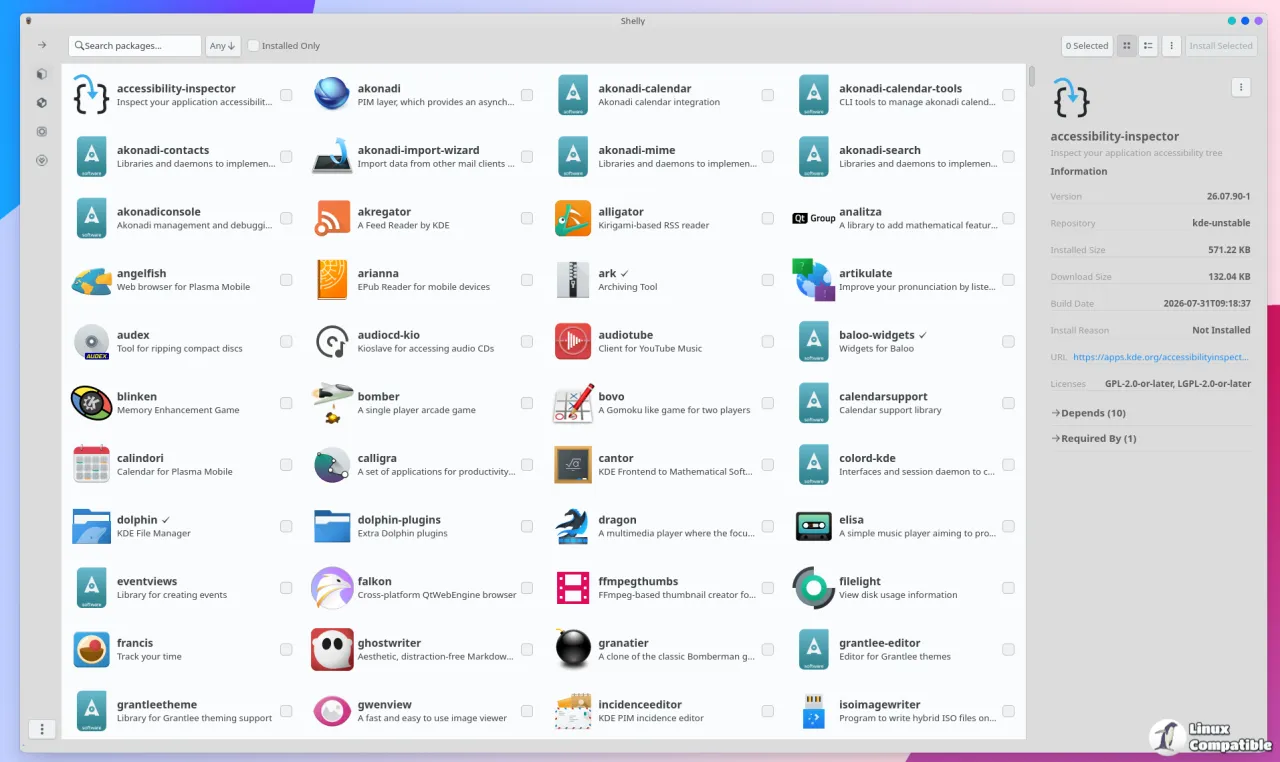
Shelly bills itself as "a pacman alternative for ArchLinux, designed with you in mind." It's a GUI-first package manager that talks directly to Arch's libalpm, the very library pacman runs on, instead of bolting a pretty skin over the command-line tool. The desktop front end is Vala over GTK4 for native Wayland support, and the engine underneath is written in Zig.
What actually changed
The headline grab is a way to claw back disk space. A new --aur-cache flag on shelly purify standard lets you preview, then delete, cached built AUR package archives and their matching signatures out of $XDG_CACHE_HOME/Shelly. Keep in mind it leaves your source files, checkout history, and build directories untouched. Only the .tar.zst artifacts and signatures get removed, so your next build still has to recompile from scratch.
The native builder got another pass over real-world PKGBUILDs. That covers trouble with SOURCE_DATE_EPOCH timestamps, install declarations, shell parsing, and sources that happen to share a filename. There's also a fix for Anydesk, Mandolin, Remora, and Pi, where binary-stripping was failing on binaries incompatible with the host. Builds now warn and keep the original file instead of breaking.
Isolated build environments now provision through Shellystrap, the project's own libalpm-based helper. That drops a dependency on Arch's pacstrap and keeps everything inside private namespaces. PGP source-signing keys can be passed from the invoking user's keyring, which is a small but welcome change if you've ever been stuck on a signing prompt.
Not bad for a 1,100-star project
The GTK side got the usual trim: package columns now use ellipses instead of overflowing text, and the detail pane is finally selectable and copyable. PGP key-import confirmations don't crash the interface anymore. The main build had 143 downloads at the time of capture, which is a modest but not insignificant number for a niche tool aimed squarely at Arch users.
The project is run largely by Caroline Snyder (@caroberrie) and Zoey Bauer (@ZoeyErinBauer), with a rotating cast of contributors this time around. This release welcomed three new faces to the credits: @square-235, @StKob, and @jamalkamaladdin. It's all GPL-3.0.
The recommended install path happens to be through CachyOS packages with sudo pacman -S shelly, which is worth pausing on. Shelly is effectively riding along inside an existing Arch distro's ecosystem rather than standing entirely on its own feet, and it's also been tagged for Garuda Linux. You can still grab it through yay or paru from the AUR, or build from source if you've got zig 0.16.0, vala, and libalpm laid out and ready.
The GUI-first package-manager scene is crowded with lookalikes, and far too many are thin wrappers around pacman that add latency without adding anything back. Shelly's real edge is that libalpm connection, which keeps accuracy and speed close to what you'd get at the terminal. However, at the same time, you're still trading terminal flexibility for point-and-click convenience, and a fair chunk of advanced package management simply has no visual counterpart yet.
The roadmap matters if you're seriously considering the switch. Repository modification is in progress, offline updates are planned in a pacman-offline style, and layout customization is on the list.
Head here to the release page to grab the binaries,.


