LibreOffice 26.8.1 ships with 40 fixes built around opening Microsoft files
The Document Foundation's first minor release of the 26.8 cycle trims bugs and steadies text import, without adding a single new feature.
LibreOffice 26.8.1 is out now. It went live on 2 October 2026 and does exactly what a maintenance release is supposed to do. It fixes things. It doesn't add them. The Document Foundation counted roughly 40 fixes in the build. A large share chase one longstanding annoyance: Microsoft documents falling apart when opened here. That's the whole point of this drop.
If you open a steady stream of DOCX, XLSX or PPTX files, grab this one. If what you actually want is the newest feature set, you've already got it, that arrived back on 26 August in LibreOffice 26.8.
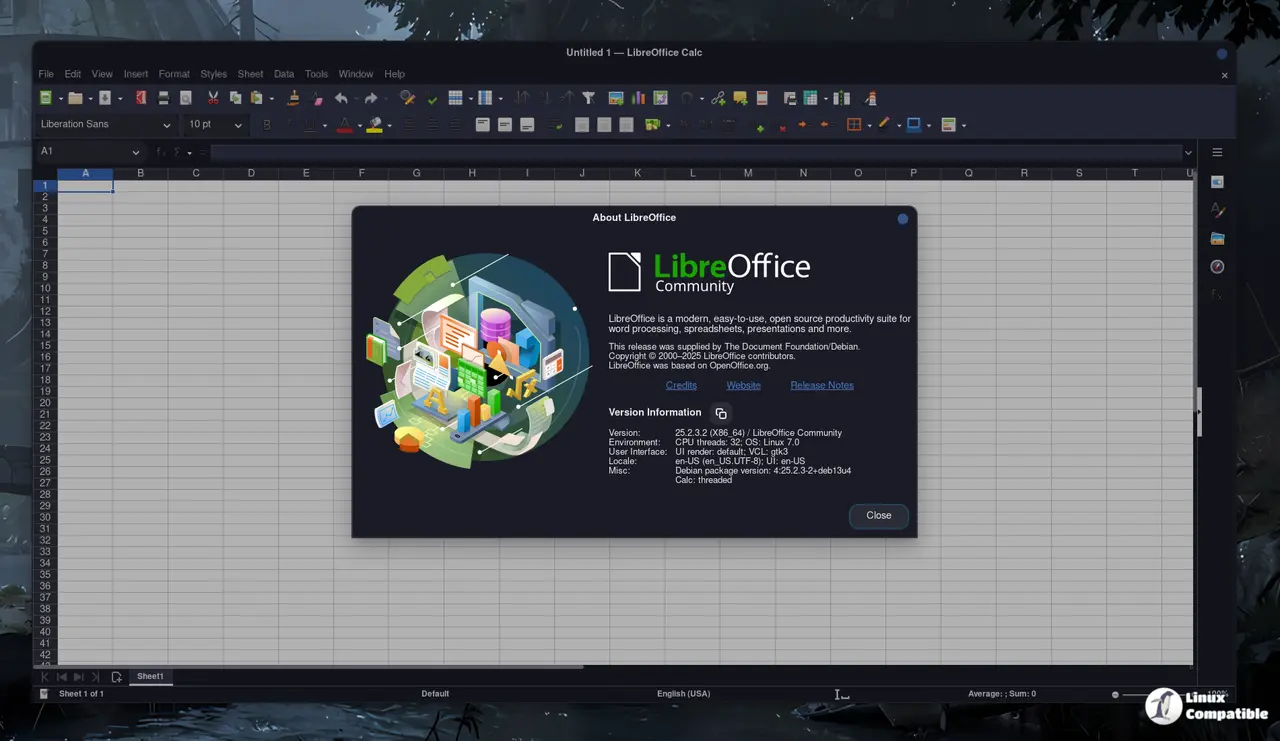
What actually changed
The 26.8.1 maintenance line is the first of its family. It follows the 26.8 major release, shaped by 206 contributors, 155 of them volunteers. That bigger launch brought a Paragraph Composer for more balanced justified text, stronger support for right-to-left and complex scripts like Arabic and Hebrew, native variable OpenType fonts, and, deliberately, no generative AI. In a year where every other office product is shoehorning a chatbot in somewhere, that absence reads almost like a statement of intent.
This minor drop skips all of that. It's about repair. The fixes split fairly evenly across two jobs: reading Office files and pulling in text.
Take the Office formats, where most of the work landed. Nobody escapes DOCX, XLSX and PPTX. Clients and colleagues keep sending them regardless of what you think about open standards, so LibreOffice keeps trying to reproduce them faithfully.
In DOCX, hyperlinks inside tables of contents now actually work, so you can jump between sections like you would in Word. Text alignment and line spacing are also reproduced more closely, trimming the visual drift that used to show up on open.
In XLSX, drawing objects and database ranges are handled better now, preserving layout and structure that previously got misplaced. In PPTX the fix that matters most is a crash where Impress would shut down entirely on certain files. Impress simply closed. No warning. A real one.
Then there's text and CSV import. LibreOffice 26.8 leaned hard on writing systems, and that thread carries forward through more dependable import across a range of encodings. UTF-16, ISO Latin 1, Chinese and Japanese are the ones named specifically. That's a meaningful boost for anyone juggling multilingual data or files exported from foreign-language apps.
Why the compatibility push matters
This isn't just a smorgasbord of small fixes. It ties into a larger argument The Document Foundation has been making all year.
Back in September, TDF laid out that 26.8 learned to recognize several chart types Microsoft stores in OOXML: box-and-whisker, funnel, Pareto, sunburst, treemap and waterfall. LibreOffice can't render them or edit them. It does recognize them, tells you they're unsupported, keeps the underlying definition untouched, and re-exports the whole thing when you save. Hand the file back to Word and it comes back intact.
TDF frames this as more than a chart trick. Preserving what can't yet be read protects users from leaning on a format whose spec a single vendor controls on a schedule nobody can see. ODF, the open standard LibreOffice uses natively, can be implemented by anyone. It's the digital sovereignty pitch, made concrete in code.
Should you upgrade?
The guidance splits neatly.
If you're already on 26.8, install 26.8.1. It only repairs, so there's little to lose. If your organization sits on the older 26.2 maintenance branch, you have some runway. Support for 26.2 runs until 30 November 2026, after which bug fixes and security updates stop. TDF suggests starting to plan the move to the 26.8 family over the next couple of months.
For larger shops, ecosystem companies offer enterprise editions. These come with SLAs, professional support and custom-development options, plus security updates held for three to five years. That's a considerably longer horizon than the community release cycle can provide.
Head here to the downloads page. The page lists builds for Linux (rpm and deb), Windows (x86-64 and ARM64), and macOS (Apple Silicon and Intel).
It stays free under the Mozilla Public License v2. No ads. No telemetry. No account. No fee, and no feature held behind a paywall.


