Fedora's community-built RISC-V Beta images for version 45 are ready to test
Fedora's RISC-V community has put non-official Server, Cloud, and Container Beta images for Fedora 45 up for testing. Here's what they do and whether you should care.
The Fedora RISC-V community has shipped fresh Beta images for Fedora Linux 45. They carry a loud "non-official" sticker, but they represent one of the more coherent attempts yet to get a mainstream Linux running on RISC-V silicon.
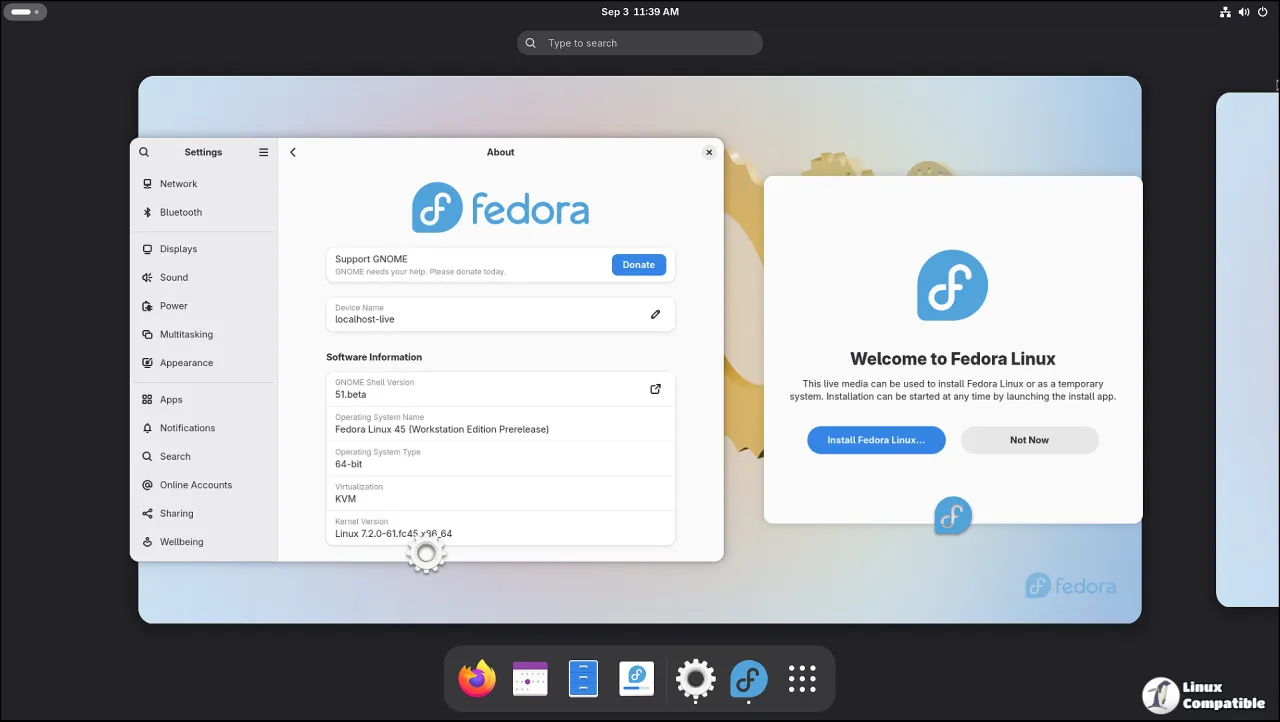
Announced today by contributor Kashyap Chamarthy, the release puts Server, Cloud, and Container artifacts up for grabs. These aren't Fedora's official build. They're community-contributed, best-effort, and aimed at testing rather than production servers.
Keep in mind that Fedora 45 itself hit Beta on September 15, for its main architectures like x86_64 and aarch64. The RISC-V track runs on a slower, community-driven cadence, and these images follow that schedule.
Two kernels, one problem
The Server category holds the interesting stuff, and it ships two distinct kernel flavors. That split says everything about the current state of RISC-V in Linux.
There's no single standard RISC-V board out there. A one-size-fits-all kernel is basically a pipe dream. Fedora's compromise is a choice between the reliable and the broad.
Fedora-Server-Host-Generic runs the standard Fedora 7.2 kernel, version 7.2.7-300.0.riscv64.fc45. The community describes it as sitting "very close to upstream," which means fewer board-specific patches and more stability. It reportedly boots on the StarFive VisionFive 2, the Orange Pi RV, and the Milk-V Mars, plus "probably other boards."
Fedora-Server-Host-Omni takes the opposite tack. Built on Fedora's Omni kernel (7.2.7-300.0.riscv64.omni.fc45), it covers a wider range of hardware at the cost of patches "still under review upstream." You want maximum board coverage and can live with less-tested code, then Omni is your move.
The Omni kernel actually landed with Fedora 44, and it's showing up here because the port has matured. Raising RISC-V drivers into mainline Linux is slow work. Vendors often build on a recent LTS release, then spend months or years rebasing before their code is even worth reviewing. The merge bar is high and frequently forces rewrites.
Instead of keeping a pile of vendor-specific kernels around, the Fedora RISC-V SIG settled on a single unified tree. It takes the standard Fedora kernel and selectively adds patches from various vendors, yielding one kernel package and one image that boots across a huge variety of machines. They prefer patches already posted upstream, ideally ones iterated a few times. Since the goal is mainly to get new hardware talking to Koji builders, anything that doesn't serve it, like an integrated GPU driver, tends to get skipped.
Why it's non-official (and still worth trying)
Fedora treats RISC-V as an experimental, community-supported port. The project's own hardware page puts it plainly: riscv64 is currently not an officially supported Fedora architecture.
That label isn't just paperwork. A lot of these images exist to bring up Koji builders, getting RISC-V hardware to compile packages. Storage access and wired networking win over video output. If you want a full desktop on a specific board, a vendor image may still serve you better.
For what it's worth, the port has kept a fairly steady rhythm. Fedora 41 arrived January 2025, 42 in April, an updated 42 in September, 43 in March 2026, 44 in June, and an updated 44 in July. Fedora 45 Beta is the latest step.
Testing is still rough around the edges, though. A June 2026 report showed an Omni image failing to boot on an Orange Pi RV2, an 8-core RV64 board. Board names don't always map cleanly, so verify before you flash.
The supported lineup runs by SoC, and board-kernel pairing matters. StarFive JH7110 boards like the VisionFive 2 use the mainline kernel. Everything higher-end leans on Omni: the SiFive P550, SpacemiT M1 and K1, the K3, the UltraRISC UR-DP1000, and the SOPHGO SG2042. QEMU emulation runs mainline too, and that's actually the recommended place to start.
The community strongly recommends testing on QEMU before you touch real hardware. Emulation is slow, but a failed boot costs you nothing. The rough recipe is simple: grab a Cloud image (anything ending in .qcow2), install QEMU and libvirt, add your user to the libvirt group, then generate cloud-init metadata to set up the default "fedora" account. Spin up a VM with virt-install, pointed at riscv64 with a maximum CPU mode, UEFI via edk2-riscv64, and at least 4 vCPUs and 4 GB RAM.
The full quickstart lives on the Fedora wiki under Architectures/RISC-V/QEMU. These images ride alongside Fedora Linux 45 Beta, which Aoife Moloney announced September 15. The wider release brings changes you'll spot well beyond RISC-V too.
kmscon replaces the legacy in-kernel console, package signatures are now mandatory before installation, and secret management is standardized through oo7. The toolchains get fresh, with early access to Python 3.15, Go 1.27, GCC 16.2, glibc 2.44, and Podman 6. Fedora CoreOS gains systemd-oomd and zram swap. The RISC-V Beta shares that content but follows its own schedule.
Want to run this in production? Probably not. These are best-effort test images meant for finding bugs, not shipping services. But if you've got a VisionFive 2 gathering dust on the shelf, this might be the nudge you need to boot something new.
Head here to download the images. The announcement thread and the RISC-V hardware and QEMU wiki pages have the rest.


