Strata 0.2.13 shipped today, delivering what may be the most practical update yet to the solo-developer engine that runs Qwen's 125-billion-parameter model on ordinary consumer PCs. The headline fix slashes Strix Halo launch times from nearly ten minutes down to 60 to 85 seconds, while also restoring Intel Arc determinism, cutting app startup latency, and reviving broken Linux expert-store loading. The MIT-licensed project, built by Slovenia's Niko Veit, has climbed past 42,000 GitHub stars. It runs fully offline with no account or cloud upload, and installers for Linux, Windows, and Mac are on the GitHub releases page.
Strata 0.2.13 ships major Strix Halo launch fix and Qwen4 groundwork
The solo-developer engine that runs Qwen's 125-billion-parameter model on a gaming PC just got its most practical update yet.
Strata 0.2.13 shipped today, and it carries fixes that actually matter to people running this on real hardware. The headline change is dramatic: Strix Halo machines that previously took up to 594 seconds to launch now start in 60 to 85 seconds. That's roughly a 10× jump, and it sits alongside a fix for flaky Intel Arc behavior plus a noticeable cut to app startup time.
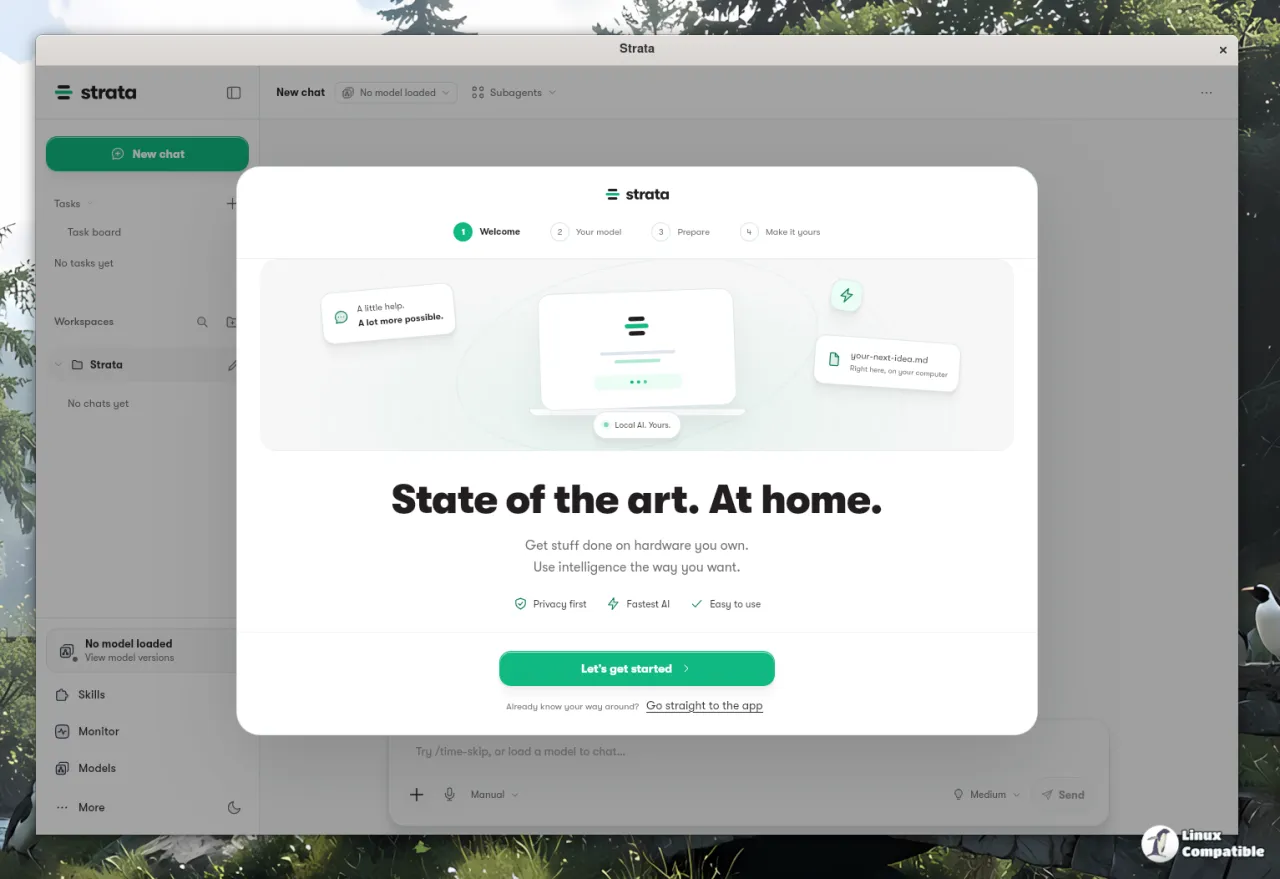
To understand why this matters, a little background helps. Strata is essentially a one-person project by Niko Veit, a Slovenian entrepreneur who publishes online as Niko1221 (@coldniko). The whole thing grew out of his own frustration. He tried running the 125-billion-parameter Qwen3.8-Flash-Next model on a 12 GB RTX 5070, got a sluggish 15 tokens per second, and decided to build a new engine from scratch. It's written in C++ to squeeze every last drop out of the hardware, and it's MIT-licensed.
The project's been climbing fast. Created on 24 September 2026, it hit around 24,000 GitHub stars in its first three weeks and has since passed 42,000 stars and 4,600 forks. That ranks it among the most-starred open-source AI projects of late 2026.
Here's the core idea behind it. Strata runs the full 125B model across your whole PC instead of cramming everything into a single chip. Qwen3.8-Flash-Next has 125 billion parameters but only about 6 billion are active per token, which makes it a Mixture-of-Experts design. The catch is that even the "cheap" parts stay far too big for one card's memory. So Strata spreads the load across your GPU, your system RAM, and even your SSD, using a kitchen analogy where frequent ingredients stay on the counter (VRAM) and the rest waits in the pantry (RAM) or the cupboard (SSD).
Keep in mind that VRAM size matters more than raw GPU speed here. Each extra GB of video memory holds roughly 700 more cached experts, and every expert already sitting on your GPU is one your CPU doesn't have to grind through. It's the opposite of your usual hardware intuition.
The engine also uses speculative decoding via a small helper layer called MTP, which guesses upcoming tokens before the full model checks them all in one pass. That buys you maybe 1.6 to 3.2 tokens per GPU pass, or roughly a 1.6 to 1.8× speed boost, without changing output quality since the big model decides every word.
What's new in 0.2.13
The most noticeable fix is the Strix Halo launch hang. Before this update, launching the Terminal with the UD-Q4_K_XL pack and images off could stall hard. In one test on the same PC, one instance hadn't been ready after 308 seconds and another took 594.8 seconds. The new version starts in 60 to 85 seconds instead. The trick: the engine stops applying its 2,560 MiB "Windows floor" on integrated graphics and writes a 700 MB reserve up front. That same change bumps usable expert-cache slots from 17,556 to 22,991.
Intel Arc users get determinism back. Previously you'd get different answers to the same prompt on back-to-back runs, sometimes 3 to 5 different outputs in just five tries. Now 50 of 50 runs came back identical on an Arc A750. Strata uses its own fixed-order kernel for certain bf16 matrix operations that oneMKL was apparently computing with a slightly different result each launch. You can still revert it with STRATA_SYCL_BF16_DET=0 if you insist.
The app itself is lighter. The main executable shrank from 3.12 MB down to 0.76 MB, and the start screen now renders in about 143 milliseconds versus 248 before. Small numbers, but startup latency adds up when you're launching this a dozen times a day.
There's also a fix for the Linux expert-store loading that an earlier change broke. Community member pjgmobile patched it in PR #5531, reportedly lifting a 1M-context workload from 47 tokens per second to 124.
On the speed side, the new DFlash2 drafting layer now uses card-specific defaults. It's a modest bump: 49.1 tokens per second on Strix Halo (up 5.2%) and 263 to 265 tok/s on the RTX PRO 5000's IQ3_S pack (up 2.8%). Not world-changing, but real.
The release also lays infrastructure for Qwen4 models ahead of time. The signed update feed can now carry an actual model list, and a model of a new shape gets its own engine download, with Control checking the reported geometry against the signed manifest at install time. That's purely groundwork though. 0.2.13's feed contains neither a model list nor a shape-specific engine yet. The model itself is an early preview of Qwen4's architecture.
Strata is unusually upfront about its own flaws, and 0.2.13 lists a fair number. A fresh install's first "Preparing your model" step can take around 5.5 minutes on an RTX 5070, for a cause nobody's pinned down yet. Setting up a model in the desktop app on an Intel Arc card still fails with "no NVIDIA GPU found," so Arc users must go through the Terminal for now. There's also a Linux AppImage restart quirk, peer mode that faults on first request about 4% of the time, and Radeon gfx1201 cards where hand-picked drafting can stall. Mac files passed Apple's notarization and self-test but weren't actually run with a model.
Running on aging hardware
The community benchmarks paint a picture of an engine genuinely flexible about hardware. An RTX 5090 pushes roughly 179 tokens per second decoding at 4K context, dropping only to about 165 at 128K. A pair of eight-year-old GTX 1070s still manages around 50 tok/s with 128K context. An older MI50 gets about 36 tok/s at 4K, barely dipping to 33.5 at 128K. The headline claim behind the nearby v0.2.10 release was that an 8 GB GPU could run Flash-Next at 20-plus tokens per second, which reflects a big parallelism overhaul.
For how few active parameters it uses, the model is reasonably competitive. Qwen3.8-Flash-Next-Base reportedly tops 8 of 14 benchmarks against bigger models like Qwen3.7-Plus.
The Linux (AppImage), Windows, and Mac (dmg) installers are all on the GitHub releases page. There's also a curl installer script and a Windows PowerShell one-liner. After you run strata launch, use strata connect for instructions on pointing tools like Claude Code, Codex CLI, or OpenCode at the local OpenAI- and Anthropic-compatible API. Strata ships 42 files totaling about 9.7 GiB, supports NVIDIA GeForce RTX 20 through 50, AMD Radeon RX 7000/9000, Intel Arc on Linux, Apple Silicon, AMD Ryzen AI Max / Strix Halo, and the NVIDIA DGX Spark.
Head here to the GitHub releases page for the latest files.


