MangoHud, the open-source performance overlay for Linux gaming, released its first public rewrite on November 25th under the name MangoHud-next. The new build adds a server/client architecture that moves code out of the game process, with YAML configs, live reloads, multiple HUD windows, and first-class Gamescope support. The original MangoHud stays completely unchanged and keeps the same command, env vars, and config file. It's a release candidate with missing features like performance logging and battery metrics, so it's meant for testers rather than daily drivers.
MangoHud 0.8.5-rc1 ships with the rewrite the community has wanted for seven years
MangoHud just grew up. The de facto performance overlay for Linux gaming got its first full architecture overhaul on November 25th, and the developer is finally naming it: MangoHud-next.
The project, which began as a modified fork of Mesa's Vulkan overlay in February 2020, has grown to nearly 9,300 GitHub stars and hundreds of contributors in that span. It's the HUD sitting on top of countless Steam sessions and the metrics engine under Valve's SteamOS.
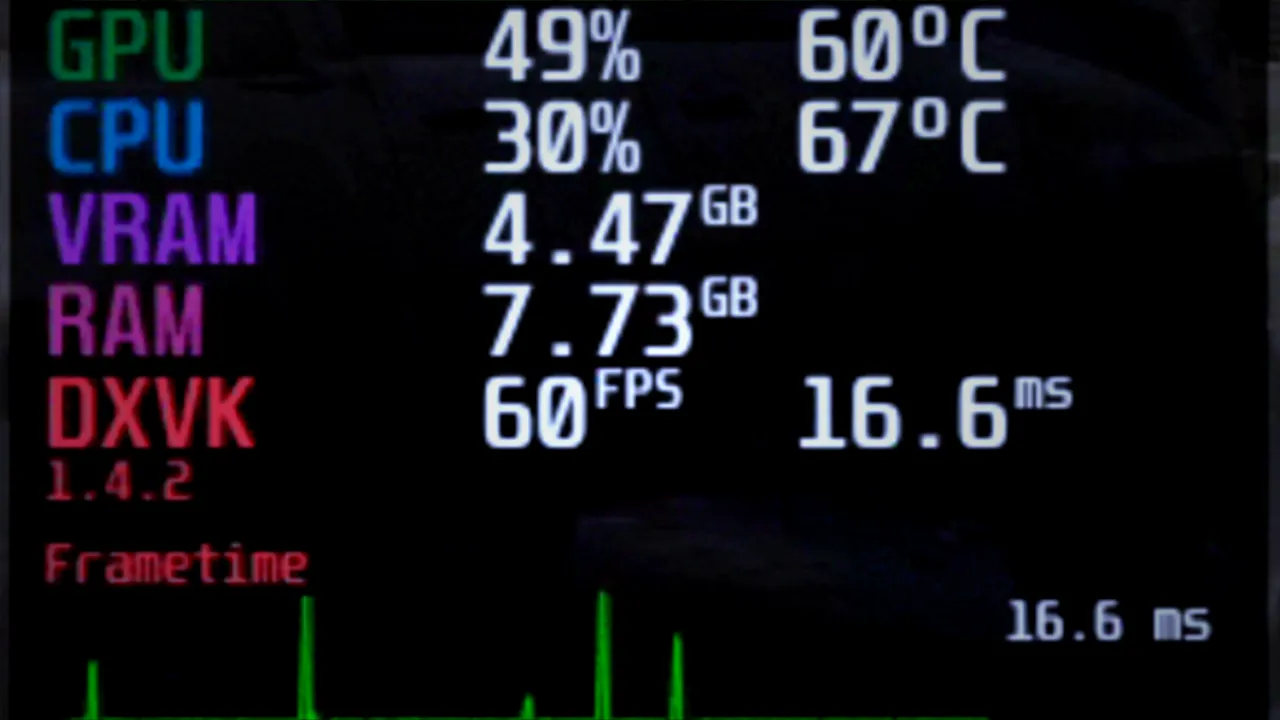
Two codebases, one project
There's the good news and the even better news. The original MangoHud, the part you've been using, isn't going anywhere. It keeps its mangohud command, its MANGOHUD=1 invocation, and its old config file. Nothing changes.
The new MangoHud-next takes a different shape entirely. Rather than injecting most of its code into your game, it runs a separate HUD server that gathers metrics once and pushes them to lightweight client overlays. It's essentially what mangoapp became inside SteamOS, just repackaged for everyone.
"With this release, I'm introducing MangoHud-next, a server/client rewrite of MangoHud that I've been working on for some time," flightlessmango wrote. "The rewrite is an opportunity to rethink much of MangoHud's architecture, address some of the limitations of the existing implementation, and provide a better foundation for future development."
The notes carry a refreshing amount of honesty. flightlessmango credits contributor @17314642 for designing the metrics architecture, and admits the whole exercise was partly a mid-career reckoning. "It's been almost seven years since I started working on MangoHud, and maybe part of me just wanted to fix a lot of what old Mango had foolishly done and prove to myself that I've grown as a developer."
What next can actually do
The most useful parts are the ones that change how you touch the overlay. Config now lives in YAML at ~/.config/MangoHud/MangoHud.yml, and edits reload live with no restart required. You can lay metrics out as a table with configurable rows, columns, and cell sizes, run multiple HUD windows at once, and even pull in shell-command output or graphs.
It also adds first-class Gamescope support, so you can run mangohud-next gamescope ... directly instead of piping through mangoapp. There's D-Bus integration for hiding and showing the HUD on demand, systemd wiring, and idle shutdown.
The metrics side is thorough: per-core CPU load and frequency, per-process GPU load, VRAM, and GTT, separate frametime tracking for the app, the display refresh, and the HUD itself, plus RAPL uncore power and HDR status.
Runtime control comes straight through the launcher:
- mangohud-next get_system pulls server-side metrics as JSON, including GPU polling state
- mangohud-next get_clients returns connected overlays and their process IDs
- mangohud-next hide_hud, show_hud, and toggle_hud toggle visibility
You can also start the server and clients independently with a standalone mangohud-server binary.
What's still missing
It's a release candidate, so it isn't a drop-in replacement yet. flightlessmango published a parity tracking issue, MangoHud-next: feature parity and known issues #2227, listing exactly what's left to do. And for what it's worth, some of the gaps bite. No custom fonts, no per-app configs, no battery readouts, no performance logging to a file. Benchmarkers who record stats over time will feel that last one hard.
There's also a known NVIDIA snag: GLX dma-buf imports may not resolve, with the recommended workaround being layer-shell output. Not a dealbreaker, but a hassle for NVIDIA users who'd rather not switch output methods.
Watch out for over-reading the changelog. It covers classic, next, and shared components all in one dump, so Steam Frame monitoring or per-core CPU metrics appearing in the list doesn't mean next already does all of it. News outlets like POPTOPIC have flagged that misread.
How to try it
If you're curious, mangohud-next %command% works as a Steam launch option, mangohud-next <application> covers the command line and mixed Vulkan/OpenGL, and mangohud-next gamescope ... handles Gamescope. The config lives at ~/.config/MangoHud/MangoHud.yml. Keep in mind this is a pre-release meant for testing, so rough edges are expected.
Still on classic? Nothing changes. MANGOHUD=1 %command% and the plain mangohud command work exactly as they did yesterday.
Why it matters
For most players, today's release is basically a non-event. Classic stays put. next stays optional. The signal here is about the next seven years, not the next update.
flightlessmango said new features and hardware support will "primarily target next," which effectively makes the rewrite the project's future home. That's a lot of weight to hand to a first release candidate.
The full release is expected as testing continues. Head here to the official release notes on GitHub.


