Strata 0.2.22 ships with a fix for the bug most people actually hit: the update pause
The release also repairs silent multi-GPU output errors, tightens the local server, and keeps agents alive during long tool calls.
Strata v0.2.22 went live on 25 November 2026, and while the notes read like a developer's diary, most of the changes target bugs that bite real users. Here's what actually shipped in this release.
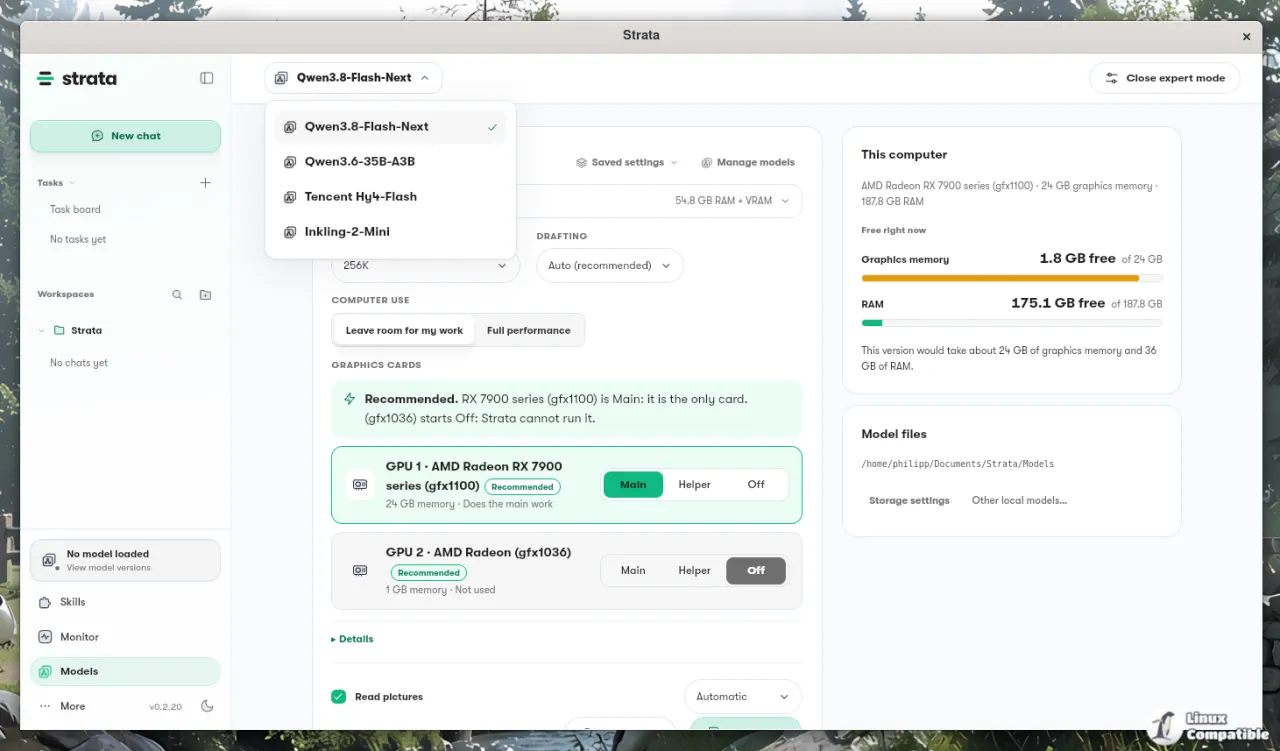
The version split
The app and terminal both sit at 0.2.22. The engine and CUDA build moved to 0.1.69, while Hy4 and the non-CUDA Inkling engines stayed put at 0.1.67. Components just version independently, and the numbers shifted because something inside them changed. The full download is 39 files totaling about 9.3GB, spanning Windows, Linux (x86-64 and ARM64), and macOS (ARM64).
The change most people will feel is almost disappointingly simple. Strata no longer leaves your chat paused after an update (issue #7099). Before this, a Control-only update could strand your agents in an "Agent work is paused" state, failing every turn until you restarted the whole app. Now they resume the moment an update finishes, fails, or is cancelled. They stay paused only while a brand-new app is being installed. The toolbar shows Resume agents, and Pause for update only appears when there's something real to pause for.
Multi-GPU output was silently wrong
The more serious fix is Inkling 2 Mini on two or more NVIDIA cards now giving correct answers again (#7093). With a model split across two to four GeForce cards without NVLink, and some of it held in RAM, Inkling could silently write garbage with no error and no warning. This was reported on a pair of RTX 3060s. The engine was reading the free memory of the wrong card and placing experts into RAM on a card that couldn't actually compute them. On two 12GB cards, the SQ-20 model now places 1,536 experts per card with none in RAM. Push a load that would still send an expert to RAM, and it stops with an explicit message instead of nonsense.
The local server gets locked down
Privacy hardening came in as well. The app and its built-in server now answer only requests that originate from the app itself (#7130). A malicious or compromised web page in your browser can no longer talk to Strata's local server. Local tools using the OpenAI API under /v1, like Open WebUI, still work fine. If you reach Strata through a custom hostname, add it to STRATA_ALLOWED_HOSTS. SVG and HTML the app hands to your browser now render in a sandbox, so they can't run script as part of the app.
Agents stop losing connections
Codex and other custom tool calls no longer drop the connection (#7132). While a model streamed a long custom tool call through /v1/responses, nothing went out for the whole duration, which let a proxy that kills idle connections — say one at 125 seconds — drop a perfectly healthy request. Strata now sends a keep-alive whenever nothing's transmitted for 10 seconds. The team noted a scripted model had been silent for 18.76 of a 20.3-second call. Not great, but fixed.
A batch of Inkling refinements
Thinking level is now respected, so the reasoning_effort setting and shared Chat settings apply in order, with only a total absence of any setting dropping Inkling down to low (#7035). Tool results now include the tool name, which they didn't before (#7051).
Claude Code's thinking budget gets capped: its default request asks for 31,999 thinking tokens, which made Inkling think far too hard, so a request for exactly 31,999 on /v1/messages is now held to the level's default of 8,192 at high (#7133). Every other number passes through. Defaults by level are 2,048 (low), 4,096 (medium), 8,192 (high), and 16,384 (xhigh).
A request naming no sampling now uses the model card's temperature of 1.0 instead of greedy picking, so temperature 0 stays greedy (#7092). The release is candid that this hasn't been shown to stop the loops it was meant to address. Big pictures get scaled down before reading (#7043), which fixes a case where a 3MP image took 743 seconds on the CPU. And failed engine installs now actually say why instead of pointing at a line above that wasn't there (#7119).
Startup and platform fixes
On a Mac with macOS 15, Qwen starts again (#7082, #3915). The team sets a few Metal prompt environment variables at startup to work around a prompt-speed regression. Read the caveat though: prompts come in about 10x slower, roughly 635 versus 60 tok/s, though generation speed is fine. The workaround wasn't actually run on macOS 15 itself, so the team is asking people to report back.
Flash-Next and Gyro use the model card's sampling again when MTP is on (#7070). Fresh Qwen Q2_0 setups on AVX-512 CPUs with a CUDA, HIP, or SYCL card now start correctly (#7090). The engine-ready timeout is now an idle period that resets on every new log line or disk read, capped at 2 hours, so slow disks don't end a start after 15 minutes (#7060). Conversation memory now scales with your RAM instead of the old 8GiB cap that forced re-reads above about 490,000 tokens (#7044).
Getting it running
The desktop installer is on the releases page for Linux, Windows, and macOS. Head here for the releases page.


