Fedora Linux 45 Candidate RC-1.1 Is Live for Testing
The first release candidate for Fedora Linux 45 is finally available for testing. The build, known as compose Fedora-45-20261017.0, went live today. It's the final dress rehearsal before Fedora 45 hits general availability on Friday, October 30.
Fedora cuts out two major releases a year, normally April and October, so this is the fall edition. The Beta shipped on September 15. You can think of the Candidate as the point where the feature writing stops and the bug hunting starts.
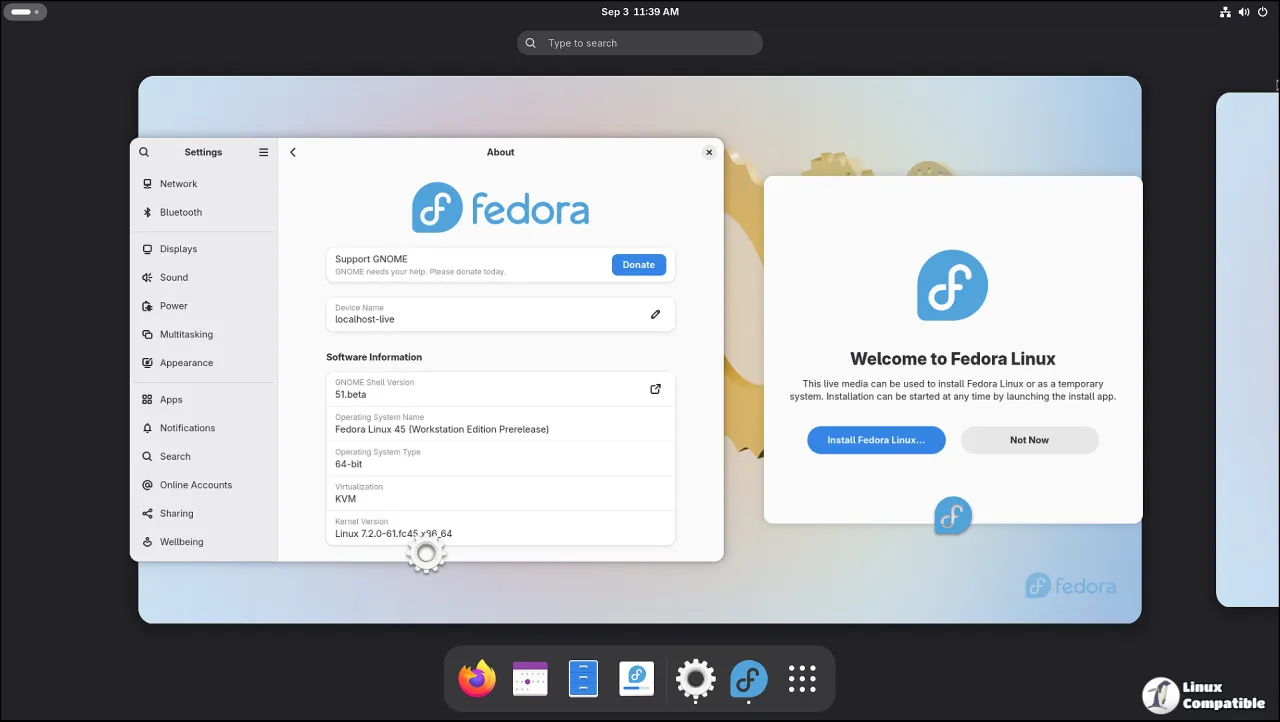
A candidate build is essentially code-complete. The goal now is less about what's new and more about what breaks when you poke it hard. Every RC-priority test case, installation, base, server, cloud, desktop, security, has to pass before Fedora declares the release ready. In short: the community is being asked to find the cracks before opening night.
Under the hood
Fedora 45 leans hard into two themes from recent releases: modernizing the system foundation and hardening the supply chain. The interesting work is mostly in places you don't normally notice. The default console is one of them.
Fedora swaps the old in-kernel fbcon for kmscon, a userspace console. The text screen you reach with Ctrl+Alt+F3 now renders smoother, handles Unicode better, and looks saner on high-resolution displays. Non-Latin scripts are notably improved.
Storage gets the same treatment. Stratis volumes are now selectable straight from the installer, with automated installs through Kickstart and manual partitioning via the new Anaconda WebUI. That web installer runs on Cockpit Storage and is live for Atomic Desktop images, where the legacy GTK installer gets replaced wholesale.
Then comes the credential change, and this one is interesting. Fedora desktop variants now default to oo7 as its Secrets Service, dropping the older GNOME Keyring and KWallet backends. It's the kind of change that should be invisible once it works. It isn't fully invisible yet, as the blocker tracker will tell you.
Security and versions
The rest reads like a supply-chain checklist, done well. Unprivileged ptrace is now restricted system-wide via a kernel sysctl, meant to stop malware from inspecting or injecting into running processes. Install debugging tools and the restrictions lift. RPM enforces signature checking out of the box now, following upstream 6.x defaults, so unsigned packages get refused unless you override it. DNF5 blocks automatic vendor changes, which stops accidental package swapping between conflicting third-party repos.
Fedora 45 also ships a fresh pile of major versions. If you follow the toolchain, the highlights are Linux kernel 7.2, GCC 16.2, glibc 2.44, Python 3.15, Go 1.27, and LLVM 23. Containers get Podman 6, databases jump to MariaDB 12.3 and MySQL 9.7, and Pandas reaches 3. That's the aggressively current software Fedora has always been known for.
On the hardening side, DNF5 gains standardized PURL metadata, builds are formally targeted at 99% reproducibility, and packages migrate from GnuPG toward Sequoia's OpenPGP implementation, quietly opening the door to post-quantum crypto support. Not everything lands at once, and that's fine.
Testing the waters
Validation here is a mix of the coconut bot's automated OpenQA runs and manual community submissions. As of the 17th, hundreds of results are logging as passing across installation, base, server, cloud, and desktop. Workstation and KDE both pass their release-blocking tests on x86_64 and aarch64, covering window manager, browser, terminal, login, keyring, file manager, and the rest.
So far there are no accepted 0-day blockers and no accepted previous-release blockers open, which is exactly the signal you want at this stage.
There's a wrinkle, though. Several proposed blockers cluster around oo7 itself, the secret subsystem Fedora is pushing as a headline feature. Bug #2552171 shows gvfs hardcoding gnome-keyring, so with oo7 in place it can't pull ssh passphrases. Bug #2540692 blocks secure-WiFi authentication because oo7-daemon isn't running. A modernization effort generating its own tail of follow-on bugs. Expected, and worth watching.
Some images are also tripping over their own weight. Several live media exceed their maximum allowed ISO size and get logged as failures. The Everything boot aarch64 image runs near 1.43 GB against a 1.30 GB cap, and the Server boot aarch64 sits near 1.44 GB versus 1.40 GB. It reflects growing image sizes and is tracked, but it's the kind of nitpick you'll see on basically every Fedora release.
If you want to dig in yourself, the images are on the Fedora build system as compose Fedora-45-20261017.0. Everything runs across x86_64, aarch64, ppc64le, and s390x, with an Asahi Remix available for Apple Silicon machines too.
Head here to the QA team's summary page for test instructions and results, and check the BlockerBugs tracker for the live freeze-exception list. The #quality chat on Matrix is where questions go, and real bugs land in Bugzilla following the official reporting guide.
GA is Friday, October 30, with an online Release Party on Matrix. You have roughly two weeks to break things, report the cracks, and then celebrate when it finally ships.
Head here to download the release.


