Fedora 45 Branched Nightly 20261017.n.0 Nominated for Testing
The Fedora QA team's automated release-validation bot has put the Fedora 45 Branched nightly compose 20261017.n.0 up for community testing. One change stands out in the announcement: the anaconda installer moved from 45.27 to 45.29, and that bump ships Fedora 45's new web-based installer for Atomic desktops plus Stratis storage support.
The timing is what actually matters here. Fedora 45's original target release date was October 20, 2026. On October 15, the project called that date a NO-GO. With no release candidate media published in time, Fedora fell back to its built-in contingency windows: October 27, then November 3. This nightly drops right in the middle of that final sprint, and testers will spend roughly the next ten days confirming whether the October 27 target still holds.
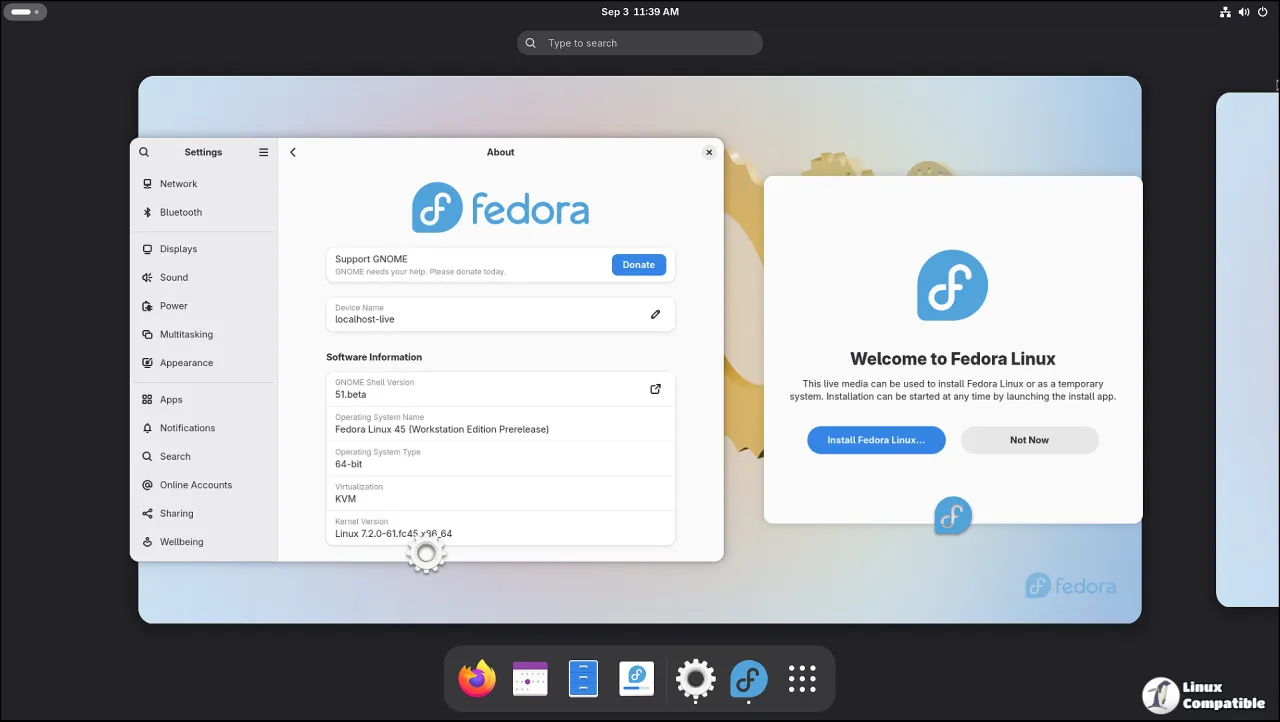
Fedora runs a predictable six-month cycle. Code sits in Rawhide until a version "branches," freezing its package set. Branched is when daily nightly composes get built so people can check progress on the way to Beta and final release. This .n.0 compose is one of those daily building blocks, not a strict release candidate. Those come later, just before Beta and GA.
The notable change: anaconda gets its biggest shake-up in years
Two minor installer bumps landed between nightlies, 45.28 then 45.29, but the content behind them is substantial. For Fedora 45, the installer is a landmark.
Atomic Desktops like Silverblue and Kinoite now install through a web-based interface instead of the old GTK Anaconda. That wraps up a modernization push that started back with Fedora 42 and 43. Stratis storage also ships support for the first time, routed through the Cockpit-backed storage module and including Kickstart automation.
There's a remote install flow too. You can boot a target machine with inst.webui.remote and finish its installation from a browser on another box over HTTPS with pin-based authentication.
That's exactly the kind of large UX and code-path change that release validation exists to catch, which is why the anaconda bump is the real signal this week. Not that this is a light test. Fedora ships a massive matrix for each compose: Workstation, Server (dvd and netinst), cloud images across EC2, Azure, GCE, generic, and Vagrant, plus every Spin and Lab. It spans x86_64, aarch64, ppc64le, and s390x.
What's in Fedora 45 itself
The release reads as a tightening of the base system and security defaults rather than a flashier desktop. GNOME 51 "A Coruña" leads Workstation, with Microsoft Teams integration in Calendar, per-user fingerprint management, and hardware-accelerated remote desktop sessions. KDE Plasma 6.7 carries the Plasma edition, with 6.8 possibly arriving in the release window.
The kernel is 7.2. It carries early AMD GPU HDMI 2.1 Frame Rate Link support, better load balancing, and improved Thunderbolt networking. kMSCON replaces the old in-kernel fbcon console, giving you a userspace VT with cleaner text on high-DPI screens.
Security is where Fedora is being most opinionated. Package signature checking is now enforced by default, so unsigned packages get refused unless you override it. ptrace is restricted for unprivileged users to limit what malware can inspect, though you get full functionality back once you install debugging tools. oo7 becomes the default Secrets Service provider across GNOME and KDE, replacing the old GNOME Keyring and KWallet backends.
The developer stack gets its usual pile of version bumps: Python 3.15, Go 1.27, GCC 16.2, glibc 2.44, Perl 5.44, OpenSSL 4.0, and MySQL 9.7 as the new default.
The test results, and the one wrinkle
Validation follows the Fedora release-validation test plan, combining automated openQA runs (the coconut bot handles a lot of it) with manual test cases on real hardware, VMs, and cloud instances. Installation, Base, Server, Cloud, and Desktop are the mandatory categories.
The current results read as a healthy, actively-tested nightly. Checksums pass across every variant. Default boot and install pass for Workstation, Everything netinst, Server, KDE, and i3. SATA, VirtIO, iSCSI, PATA, and SCSI storage installs all passed. NVMe and SAS aren't tested yet.
There is one genuine snag, and it's mostly cosmetic. Several ISOs exceed their advisory maximum sizes. The Everything netinst aarch64 image is 1.43 GB against a 1.30 GB cap, and a handful of Spins—LXQt, SoaS, XFCE, Cinnamon, LXDE, MATE—run oversized too. That's an image-size problem, not a functional breakage, and Workstation and Cloud passed cleanly. Worth keeping in mind if you're downloading the larger variants.
Why the schedule slip is the bigger story
Fedora 45 missing its October 20 date is worth sitting with for a moment. It's the first time in recent memory the project blew an initial target this close to the finish line. A NO-GO this late usually means a blocker someone missed, not merely bad luck, and the community-driven validation machine is how the project races to catch up. Every blocker bug filed this week either keeps October 27 alive or pushes the release to November 3.
The whole process is about as transparent as open-source development gets: a bot nominates the compose, volunteers run test cases, and failures get flagged as release blockers in public. It's a model Red Hat sponsors and the community runs.
If you want to join the testing, the compose publishes at the usual Fedora download site across all architectures and spins. Start with the Installation and Base pages, since those feed the Go/No-Go decision.


