Fedora QA has launched a five-day community test window for GNOME 51 on Fedora 45 Workstation, running from August 17 to August 21 ahead of the desktop's September 12 stable release. The update ships over 47 upgraded modules, featuring web-based authentication, a standardized frosted glass window protocol via Wayland, exact rational math in Calculator, and a rewritten GTK frameclock. Participants are instructed to install Fedora 45 on non-production hardware, run the official test cases, and file verified bugs against upstream GNOME GitLab or Red Hat Bugzilla. This final quality gate ensures Fedora 45's full desktop stack is stable before it reaches the general public next month.
Fedora QA Wants You to Stress-Test GNOME 51 Before Fedora 45 Lands
Fedora's quality team just announced a five-day community test window for GNOME 51, the next major desktop environment rolling into Fedora 45 Workstation.
GNOME 51, officially codenamed "A Coruña," sits at the top of Fedora 45's install media. It represents the desktop stack's next step after GNOME 50 finished the historic X11 to Wayland transition. Code freeze hit on August 1, which means the development team can only fix regressions and polish from here until the final build drops. The beta image landed just two days before the test window opens. Four days left. That's after the freeze took effect.
I remember covering the GNOME 40 freeze back in 2020, and even then the QA cycle felt rushed. Three years later, the process is tighter, but the fundamental problem remains the same. Upstream developers are shipping more features than downstream testers can realistically cover before the deadline.
"This Test Day will focus on GNOME 51 Desktop. We will test the main desktop, the most important applications, and also new applications added to GNOME in Fedora 45 Workstation," wrote Fedora Quality organizer Kamil Paral. "Your participation helps us find and fix bugs before the next release, ensuring a smoother experience for all users."
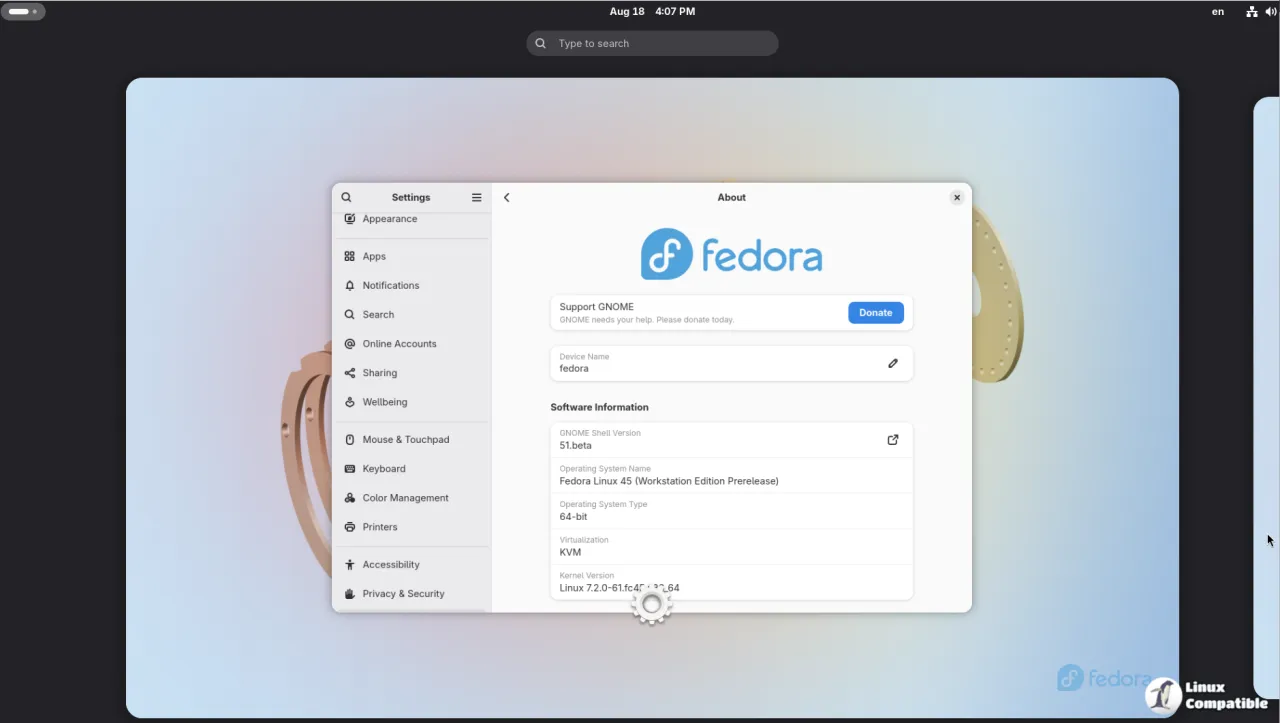
What Actually Changed in This Build
The beta ships with over 47 updated modules across the stack. Authentication just got a major overhaul. GNOME Shell now supports web-based logins alongside the traditional password dialog, which opens the door to SSO-style flows. You will also find a new fingerprint management panel in Settings and a host of Orca screen reader upgrades, including MathML support.
Display stuff is getting interesting too. A new Wayland protocol called ext-background-effect-v1 lets Mutter and GTK render blurred window backgrounds using a standardized approach instead of patching it into every app individually. SVG-based cursors are arriving for cleaner rendering at odd DPIs, and HDR mastering metadata support has landed for display output.
Core apps saw their own polish. GNOME Calculator can finally do exact rational arithmetic using GMP, so it stops approximating irrational numbers. Nautilus gets a tab overview in narrow mode and can open locations from other apps in new tabs. Epiphany adds URL pinning, Reader Mode line spacing tweaks, and a few crash fixes. GTK 4.23.3 includes a complete frameclock rework to drop fewer frames, while GLib 2.89.3 bumps the C standard requirement to C11 and patches a pre-authentication denial of service vulnerability.
Not everything landed this cycle. The long-rumored GTK 4 rewrites for GNOME Boxes and GNOME Disks got shelved. Both apps will stick with their previous codebases for GNOME 51, despite earlier promises from the dev teams.
Fedora's angle here is practical. You are testing how GNOME 51 actually behaves inside Fedora's packaging, alongside proprietary NVIDIA drivers and distribution-specific tweaks. The team warns you to skip production machines entirely. Install a fresh copy of Fedora 45 Workstation or fully update from the latest nightly, then run through the predefined test cases.
Adam Williamson, Kamil Paral, and a handful of other Fedora QA engineers are running the event, with direct chat support on Matrix. If you find something broken, file it against gnome-shell in the upstream GNOME GitLab tracker for general desktop issues, or hit Red Hat Bugzilla for downstream packaging problems. Effective reports need exact reproduction steps, screenshots or video, and a full system journal log.
GNOME 51 hits stable on September 12, with a first maintenance update following on October 10. The Fedora 45 Workstation launch is riding that exact window, so this test day is less about feature validation and more about making sure your desktop does not randomly fail on the first boot. Keep in mind that exploratory testing outside the scripted cases is actually more valuable to the team than strictly following the checklist.
Head here to get started.


