Debian launches a free AI inference portal for contributors. It took a razor-thin vote to get there
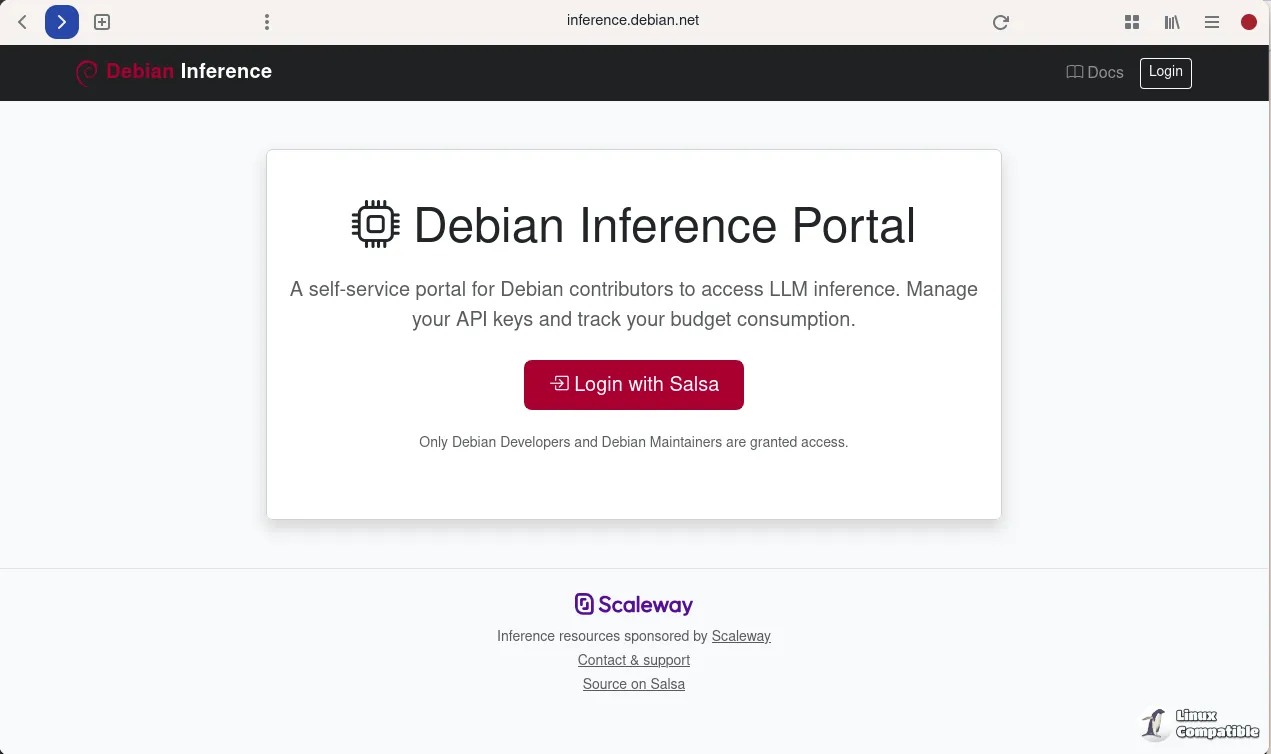
Debian has launched something that would have seemed inconceivable a couple of years ago: shared, free AI model access for its own contributors. The new Inference Portal is live at inference.debian.net, backed by a sponsorship from Scaleway, the French cloud provider. Rather than asking Debian Developers to pay out of pocket for commercial API keys, the project has pooled inference credits and handed them out behind existing community accounts.
Keep in mind that this isn't open to the public. You need a Debian Developer (DD) or Debian Maintainer (DM) identity to log in. Sign in with your Salsa account (Debian's GitLab instance) and you land on a dashboard where you can mint an API key, watch your spend, and manage your budget. The key points at any tool that speaks the OpenAI-compatible protocol, so coding agents like OpenCode and Cursor, editors, and a pile of command-line utilities all work.
What you actually get
Two models are live right now.
The first is scaleway/deepseek-v4-flash-0731, DeepSeek's V4 Flash. Debian points everyone here first. It's the cheaper option and, importantly, it splits cached input tokens from fresh ones when billing. The second is scaleway/glm-5.2, Zhipu AI's GLM-5.2. It's more capable but charges cached tokens at the full rate. That bites hard in agentic workflows, where the agent re-reads the whole conversation on every step. In those cases, GLM-5.2 "adds up quickly," per the docs.
Both expose the standard Chat Completions interface and the newer Responses API. You don't even need a Scaleway account yourself. Debian holds the provider credentials and just forwards your calls.
Budgets are where the fair-use model bites. Each user gets a soft weekly cap: $25 for developers, $10 for maintainers. Hit it and new requests fail until the window resets. Keys expire after 90 days by default, though there's a "Renew" button to extend them. That button is gated, too. It only works while the predicted org-wide monthly spend still fits comfortably inside the shared pool, so you can't just reload indefinitely.
That's the whole philosophy here. Debian is treating inference as shared infrastructure, not a personal subscription. The docs are blunt: the service isn't for unrelated personal tasks. Since the credits are donated, contributors may get pestered for brief feedback on how the tool helped. Fair enough.
The context that makes this interesting
Now here's the part worth unpacking. Debian didn't just decide to hand out AI access on a whim. This portal is the infrastructure half of a political settlement the project reached just months ago over whether AI-assisted contributions should even be allowed at all.
Discussion on the mailing list opened July 24, 2026, around a General Resolution, which is Debian's highest form of policy decision. Five proposals landed on the ballot, spanning a full range from total ban to permissive acceptance. Proposal A, from Matthias Geiger, called for a complete ban and was notably written without any language-model assistance, a deliberate little meta-commentary given the subject. Lucas Nussbaum's option B was the most permissive, pulling in the most seconds. Ian Jackson's middle-ground proposal C flagged something genuine: contributors with limited English proficiency often rely on these tools, which sits right at the heart of the tension in the debate.
Voting ran August 15–28. Debian used ranked preferential voting, and after a bunch of pairwise comparisons, Marc Haber's "Responsible Use of Generative AI" framework squeaked past Nussbaum's by just 55 votes. About 64% of voting developers favored allowing LLM work; roughly 36% wanted it banned or firmly discouraged.
"We have a lot of work ahead of us to act as a community and understand how we can continue to accommodate the very large minority that would have preferred to ban or discourage AI," Nussbaum wrote. Haber was more wry: "It is just too early to take a final decision on the matter. Let's revisit this in two years or so, and let this mess of a GR be a warning for our future selves."
The portal as compromise made concrete
In a lot of ways, the Inference Portal is that "responsible use" compromise turned into something you can actually run. The community decided AI-assisted Debian work is on the table, with human oversight still required, so Debian now provides the plumbing: shared inference behind verified identities, bounded by fair-use budgets, scoped to project work. The privacy posture mirrors the debate too. Scaleway's Generative APIs sit under a Zero Data Retention Policy. Prompts aren't stored or used for training, only anonymized metadata is kept for up to six months, and everything lives in Paris, France.
The docs even flag a security caveat you rarely see in vendor writing. Coding agents should be treated like untrusted programs, and they hand you a bubblewrap example for sandboxing. Then it admits plainly that the sandbox isn't full containment, while the process still shares your terminal and can reach local sockets. Debian doesn't sugarcoat the limits, and that's largely the point.
Verdict
It's arguably one of the more sensible approaches to contributor AI access I've seen this year. No personal accounts, no surprise bills, data stays in Europe, and it's tied to real accountability for the work you submit. The catch is the usual one for free infrastructure: it depends entirely on sponsorship, and the whole thing runs on self-regulation with no new oversight body. Nussbaum himself produced his results visualization with an AI-generated script, disclosing the move despite the obvious irony.
If you're a Debian Developer or Maintainer and want to try it, head here and sign in with your Salsa account to grab a key. The documentation is available here.


