System76 Tags COSMIC Epoch 1.8.0: Submodule Sync Targets Linux Packagers
The new release is a coordinated submodule bump that brings window manager overhauls, pasteboard sharing, and multi-factor login fixes to the Rust-based desktop.
System76 has tagged COSMIC Epoch 1.8.0, pinning the desktop environment to its latest development commits across more than twenty submodules. The release lands on GitHub as of September 9, 2026. Jeremy Soller kept the commit note deliberately brief, writing just "Update submodules." The actual diff tells a much longer story.
Epoch releases from COSMIC aren't traditional feature drops. They're coordinated snapshots that tie together dozens of independently developed components into a single, tested build. Pop!_OS gets these same changes through its internal packaging pipeline, but the epoch tag gives Arch, Fedora, NixOS, and other distros a reliable pin point. Keep in mind that the desktop has been shipping rapid minor releases all year, and this one follows the same pattern. The systemd-sysext testing workflow mentioned in the README hasn't moved an inch, which means out-of-tree testers still have to cobble together their own extension paths.
What's Actually New Under the Hood
The heavy lifting happened in cosmic-comp, the Wayland compositor. Nearly fifty files were touched during this interval, with the tiling layout grab handlers receiving a full rewrite for more accurate resize behavior. A new tablet emulation subsystem added two hundred fifty-six lines of code, finally giving drawing tablets proper input routing at the compositor level. libei integration is now wired up, which means you can copy text in an X11 app and paste it into a Wayland one without a clipboard daemon throwing a fit.
The compositor also picked up a pointer-warp-v1 protocol handler for cross-window cursor syncing, a keyboard-layout-unstable-v1 handler for proper layout switching, and a cornerRadius protocol that finally allows rounded window borders. Xwayland received fractional scaling border fixes, KMS/DRM cleanup got more robust error handling, and the shadow rendering module was quietly stripped out as dead code. Input handling modules grew from roughly one hundred five net lines to three hundred thirty-two, reflecting a complete overhaul of pointer warping and grab state management.
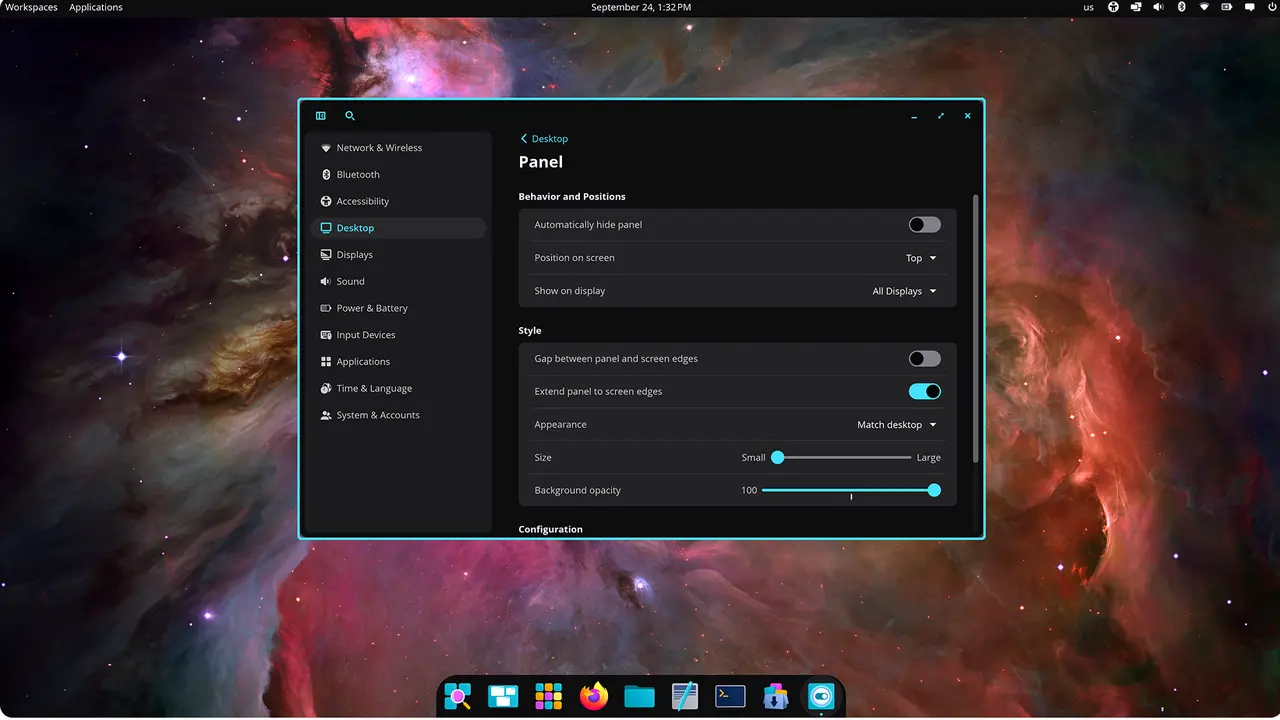
Outside the compositor, the changes are quieter but still useful. The Bluetooth applet now displays device alias names instead of raw MAC addresses, and the Settings panel lets you rename paired devices directly without digging into the command line. A long-standing audio bug finally got fixed, meaning the source volume slider now actually adjusts the input device instead of silently rewriting the output volume. The network manager applet bumped its Rust client to nmrs 3.5.2, which should smooth out compatibility issues with newer NetworkManager releases. System tray icons also stopped rendering downsampled when scaled below one-to-one, fixing that persistent fuzzy icon issue in smaller panels.
The file manager stopped redrawing the rubber band selection incorrectly when you drag it. Tab focus behavior in cosmic-files now correctly stays put when you close a different tab, and the search drawer in Settings preserves your scroll position instead of resetting to the top of every section. The app launcher switched to a standard build.rs, added its first official CI pipeline for clippy and formatting, and stopped leaking environment variables into downstream builds. The greeter finally chains sequential PAM prompts, which fixes login failures for users running dual-factor setups.
It also ships full Nix flake packaging now, which should make life easier for NixOS users who previously had to cobble together derivations. The logind feature gate finally compiles cleanly when building without systemd dependencies, removing a long-standing pain point for non-systemd distributions. A lot of the commit history here is build system hygiene, but it's exactly the kind of polish that separates a proof of concept from something you actually want to use daily.
The Module Breakdown
Not every component moved at the same pace. The terminal emulator and app store just got version string bumps. The workspaces module continued tidying up blur rectangles when windows close. Icon assets gained a printer queue symbol and a refreshed browser icon. The initial setup wizard picked up Filipino and Hungarian translation coverage. Meanwhile, the cosmic-sound-theme and cosmic-screenshot modules were added to the repository structure for the first time, though they weren't fully baked yet.
The contributor footprint looks healthy for a half-window release. Jeremy Soller and J. P. Soller are still running point on version bumps and core architecture, while hojjatabdollahi and mmstick are handling the bulk of the bug fixes across the file manager and settings panel. The Weblate team pushed through a massive localization sweep across fifteen languages, covering everything from Czech to Traditional Chinese. r0chd and demesm handled the greeter's Nix packaging and PAM chaining, while cachebag managed the network manager dependency bump. It's a distributed effort, and the commit timestamps show steady daily activity throughout the two-week window between epoch 1.7.0 and 1.8.0.
If you want to test it, you've got options. Pop!_OS 24.04 already ships COSMIC as the default, and you can upgrade from 22.04 with a single terminal command. Arch users can grab it straight from the repos. Fedora 41+ offers it as a group install, with nightly builds available via COPR. NixOS 25.05+ has native support built into the display manager options. openSUSE Tumbleweed and Gentoo round out the official support list with their respective package managers and community overlays.
It's a rather heavy bump for what is technically just a pointer update across the board. But then you look at the actual diff in cosmic-comp and realize nearly fifty files were touched with new protocol handlers and input subsystem overhauls. The lack of a unified changelog for end users does make it hard to tell what actually shipped versus what just compiled, though. For developers and distro packagers, it's exactly what you need. For someone just waiting on their Bluetooth mouse to connect, you might want to wait for Pop!_OS to push the actual desktop update.
Head here to the GitHub repository if you want to track the work yourself.


