KDE Plasma 6.9 locks in stable Picture-in-Picture and smarter window placement
KDE Plasma 6.9 is quietly getting good. This week's development report shows the next release locking in several features worth celebrating: Picture-in-Picture is now stable under Wayland, windows remember their spot per screen arrangement, and legacy X11 apps get tighter controls. It's a productive week for the team developing 6.9, even as the same report documents a bug flood pouring in after the 6.8 upgrade. The team is doing both at once.
Before getting ahead of myself, a little context. Plasma 6.8, branded the "30th Anniversary Edition," shipped October 14, three decades after Matthias Ettrich founded KDE in 1996. It officially retired the X11 session, making Wayland the sole supported display protocol for the desktop. XWayland still carries the apps that need X11, and KDE has pledged to keep the old session through early 2027. The 6.8 stack sits on KDE Frameworks 6.30 and Qt 6.11.
Major transitions rarely go smoothly, and 6.9 is rolling along on the fresh 6.8 base. So what's actually landing there?
Plasma 6.9: the features locking in
The headline is Picture-in-Picture. KWin's support for the Wayland PiP protocol is now stable enough to enable by default, so a floating mini-window can hover over other content without a workaround. That's a real quality-of-life win that macOS users have taken for granted for years, which is about as high a compliment as we can pay a window-manager feature.
Windows also remember where they lived, and this one is genuinely useful. Sizes and positions are stored per screen arrangement, so disconnect a display, switch to single-screen use, reconnect, and everything snaps back. Keep in mind that this applies to open windows within a running session. Closed-then-reopened windows are still in development, so don't expect perfection yet.
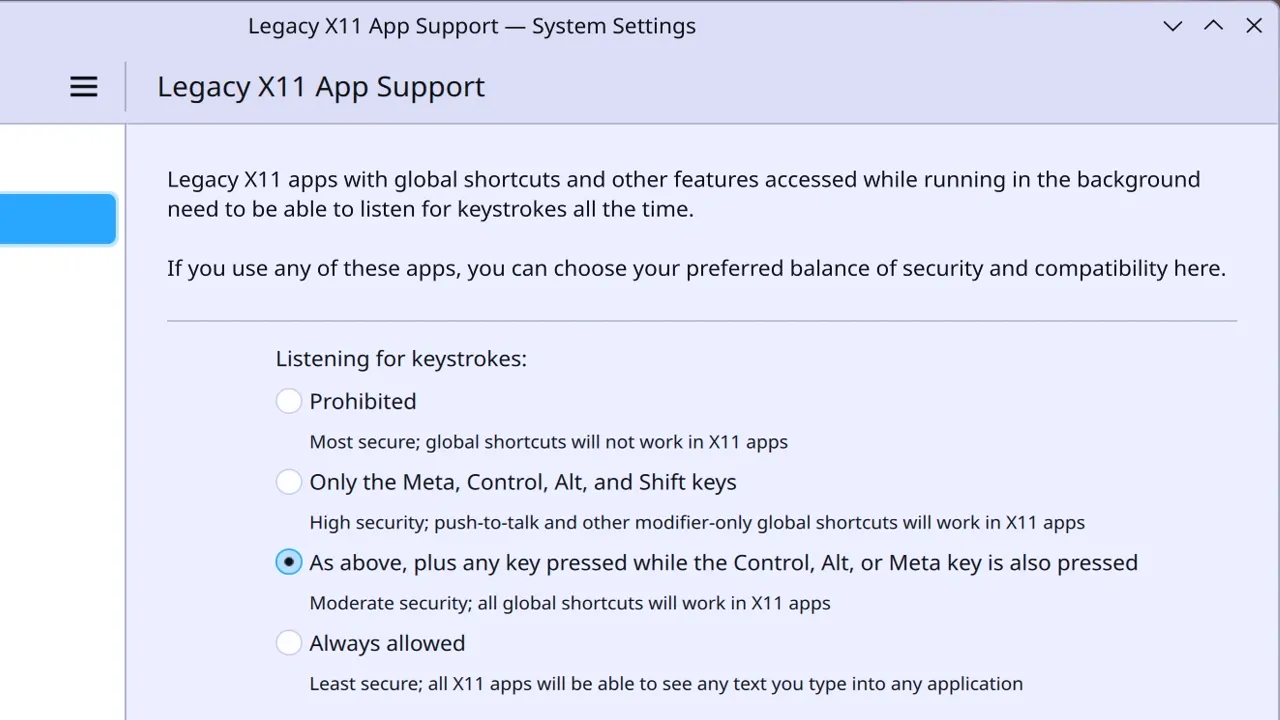
On the security side, you can now permanently deny XWayland apps the ability to control your pointer and keyboard, and revoke those denials straight from System Settings. A new "See Denied Applications" button on the Legacy X11 App Support page keeps things transparent. It's a small but meaningful tweak tied directly to the post-X11 world we're now living in.
Browser integration grew too. Brave is now supported, joining Firefox and Chromium, and you can pause and resume Firefox downloads that surface as native notifications. Two small ecosystem gains, but they add up.
The UI polish rounds it out. The Task Switcher now fires a real live preview instead of a simulation, which fixes cases where certain styles couldn't be previewed at all. System Monitor finally uses "forget" for dropping Wi-Fi networks, a terminology change that matches common parlance. Holding Shift or Ctrl for multi-select actually stops the list from rearranging, so selection works.
The 6.8 cleanup, performance, and KDE's push
While 6.9 pushes forward, 6.8 is absorbing the fallout. As the This Week in Plasma post (by Nate Graham, John Veness, and Farid Abdelnour) puts it, people upgraded and found all the bugs that nobody reported during the beta period, adding that the team "worked incredibly hard to fix them." There's a warning buried in there too: not enough people test betas, so regressions slip into stable. KDE says it's open for ideas, the same open-source dilemma that's plagued volunteer QA for as long as fast release cycles have existed.
The fixes spread wide: plasma-workspace, kwin, kscreenlocker, ksvg, krdp, kpipewire, plasma-systemmonitor, and plasma-browser-integration, plus upstream Qt. An in-place upgrade from 6.7's X11 session to 6.8's Wayland session could break the lock screen, though that's now fixed. In-place upgrades are discouraged for exactly that reason, so the breakage was foreseeable. Plasma could also crash while displays were connected, disconnected, or rearranged, a notable headache for the multi-monitor crowd.
The multi-monitor problems ran deep. Files briefly vanished on the primary screen, wallpapers reset across displays, and the Activity Switcher sidebar overflowed off the bottom of horizontal panels. The Task Manager picked up two fixes, covering wrong open positions and tasks vanishing when dragged between screens. The built-in remote desktop server grabbed a cluster too, fixing an issue that only took the first connection from Apple's Windows App for Mac, plus blank screens for clients lacking hardware-accelerated H.264.
The sheer volume says something about how much stabilization happens after a release. It's the unglamorous half of shipping software, done in public.
Under the hood, several things got faster and steadier. SVG parsing, used throughout basically every theme, got a boost, and since SVG is everywhere that's a broad win you'll barely notice. A long-standing hang is gone: KDE software can no longer freeze when a manually-mounted network share drops out of the Places panel. Line charts in System Monitor can no longer retain so much history that data collection makes Plasma lag. The idle login screen now lets monitors sleep, and auto-generated TLS certificates for the RDP server last ten years instead of one day. Qt 6.12.1 fixed a bug that hung Plasma on logout when System Monitor widgets were present. And KRunner no longer mis-pluralizes "Hertz," a fix that annoys precisely nobody but somehow still counts.


