BlueOnyx ships fresh installation media for all three active server releases
Today's BlueOnyx update bundles every available DNF change into new ISO, virtual-appliance, and Incus images. It's the third install-media refresh of the year.
BlueOnyx has refreshed installation media for its three currently supported server versions, 5210R, 5211R, and 5212R, as of September 21, 2026. This isn't a big feature release. It's the third install-media roll-up of 2026 alone, after June 24 and August 14, and the images bundle every DNF package update available up to the build date. They come in three flavors: bootable ISOs, virtual appliance images (VDI and VMDK), and Incus/LXC container images.
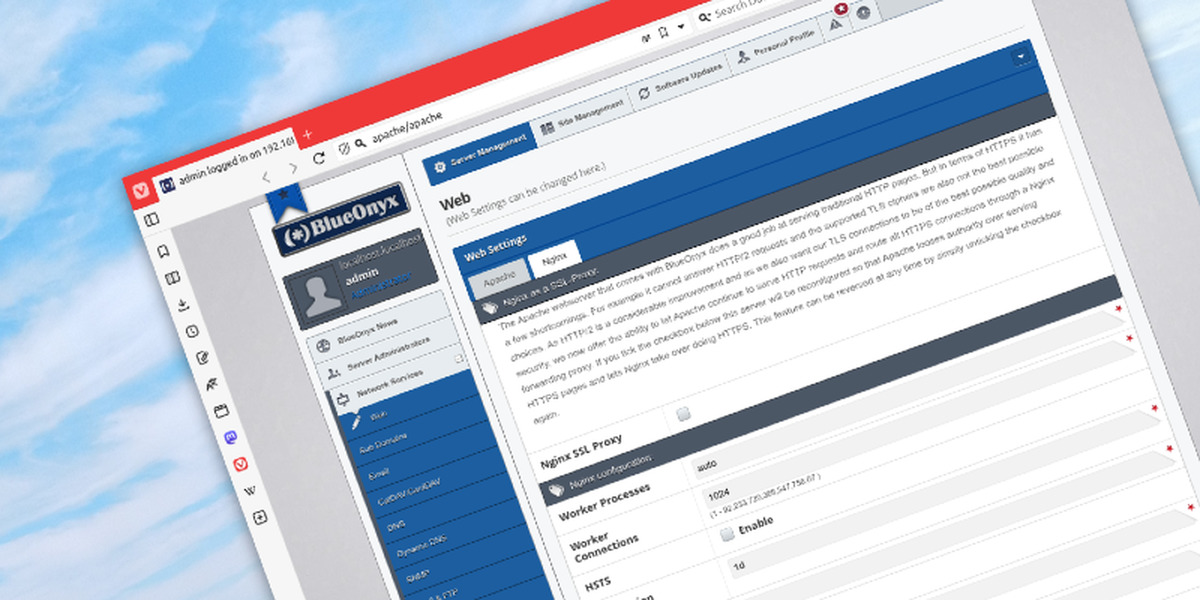
For those not familiar with the project, BlueOnyx is a free, open-source web hosting control panel built on Enterprise Linux. You get a browser-based GUI for the full shared-hosting stack: websites and virtual sites, mail, DNS, MariaDB, PHP, FTP/SFTP, SSL, users, reseller accounts, and two-factor auth. It carries some real heritage too, tracing back through Sausalito, BlueQuartz, and the old Cobalt RaQ, and it has survived several Linux generations along the way.
Here's where BlueOnyx tends to make its pitch. Unlike cPanel and Plesk, it charges nothing per account, per domain, per mailbox, or per CPU. The base license is free whether you run one box or a few hundred. The idea is that your limits should be storage and capacity, not a per-license line item that grows every time you sign a customer. In a published comparison it cites a cPanel Premier figure of roughly $265.99 a month for around 500 accounts, based on June 2026 pricing of $69.99 a month for up to 100 accounts plus $0.49 for each extra one. That vendor number comes straight from BlueOnyx's own comparison, so it may be worth a second look before you lean on it.
BlueOnyx recommends the 5212R build on AlmaLinux 10 for anything new as of right now. The 5211R (EL9) remains the most widely deployed version, and the 5210R (EL8) is the oldest still supported. Everything older, the CentOS-based 5209R and the 5207R/5208R, has been retired and archived.
What's actually in the images
The Complete ISOs carry everything through the last standalone update, released September 18, just three days before the media went out. A couple of things are worth flagging.
An Easy-Migrate fix lands first. Migration tooling had been reading user and group info from Vsites and users via perl(Unix::PasswdFile), which could choke when the password files were locked during a GUI or shell transaction. It now uses BlueOnyx's own read-only parser during the info-gathering stage, which cuts down on contention.
PHP gets two changes. Restrictive open_basedir limits used to leak into the CLI as well, where they usually just cause trouble. base-vsite and base-apache now strip those limits from php.ini across all installed PHP versions. Web-side restrictions via PHP-FPM, suPHP, DSO, or mod_ruid2 stay put for Vsites — only CLI usage is affected.
Newer PHP versions sold through the BlueOnyx shop ship with Opcache on. This update makes it consistent: Opcache stays enabled for webserver requests but stays off when PHP runs on the CLI.
Then there's the genuinely handy one. Jailkit "self-healing" jails now get a daily consistency check. Once a day, via cron or the first CCEd restart of the day, a script verifies jail configs, binaries, and libraries. If an OS update has left something inconsistent, the jail is reinstalled to its configured defaults. You can trigger the check manually with /usr/sausalito/sbin/jailkit_integrity.pl, including a --dry-run if you want to see what it would fix without touching anything.
This is the kind of operational maturity that doesn't always show up in a free panel.
A small detail that does trip people up. The Complete ISOs all bear the 20260921 date stamp, while the NetBoot images keep older dates like 20260527 and 20260306. That's expected rather than a mistake. NetBoot images are lean and pull most packages from configured repositories at install time, so they don't need re-rolling as often. Only the payload-bearing Complete images get a fresh date. It's a minor thing, but if you've ever wondered why your install images look like they're from different years, that's your answer.
Watch the DD mode
Because these images are hybrid and use the modern Anaconda layout, how you write them to a USB stick actually matters. BlueOnyx says they were re-rolled to be more durable when written to a stick, but getting the write wrong still gets you a bootable stick that then fails partway through install.
Keep that in mind. Rufus users: pick ISO Image, set the partition scheme (GPT for UEFI, MBR for legacy BIOS, UEFI as the target system), and then choose "Write in DD Image mode." Not ISO mode. balenaEtcher does it all for you in raw image mode, so there's nothing to fiddle with. The rule is simple enough: if a tool offers DD, raw, or image mode, take it.
If you're keeping score, that's a lot of movement for a free panel. AV-SPAM, its optional anti-spam and anti-virus module, went to 8.1 on September 6, bringing back DCC and SpamRATS RBLs and adding automatic Ham/Spam Bayes training. In August it added a free AI Assistant for log analysis and routine troubleshooting, and earlier this year shipped a FOSSBilling server module for billing. The whole thing runs on a model the project sums up as free to use but not free to maintain, funding development through tiered donations (the shop lists €25, €100, and €500 levels) and optional paid add-ons, with priority assistance reserved for recurring contributions of €50 a month or more.
Head here to the downloads. ISOs, the VDI/VMDK appliances, and the Incus images all sit on the same global mirror set, spanning hosts in the US, Germany, the Netherlands, and Tokyo. Incus users add the remote and copy by alias, per BlueOnyx's documented commands.
And if you're starting fresh, the 5212R build on AlmaLinux 10 is the one to go with.


