Ardour 9.8 Ships With Musical Key Tracking, Crash Recovery Fixes, and Clip Recording Overhaul
The open-source DAW brings scale visualization, caps mid-recording crash data loss at five seconds, and adds a guaranteed two-bar count-in for clip recording.
Ardour 9.8 dropped this morning. The open-source DAW is adding what the developers call initial support for musical keys and scales. If you spend any time writing MIDI lines, you can now see out-of-scale notes directly in the editor and force Ardour to snap incoming input into your chosen tuning. The release also caps mid-recording crash data loss at five seconds, guarantees a two-bar count-in for clip recording, and patches a long list of stability bugs.
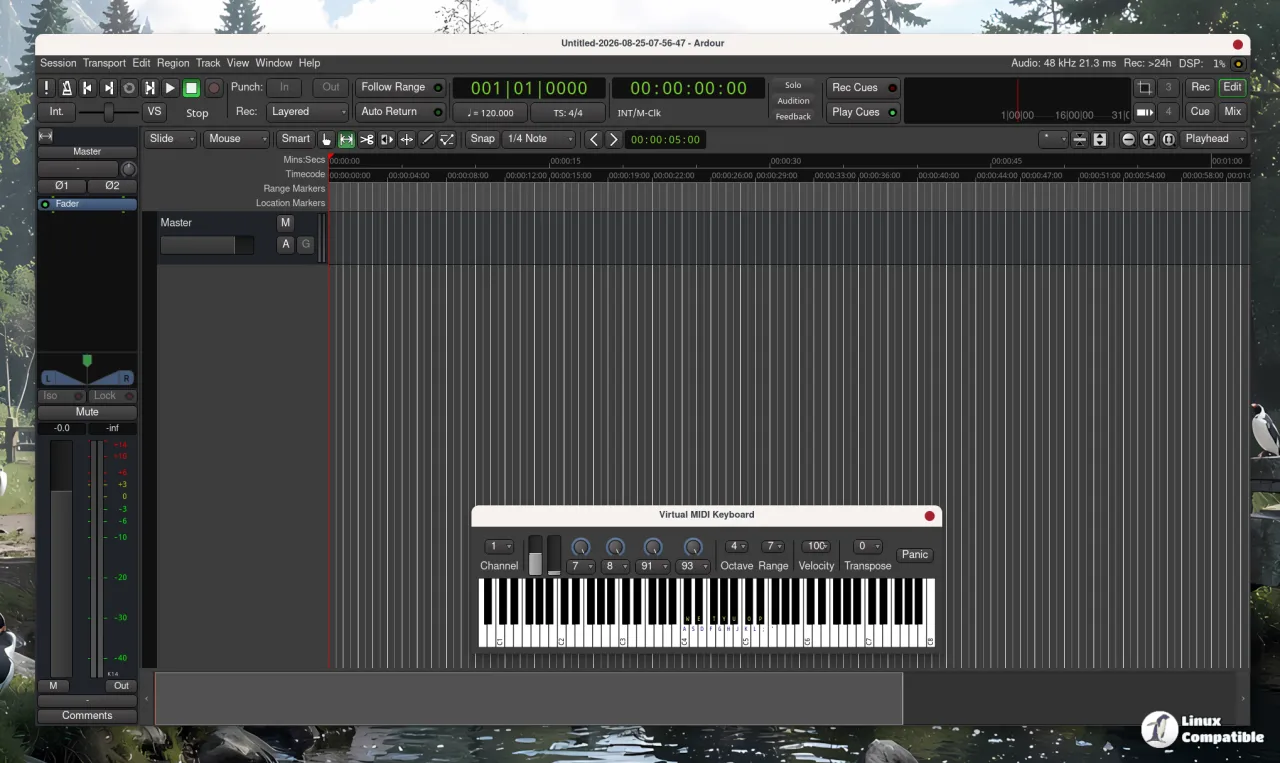
The new scale tracking works the way a modern DAW should, though it stays strictly opt-in. You set a key and scale per track through the header right-click menu. The editor then highlights any notes that fall outside your chosen grid. Ardour uses a hierarchical model where the session sets the default, but individual tracks can override it. You can block off-key notes from being drawn entirely or have the editor auto-correct incoming keyboard MIDI. The developers are calling this an early implementation. Extended tunings beyond standard 12-TET, timeline-based key changes, and SCALA file support are all slated for future patches.
Open-source audio workstations have been remarkably quiet for the last several years. Most of the heavy lifting in the market stays locked behind monthly subscription fees, which leaves hobbyists and small studios waiting for the occasional stable release. Ardour is one of the few projects willing to ship experimental features and tell you upfront that they are not finished. You get the source, the patch notes, and a community that actually reads both.
Crash Recovery and Clip Recording
Session recovery just got a major bump. If Ardour crashes while recording, the audio region snaps back into place with at most five seconds of lost data. Loop and punch recording modes get the same treatment. That has been a known pain point for years. Partially written FLAC and BWF files also get reconstructed into properly formed containers with their metadata intact. The original truncated file stays on disk just in case.
Clip recording gets its own overhaul. Ardour now guarantees at least a two-bar count-in before it starts capturing audio. The countdown shows up on screen inside the clip editor. The clip start automatically adjusts to match the exact recording point. If you need to shift the clip boundaries later, a new Shift-Ctrl/Cmd-drag modifier moves both ends together so the duration stays locked. The audio editor also finally fixes playhead positioning for data that extends past its host region.
Beyond the headline features, there is a long tail of incremental fixes. MIDI Tools now includes an arpeggiate option for chord editing. The tool tab itself packs into a scrolled window so it does not eat your screen real estate. Automation drawing no longer lets you drag bidirectional strokes if you start with a straight line and pivot mid-stroke. LTC handling gets a solid bump for live sessions clocked by external gear, with recording now surviving timecode discontinuities.
Plugin support covers LV2 string parameter UIs, refined property change messaging, and updated VST3 search paths for Linux and macOS. Control surface support adds the Novation Launchkey Mk4 88, Arturia Drumbrute MIDNAM definitions, and a host of Mackie/PPG protocol corrections. Build improvements tidy up MinGW, MSVC, and macOS compile flags, including a fix for crashes triggered when hardware devices disconnect. Translation updates land for German, French, Polish, and Russian.
It is a fairly thorough release for a project that has historically prioritized stability over flash. The scale visualization is not going to replace a dedicated MIDI plugin, but having it baked into the editor cuts down on decision fatigue when you are writing bass lines or chord progressions. The crash recovery cap is the kind of boring improvement that only matters right after something breaks, which is exactly when you need it.
Ardour 9.8 is available now through the official community page. The full changelog is lengthy enough that you might want to bookmark it before your next session.


