Ladybird, an open-source browser with a from-scratch engine, released its first alpha build on November 23, 2026, ending roughly seven years of development that began as a SerenityOS hobby project. It is one of the first genuinely independent browser engines in decades, ignoring Chromium, WebKit, and Gecko entirely, and it runs as a San Francisco non-profit funded by donations rather than advertising. In a controversial June 2026 move, the project stopped accepting public pull requests, citing AI-generated code that undermined the old "patches welcome" model. Progress has been rapid, with Ladybird recently surpassing Safari Technology Preview on web standards tests, though the software remains alpha and still crashes sometimes.
Ladybird browser ships its first alpha, seven years into building a from-scratch engine
The open-source browser that began as a SerenityOS hobby project finally lets you download it.
Ladybird, the browser that has no connection to Chromium, WebKit, or Gecko, shipped its very first alpha build on Monday, November 23, 2026. That is roughly seven years after what started as an HTML viewer tucked inside the SerenityOS operating system became something you can actually download instead of compiling yourself. The build is tagged 2026.47.7.
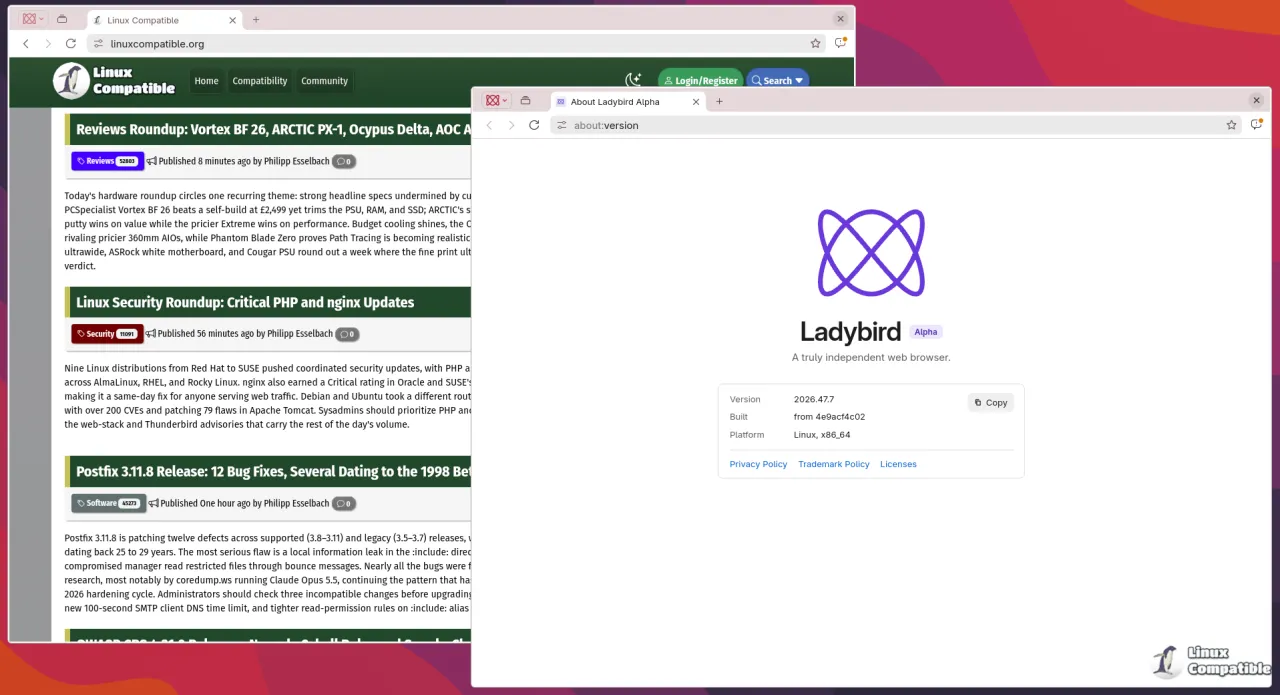
The web happens to run on three engines. Blink, owned by Google. Gecko, owned by Mozilla. WebKit, owned by Apple. Each controlled by one company with its own agenda, and in nearly every case an eye on advertising. Ladybird is openly aiming to be a fourth option, and it is built entirely from scratch.
Keep in mind that this is an alpha. Founder Andreas Kling said plainly that some sites will break and it will crash. The idea is for you to break it on purpose. Ladybird is actively inviting security researchers to hack it, which is a bold move for software that has made no security promises yet. A browser that assumes it will be compromised is at least honest about it.
A genuinely independent engine, for what it's worth
Ladybird's central claim is not just that it exists but that it is the first real browser engine built from scratch in decades. It does not wrap Chromium or fork Gecko. It implements web standards itself and copies spec text into code comments so you can trace exactly where a behavior comes from.
The pieces have names. LibWeb handles HTML, CSS, and layout. LibJS is the JavaScript engine. LibWasm handles WebAssembly. There is also AK, its own standard library, plus a multi-process model where sites from different domains run in separate sandboxed renderers.
It is lean. By the project's own accounting, LibWeb is roughly the same size as Servo and about a fiftieth the C++ code of Chromium. That is either elegant or a sign that it has a long way to go. Both can be true at the same time.
For what it's worth, sites that render now include Google Slides, ChatGPT, Gmail, Instagram, and even a browser written entirely in CSS that emulates an x86 CPU. Those are useful markers that something underneath is actually working, even if the paint occasionally stutters.
The money and the model
Ladybird is run by a US non-profit, the Ladybird Browser Initiative, a 501(c)(3) registered in San Francisco. It takes donations and sponsorships. No default search deals. No crypto tokens. No obvious way to monetize you directly.
The seed money came from Chris Wanstrath, the GitHub co-founder, who donated $1 million alongside his family. FUTO added a separate $200,000 grant. Shopify was the first corporate sponsor, paying $100,000 a year at the Platinum tier. Cloudflare, Proton VPN, 37signals, and JetBrains round out the backers, with smaller donations running through Donorbox.
"We're building a browser for the people, not for advertisers," Wanstrath said when the initiative launched in July 2024, framing the whole effort as a response to an engine world where nearly everything traces back to Google's advertising empire.
Catching up at machine speed
Late 2026 progress has been fast. A JavaScript JIT and a new WebAssembly engine pushed Speedometer 2 from about 84 to 156 and Octane up nearly five times within a single month. By October, Ladybird had passed Safari Technology Preview on the Web Platform Tests, finishing with just under 2.18 million subtests behind Chrome and Firefox.
Speed matters less than trust at this stage, but the raw numbers explain why a project with three years less history than the big three is being watched so closely.
How to run it
Head here to ladybird.org to download the macOS and Linux builds. You can grab archives, tarballs, .deb and .rpm packages, or a Flatpak. If you'd rather build it yourself, cloning the repo and running the Meta script gets you a running instance, though you should expect to fix things as you go.
The roadmap calls for alpha now, a downloadable beta in 2027, and a stable release for general use in 2028. Kling's standing promise is that it will stay free of search deals and direct user monetization. That is a deliberate bet on a model where a browser answers to donors rather than advertisers.
It is an ambitious bet for software that still crashes occasionally. The long wait is over at least. Now the real test begins: whether an engine that ignores the big three can survive on its own terms, with the community mostly on the outside looking in.
Head here to the Ladybird website for more information.


