AMD has launched the Ryzen AI Halo, a $3,999.99 pocket-sized developer kit built around the Zen 5 Ryzen AI Max+ 395 processor and 128 GB of unified LPDDR5x-8000 memory. The hardware is explicitly designed to eliminate the friction of local LLM development, offering a curated software stack with pre-validated configurations and step-by-step AI playbooks for both Windows and Linux. While its 256 GB/s memory bandwidth falls short of Apple's high-bandwidth silicon for dense model inference, it successfully demonstrated that the XDNA 2 NPU can run a 20-billion-parameter model at roughly 20 tokens per second using just 35 watts. It isn't a raw inference powerhouse, but for developers priced out of a DGX Spark or a fully specced Mac Studio, it delivers a genuinely turnkey environment for building and testing on ROCm without wrestling with dependency hell.
AMD Ryzen AI Halo: The $4,000 Developer Kit Built for Local LLMs
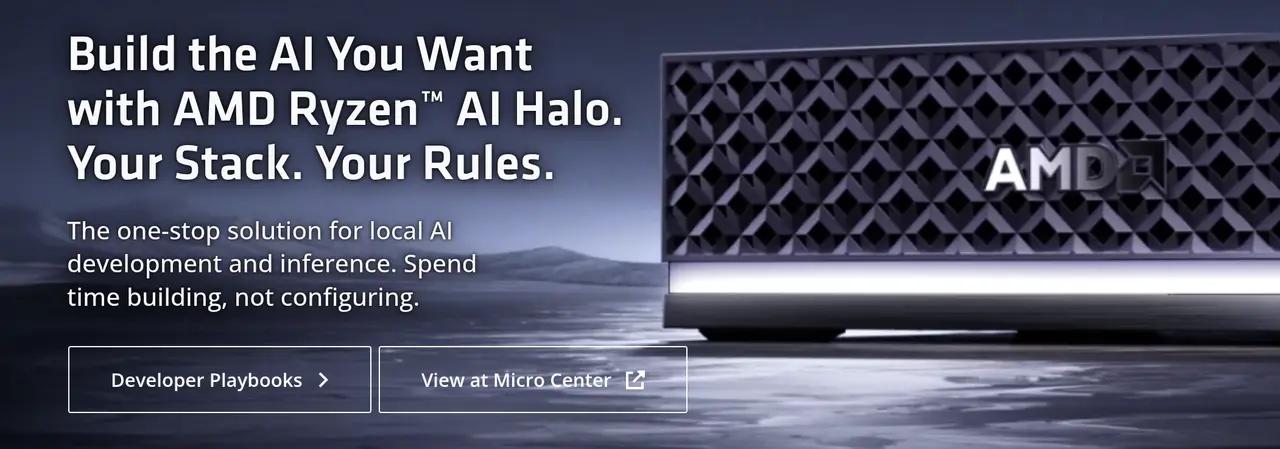
AMD has shipped the Ryzen AI Halo, a pocket-sized mini-PC developer kit aimed squarely at people building and running local large language models. It costs $3,999.99, ships with 128 GB of unified memory, and runs on custom version of Debian. In short, AMD is selling you a turnkey AI workstation and explicitly telling you not to wrestle with drivers.
The local LLM space has gotten loud. Everyone from hobbyists to enterprises wants to run models locally, but setting up ROCm on Linux is still a patience-testing exercise. AMD knows this. The Halo isn't trying to be a gaming rig or a general-purpose workstation. It's a purpose-built dev platform designed to remove the friction between your ideas and a running inference pipeline.
The Hardware
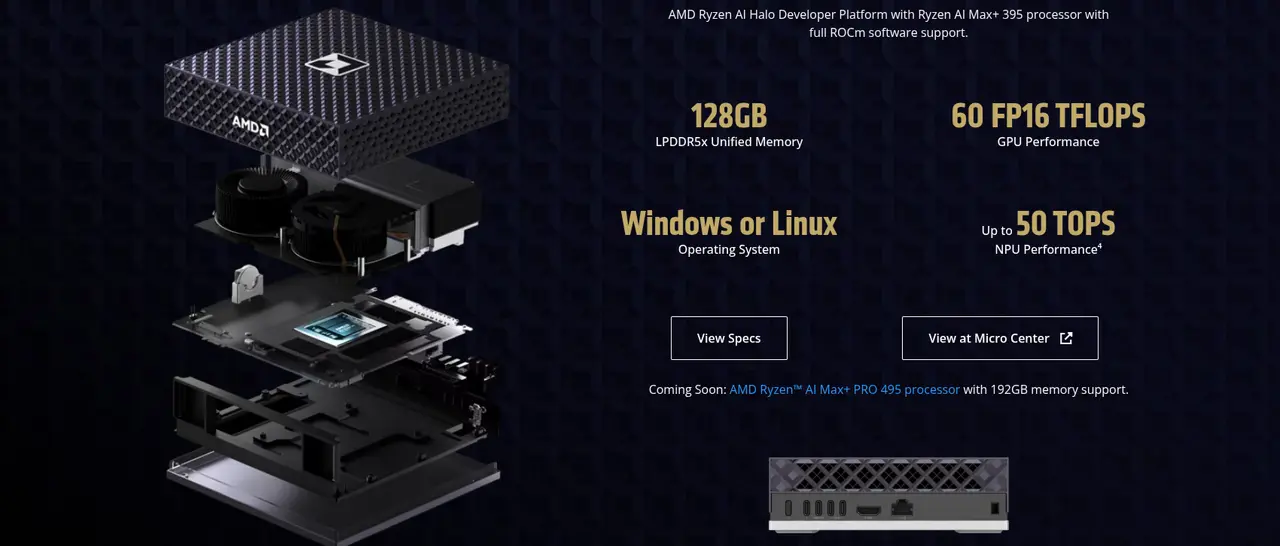
Let's talk about what's under the lid. You're looking at the Zen 5 Ryzen AI Max+ 395, a 16-core, 32-thread processor with an integrated Radeon 8060S GPU boasting 40 RDNA 3.5 compute units. Pair that with 128 GB of LPDDR5x-8000 running at 256 GB/s, a XDNA 2 NPU, and a 2 TB removable M.2 SSD, and you've got a surprisingly dense package. The chassis itself is roughly the size of a hardcover book, less than two inches tall, and weighs in at 1.2 kg. Four USB-C 3.2 ports, an HDMI 2.1, 10 GbE, Wi-Fi 7, and a single USB-C supporting up to 240 W via PD Extended Power Range round out the rear panel. It draws 120 W sustained, boosting to 140 W for short bursts.
LTT Labs put the Halo through its paces with three open-weight models: Qwen 3.6 35B, Gemma 4 31B, and GLM 4.7 Flash. The results paint a clear picture. Prompt processing runs compute-bound, meaning AMD's integrated GPU actually holds its own against Apple Silicon here. Token generation, on the other hand, is strictly memory-bandwidth limited. At 256 GB/s, the Halo falls well short of the M3 Ultra's 819 GB/s, which translates to noticeably slower output on dense models. ROCm and Vulkan backends traded blows with no clear winner. Performance heavily depends on the model architecture and context size.
Agentic workloads showed the expected context window degradation as tests stretched from 4K to 65K tokens. That's an industry-wide challenge, not a Halo-specific flaw. Thermally, the dual blower fans handled sustained loads cleanly. The chassis bottom settled around 50°C, and the noise profile stayed closer to a steady woosh than a jet engine.
The Real Selling Point
Here's where the Halo actually earns its price tag. The Ryzen AI Max+ 395 shows up in plenty of other mini PCs, but AMD's software stack is curated differently. On boot, you hit the Ryzen AI Developer Center, which handles OS updates, app installs, and acts as a one-stop shop for the entire developer ecosystem. There's even a factory reset button, which sounds funny until you've spent six hours debugging a broken Python environment.
AMD also ships Best Known Configurations, or BKC. These are pre-validated system states where every driver, package, and runtime plays nicely together. For developers who just want to start coding instead of fixing dependency conflicts, that alone is worth a chunk of the $4,000 asking price. Pair that with AMD's AI Playbooks, step-by-step guides for things like remote VSCode connections, LM Studio setup, and PyTorch fine-tuning, and you've got a genuinely frictionless onboarding experience. New playbooks drop monthly via GitHub.
The XDNA 2 NPU finally has a real workload to showcase. AMD's FastFlowLM project successfully ran a 20 billion parameter model directly on the neural processor. The result? Roughly 20 tokens per second pulling just 35 W, with the CPU and GPU sitting completely idle. NPUs have been criticized for years for lacking actual workloads, but this is a solid early proof that they can handle inference efficiently. The software ecosystem around it is still catching up to the hardware, but the architecture is clearly moving in the right direction.
It's not all smooth roads. The integrated GPU and 256 GB/s bandwidth mean you won't be running the largest dense models without hitting walls. At $4,000, there are no upgrade paths for memory or storage. You're locked into the 128 GB configuration. Sustained workloads drop from the 140 W boost to 120 W after about five minutes, which could throttle long inference jobs. And despite the tiny footprint, AMD hasn't included any obvious stacking hardware for multi-unit setups. The software ecosystem, while polished, still has rough edges.
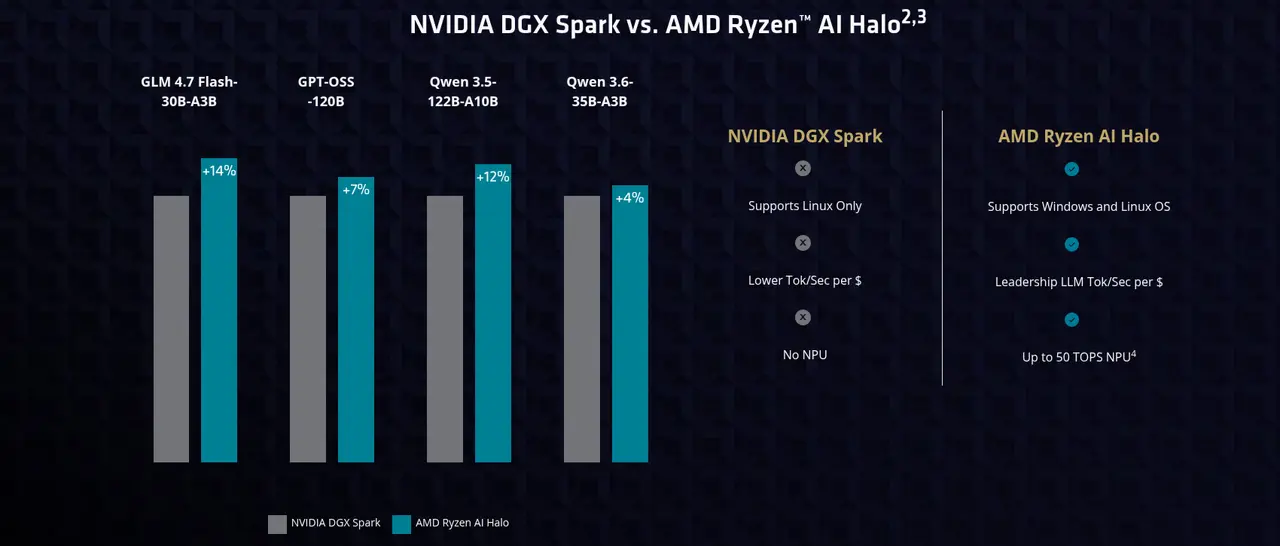
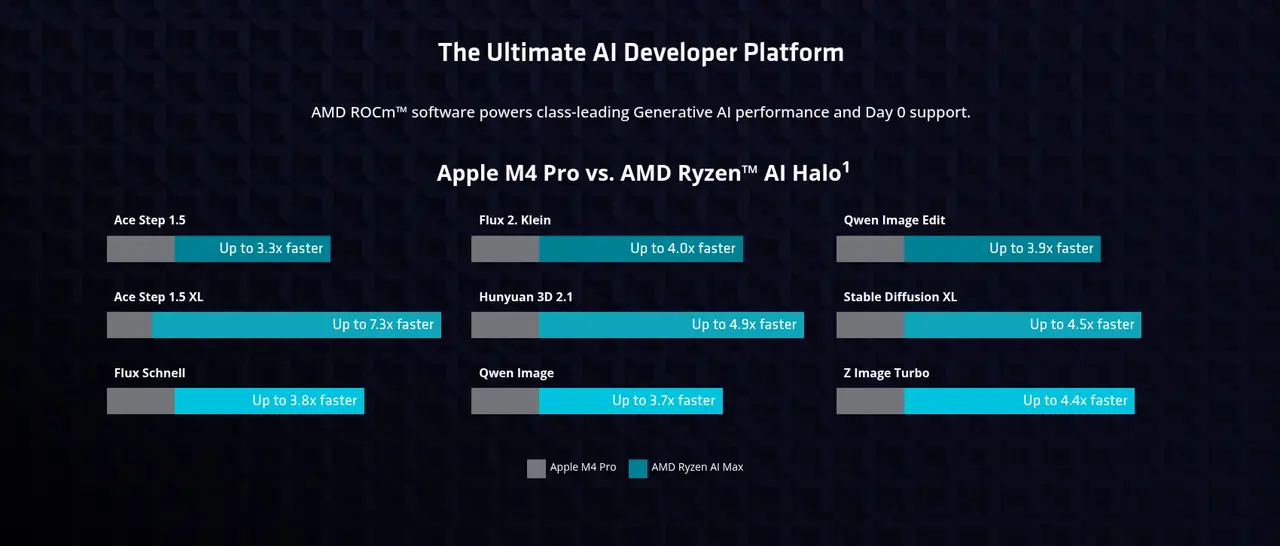
The AMD Ryzen AI Halo isn't here to beat dedicated GPUs or Apple Silicon on raw inference speed. It's here to make AMD hardware the path of least resistance for local LLM development. If you're building agents, fine-tuning models, or just want a turnkey ROCm environment that boots and works, the Halo delivers exactly what it promises. Developers priced out of a DGX Spark or a fully specced Mac Studio will find a surprisingly capable sandbox. If you need maximum throughput or plan to run models larger than 32 GB, you'll want to look elsewhere.
Head here to the product page. The Ryzen AI Halo developer kit is available now at $3,999.99 and is currently only available in the US.


