YServer 1.7.0 Brinks Vulkan 1.2 Support and 1990s Desktop Compatibility to the From-Scratch Rust X11 Server
yserver 1.7.0 is out now, and the from-scratch Rust X11 server can draw desktops on hardware most people would have scrapped years ago. The new version reaches Intel integrated graphics dating back to Haswell and Ivy Bridge, and it boots the Common Desktop Environment, a Unix desktop straight out of the 1990s.
With 1.7.0, the project looks like it wants to move past "works in the demo" and into "actually usable on real hardware." yserver is written by Belgian developer Jos Dehaes, who goes by joske online, and it has climbed to nearly 590 GitHub stars. The name itself is a working title, and joske says it could still change, though nothing else on GitHub uses it for an X11 server.
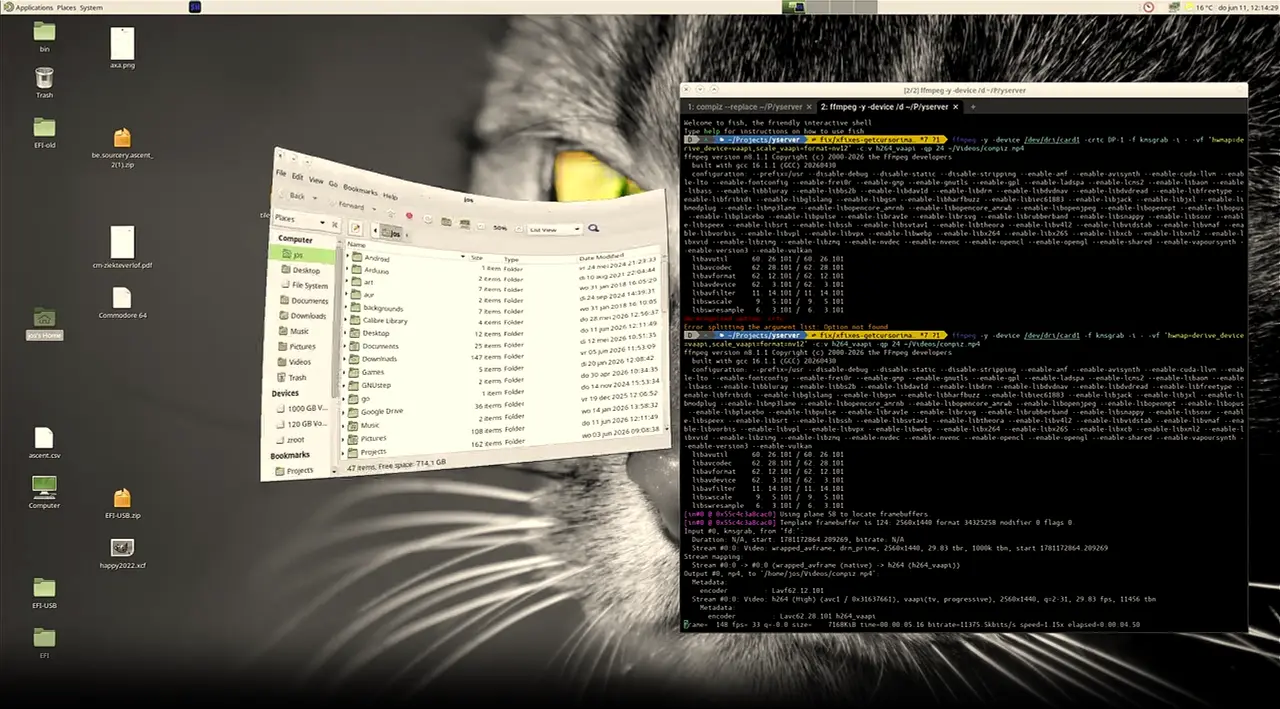
Older hardware, a font rebuild, and some VRAM fixes
Xorg has been the default way Linux draws desktops for over a decade, and nobody's done much to reinvent it. yserver is the most earnest attempt I've seen to pull that off. It's a full X11 server built from nothing in Rust, and the author has been clear from the start that it isn't trying to clone Xorg's internals. It just wants to run real desktops and ditch the cruft.
That cruft includes non-TrueColor visuals, indirect GLX, the DDX driver ABI, and endian-swapped clients. The server deliberately runs single-threaded, with one thread owning all state and driving a mio poller. It's not the sexiest architecture for a modern box, but it keeps protocol reasoning simple.
The headline change is Vulkan 1.2 support. That reads as a minor bump until you remember it opens the door to Intel Haswell and Ivy Bridge GPUs, which predate Vulkan 1.3. Shaders compile to SPIR-V for 1.2, image copies lean on the 1.0 copy commands, and the server refuses to boot on anything older with an error naming exactly what's missing. Not a cryptic crash. A real message.
Next comes a font subsystem overhaul. Indexed and cached lookups mean apps that query fonts repeatedly stop re-measuring them on every request. Compressed .pcf.gz fonts now load, full PCF PROPERTIES tables report in file order, and alias handling mirrors Xorg.
Contributor @ariel3259 also added a dynamic XInput device registry, exposing one device per physical mouse, keyboard, and touchpad. And the VRAM growth problem gets addressed: a 64 MiB LRU budget plus a 60-second idle trim caps the freed-pixmap cache, so sustained sessions don't quietly eat your memory.
Chasing Xorg byte-for-byte
What I actually find most compelling is the testing. yserver runs an automated suite, called the vng-suite, inside a virtme-ng VM and compares its behavior against a live Xorg instance across dozens of scenarios. A font-list scenario checks default characters and bounds. A pixmap-pool scenario verifies the freed-pixmap pool stays under budget. It's the kind of rigor you rarely see in a side project.
The project also runs the X.Org X Test Suite, which takes roughly 50 minutes and shouldn't be interrupted, because xts drives the mouse on some tests. That's a detail only someone watching this project closely would mention off the top of their head.
Fixes on top of that: window backgrounds no longer flash in odd colors after an XOR draw, cursors get released properly, and the pointer re-enters InputOnly windows so subtle UI handles like dtwm's frame-resize markers show their cursors again.
The surprising one is CDE. With 1.7.0, dtsession, dtwm with its panel, dtterm, dtfile, dtpad, and the Motif/Xaw apps around them all start "as fast as on Xorg." Those old toolkits draw exactly as they do on Xorg, and the team built a dedicated CDE recipe into its tooling.
The tested list is broad, honestly. Window managers and desktops range from Cinnamon and MATE to a sonic KDE Plasma X11 fork and enlightenment e16. Hardware spans AMD Ryzen, Intel Core, an NVIDIA GTX 1050, a Snapdragon X1, Apple M1/M2 on Asahi Linux, and a virtualized virtio-gpu. Steam games reportedly perform "almost" on par with Xorg.
One caveat stands out: the GLX texture-from-pixmap feature can't work on NVIDIA's proprietary driver. The project is honest about that limitation, which is refreshing given how often hardware quirks get glossed over.
It's arguably the most ambitious X11 rebuild in years, though it's a long way from a mainstream Xorg replacement. What stands out is the parity testing plus genuine competence with exotic hardware, which makes sense given joske's background. He maintains the asahi-alarm project and is deeply involved in Asahi Linux, the effort to run Linux on Apple Silicon.
Whether yserver becomes a real alternative to Xorg or stays a valuable proof-of-concept, 1.7.0 is a clear step toward the former.
If you want to try it, build from source with just install-local, then switch to a free virtual terminal and run starty. Arch users can grab yserver from the AUR, and binary releases for Fedora, Debian, Ubuntu, and Alpine should be soon available in the GitHub Releases section.


