Strata 0.2.17 turns off a quality-cutting shortcut by default after users complained
A fast-rising open-source local AI engine has quietly reverted one of its own defaults. Strata 0.2.17, released today, flips "route tail skip" off for everyone by default — a move the maintainer makes clear was a direct response to people reporting worse answers.
It's a course-correction rather than a feature dump. The release is mostly RAM tweaks, Blackwell (RTX 50 series) speed-ups, and a bug-fix sweep across every platform. But the headline detail, quietly rolling back a change that hurt quality, says something about how this project handles pushback.
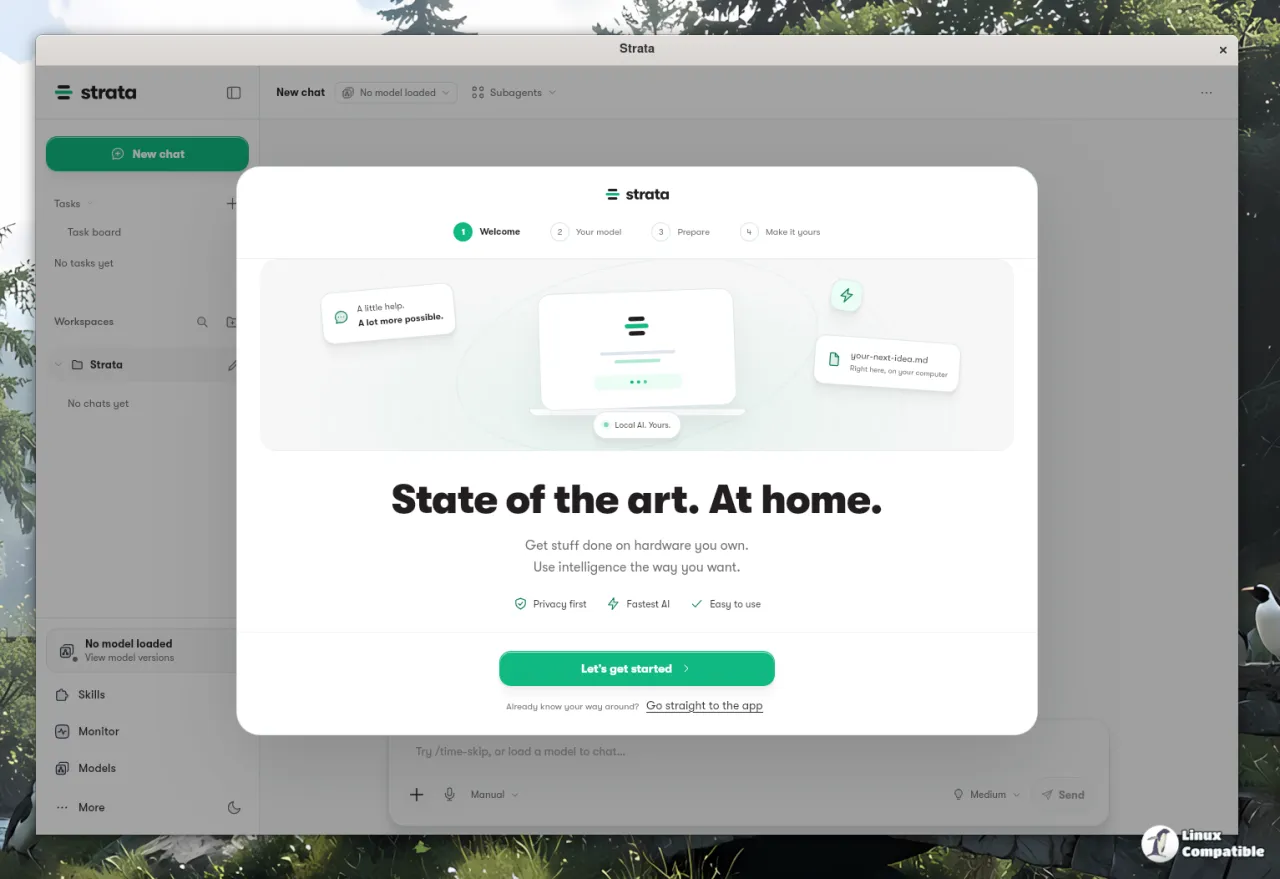
What Strata actually is
Strata is an MIT-licensed inference engine, the kind of software that runs large AI models on hardware you'd already own. It was built by Niko Veit, and first hit GitHub on September 24, 2026. The core trick is ambition. Instead of shrinking a model to fit your GPU, Strata tries to fit a model far bigger than your hardware should allow by spreading it across everything. Its flagship is Qwen3.8-Flash-Next, an open-weight mixture-of-experts model of roughly 125 billion parameters.
It has about 24,576 experts. Each token only routes through roughly ten of them, so about 6 billion parameters are actually active per token. Most-used experts live in VRAM, all of them live in system RAM, the CPU computes some in parallel, and an SSD backs a large lookup table. A small draft model guesses upcoming tokens while the big one verifies them in a batch, which the project claims buys about 1.6 to 1.8 times faster generation.
The full uncompressed weights run near 335 GB. Strata doesn't slim the model down. It just distributes it, which is presumably why it's named after rock layers.
The headline: route tail skip is now off
Route tail skip is an expert setting STRATA_ROUTE_TAIL_SKIP that skips parts of the model rarely used in verification. If a verification window needs an expert that no token routes to at rank 7 or lower, the engine skips copying and computing that expert entirely. On paper that's free speed. In practice, users said their answers degraded.
So the maintainer flipped it back to off. That matters more than the setting itself. It's a public, data-backed retraction of a default, not a silent rollout hidden in a patch.
The trade-off is real and the release states it plainly. On an RTX 5090, decode runs at 73.4 tokens per second with the skip off versus 94.5 with it on, about 1.29x faster with it on. But forced-token KL divergence against exact routing sits at 0.0126 with the skip on, a tiny but measurable quality delta. On 2x RTX A4000 cards you're looking at 47.0 tok/s off against 50.8 on.
Here's the interesting part: on some older and lower-end cards, the Radeon R9700 and Tesla P100, answers already came back identical to the previous build once STRATA_ROUTE_TAIL_SKIP=7 was set. In other words, most users don't even lose anything meaningful by keeping it off.
What else changed
A few things sit alongside the reversal. When your model doesn't fit in RAM, Strata now leaves 17 GB free instead of 24, keeping more experts resident. On a 64 GB PC with an RTX PRO 4500 Blackwell running UD-Q4_K_XL, resident experts jumped from 40 to 47 GB, and SSD reads for a 65K-token prompt dropped from 97.7 GB to 37.0 GB while decode climbed from 57.7 to 84.2 tokens per second.
There's also a new pinned build for the Coder model (revision bba88856f8c3, shard 1 of 29,608,446,496 bytes, fresh SHA-256). If you still have the first shard from before, you'll re-download roughly 29.6 GB.
On low-VRAM RTX 50 cards, 16 GB or less, a fetch optimization is now on by default (STRATA_ADAPT_FETCH=2). The project even gives you revert flags for most of the speed work, which is unusual and, honestly, refreshing. You get the option to judge the speed-for-quality trade-off yourself instead of being told your hardware is good enough.
The release ships 34 files totaling about 6.67 GB, with engine builds for CUDA 12 and 13, AMD HIP, Intel SYCL, and Apple Metal. Testing reportedly passed 4,222 terminal, 2,055 server, 1,853 tool, and 2,096 app tests on Linux with zero failures.
Head here to the GitHub release page for the full release notes.


