XanMod Ships 7.2.13 and 6.18.59 Kernels in a Coordinated Dual Release
Two kernels, same day: a feature-packed MAIN build and a security-hardened LTS release, both riding the latest upstream stable trees.
XanMod is not alone in moving fast this week. The Liquorix kernel project dropped its own updated builds just before, and now we have two new XanMod releases on top of that. The MAIN branch now runs 7.2.13-xanmod1, carrying the freshest upstream features, while the LTS branch lands at 6.18.59-xanmod1 for anyone who simply wants their machine to keep working. Both builds were committed by Alexandre Frade on October 26th, the very same day Greg Kroah-Hartman pushed the upstream stable point releases these are based on.
It sounds like routine version bumping. It is not.
A kernel for every kind of system
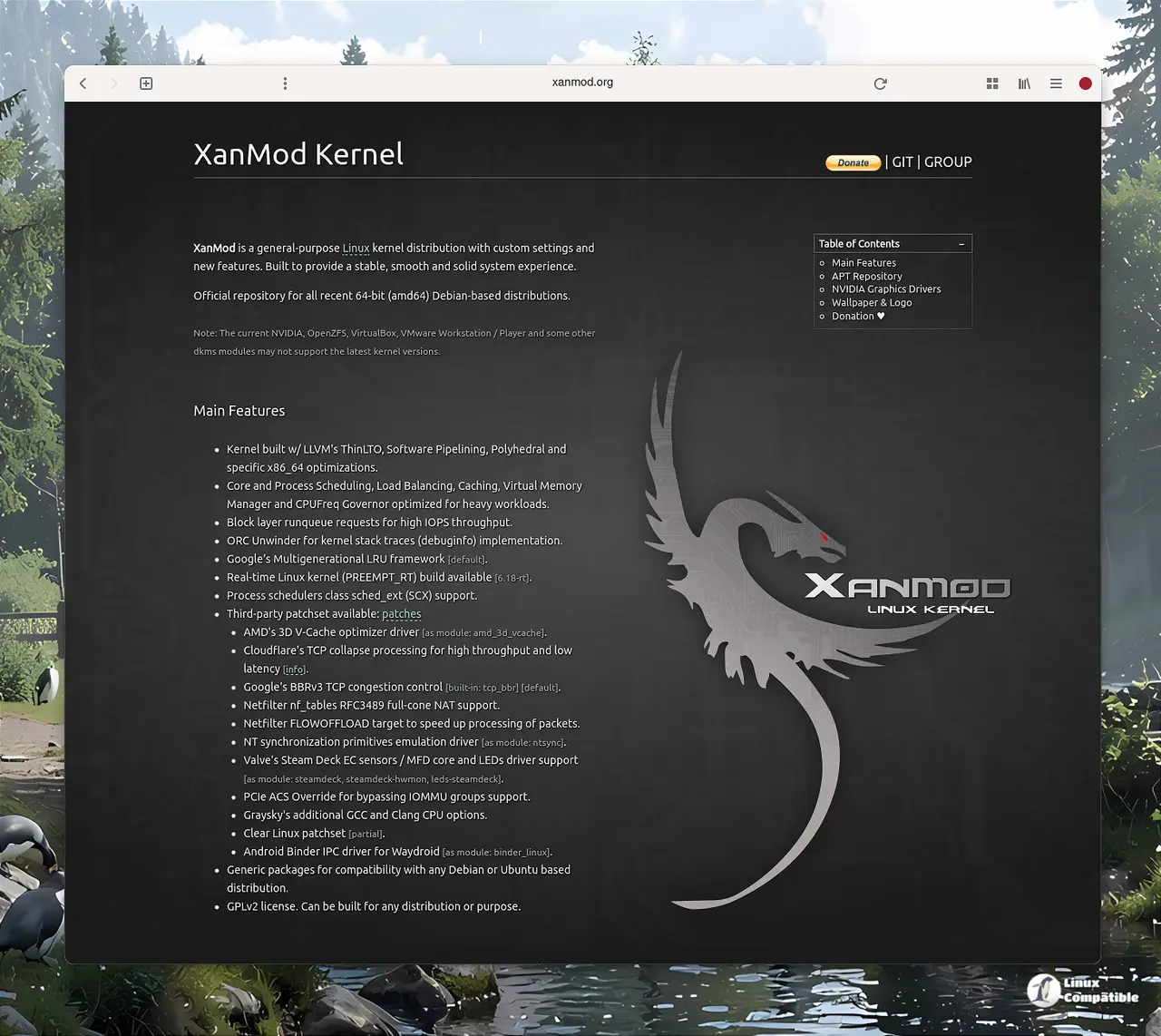
XanMod is not your average stock kernel. Alexandre Frade has maintained the project since 2015, taking the vanilla upstream Linux and recompiling it with performance patches and x86_64 optimizations bolted on. The stated goal is a "stable, smooth and solid system experience," which for most of us means a desktop that feels snappier without us hand-tuning a build at 2 a.m.
You get those gains through a pile of build-time tricks. There is LLVM ThinLTO for link-time optimization, software pipelining, polyhedral analysis, and a stack of x86_64 micro-optimizations. XanMod even ships llvm-toolchain-21 alongside the kernel, and it defaults to Google's multigenerational LRU for memory management.
Those runtime tweaks get backed by real third-party patchsets, some you would recognize off the shelf. There is Cloudflare's TCP collapse processing, Google's BBRv3 congestion control, and even a Steam Deck EC sensor driver that lets the kernel talk to Deck hardware directly. Not cheap to call the whole thing a mere repackage.
A quiet sweep of security holes
Here is the part that actually makes this release worth a read. Look at the changelogs and you will find it dominated by bugfixes rather than new features, and a good chunk of those are memory-safety problems waiting to bite someone.
The 7.2.13 build alone carries well over 200 upstream commits. A big cluster targets the NTFS and SMB/CIFS world: heap overflows in ACL handling, data corruption when you truncate a file with concurrent writes, and an uninitialized-memory leak in ksmbd that could spill up to 56 bytes of stale memory back at whoever asked.
Networking gets the same treatment. There are fixes for the cls_flower scheduler mask pointer, a use-after-free in the psp driver, and a UDP side-channel mitigation that defeats an off-path attacker trying to enumerate your ephemeral ports.
Even the everyday stuff has teeth. The KVM changes fix SS-bit handling that actually surfaces when you run Hyper-V under Windows 11, and a sched_ext fix clears a stall that left tasks stuck for 40-plus seconds. Point releases are supposed to be boring. This one is boring for good reasons.
The choice usually comes down to what you run. MAIN 7.2.13 rides the newest features, which matters if you have early Zen 6 or Panther Lake hardware on the bench. LTS 6.18.59 is your long-term bet, backed through December 2027 for production boxes that hate surprises. There is also an RT branch for real-time workloads and a rolling EDGE line if you like living on the edge.
You can match your CPU to a build tier too, picking from x64v1 for legacy gear up through x64v3 for anything built since about 2015. A simple check_x86-64_psabi.sh script tells you which level your chip supports before you install anything. Skip that and you may end up fighting a CPU that predates the build baseline.
One caveat worth repeating: XanMod hosts its own NVIDIA driver repo, with a production branch at 595.112.07 and a feature branch at 615.78.08. But the project warns that the latest kernel may outrun some proprietary DKMS modules like NVIDIA, OpenZFS, and VirtualBox. If you run GPUs or virtualization, test before you commit.
The cleanest path is the APT repository. You register the PGP key, add the deb line for your distro's codename, and install linux-xanmod-x64v3 for modern hardware, dropping to x64v2 or x64v1 for older machines. After that, a quick cat /proc/version confirms you are actually running the new kernel. Standalone .deb files work too, if you would rather skip the repo entirely.
For what it is worth, the project stays small. Frade runs it solo, funds it through a donation drive with an annual goal of roughly $1,200, and keeps the source on GitLab. That the two builds still landed on the same schedule speaks to how much effort goes into each one.
Head here to the XanMod website for more information.


