XanMod Drops Linux 7.2.4 and 6.18.50 Kernels
Two new kernel branches land September 7, bringing fresh hardware support and the same performance tweaks long-time users expect.
XanMod has officially shipped its latest kernel builds: Linux 7.2.4-xanmod1 for the main branch and Linux 6.18.50-xanmod1 for long-term support. Both hit the archive on September 7, 2026, rolling upstream commits into the project’s custom patchset. If you are running a Debian derivative and chasing lower latency, these are worth your time.
The project has been maintained by Alexandre Frade since 2015, and the philosophy has stayed consistent. XanMod says the builds aim to prioritize "stability, smoothness, and a solid system experience" over experimental scheduling changes. You pick from three CPU tier packages, so whether you are on a decade-old Opteron or a brand-new Zen 5 rig, the binary is tuned to match your silicon.
What’s Actually New
The main branch pulls in 714 upstream commits for 7.2.4. Wireless users will notice a smattering of fixes across mt76, rtw88/89, rtlwifi, and iwlwifi, alongside memory management patches that quietly resolve node reclaim bugs and defrag storm regressions. Security hardening rounds out the changelog, with UAF and OOB write fixes for SMACK, AppArmor, and shared siginfo handling.
The LTS line brings 549 commits to 6.18.50, with a heavier emphasis on storage and network stack stability. NVMe-over-TCP gets a host memory disclosure fix, openvswitch clears up a flow mask use-after-free, and SUNRPC gets harder against krb5 wrap token abuse. It is a rather conservative update for a long-term support branch, though that restraint is exactly why production systems should sit on it.
The XanMod Twist
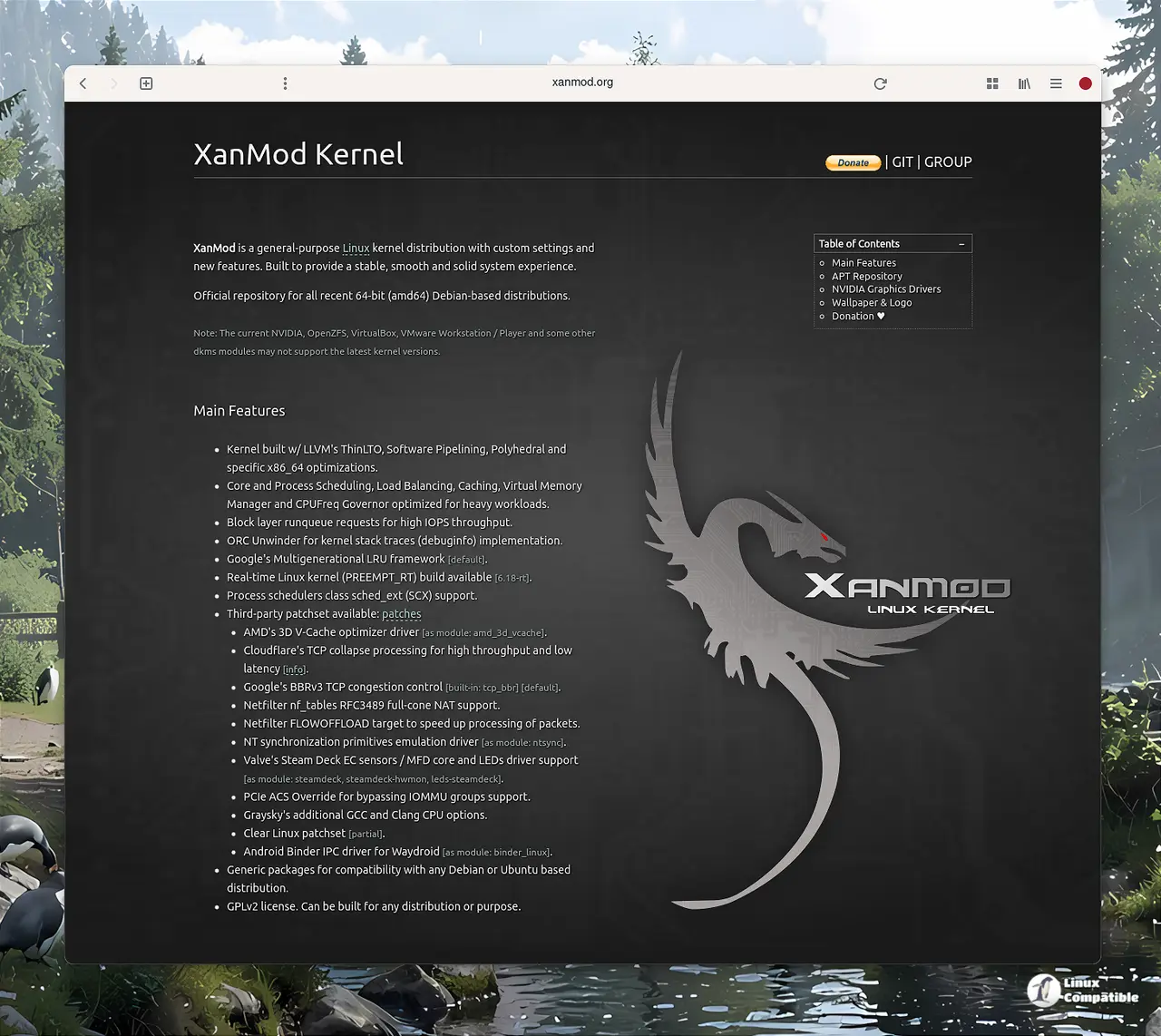
What separates these from vanilla upstream kernels is the layer of performance tuning baked into the defaults. BBRv3 is the stock TCP congestion control now, paired with Cloudflare’s collapse processing for low-latency throughput. The memory manager ships with Google’s multigenerational LRU and Firelzrd’s anonymous page protection under load. You can also run the new scx_sched_ext scheduler if you want to experiment with process scheduling beyond the traditional CFS baseline.
XanMod also keeps adding niche hardware support that upstream does not always pick up for modules. Steam Deck EC sensors, Canonical’s Android Binder driver, and a PCIe ACS override for IOMMU group bypasses all land as loadable modules. There is even a PREEMPT_RT real-time build (6.18-rt45) ready for x64v2 and x64v3, plus a dedicated NVIDIA driver repo that currently hosts 595.99.02 on the stable branch and 610.57.04 on the feature branch. Keeping driver versions in sync with kernel releases has been a recurring headache for Linux users, and shipping a vetted NVIDIA repo inside the same archive helps.
The custom scheduler and memory tuning are not magic bullets, but they do shave latency off workloads that would otherwise thrash under pressure. However, at the same time, you are still locked to x86_64. ARM and RISC-V users will keep waiting. DKMS friction is also real if you rely on out-of-tree modules like NVIDIA or VirtualBox, so you will need to install libelf-dev, clang, and llvm before the first reboot.
Head here to the official XanMod website.


