Strata 0.2.3 brings Intel Arc support and a speed bump
Strata, the open-source engine that crams a roughly 125-billion-parameter language model onto an ordinary gaming PC, shipped version 0.2.3 on October 23. The update mainly speeds up AMD's Strix Halo chips, finally gives Intel Arc a first-class engine package, and keeps a coding agent from drowning when you hand it a prompt too big to fit in memory.
The project has a decent following for a local inference tool. As of the release the GitHub repo had about 30,900 stars and 3,300 forks, with more than 300 open issues and nearly 400 pull requests still queued up. Strata runs mixture-of-experts models on NVIDIA, AMD, and Intel GPUs across Linux, Windows, and macOS, and it does so without an account, a cloud dependency, or telemetry. That last part matters to people who run these things locally for a reason.
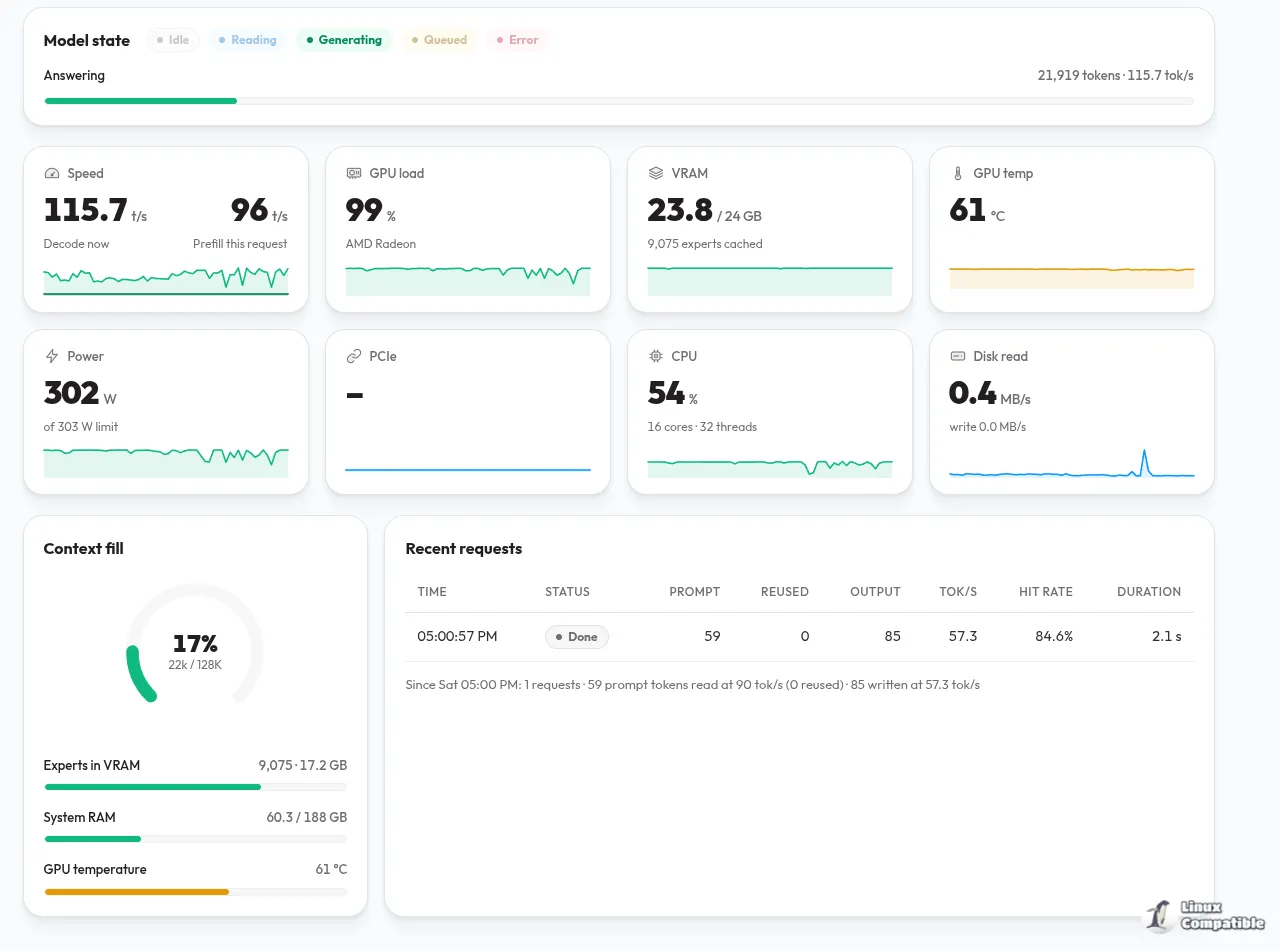
Faster on Strix Halo, finally on Intel Arc
The headline numbers come from a Strix Halo PC running the IQ3_S model, comparing 0.2.3 against 0.2.2. Answer speed jumped 6% to 19% depending on the workload: tool calls went up 19%, code tasks 18%, a 64K prompt 13%, and agent chat 9%. Prompt read speed rose 5% to 14%, landing at absolute speeds of 685, 783, and 749 tokens per second at 4K, 8K, and 64K.
Strata credits three changes. It now reads hyper-connection weights as 8-bit, resumes 8,192-token prompt chunks on Windows, and lets the engine find its own tuning table even when you bypass the launcher. The catch is that answers are no longer bit-identical. Two runs of the same prompt can differ at near-tie words, about as much as the engine's own CPU-to-GPU rounding. Flip two environment variables and it matches 0.2.2 exactly on the test prompts.
The other real change is Intel Arc. Until now the SYCL backend was a fiddly work-in-progress thing. In 0.2.3 it ships as a normal engine package that strata launch and strata update fetch automatically, and B-series cards like the Arc Pro B70 are finally allowed. The maintainers tested the A750 on real hardware. It's worth flagging that B-series was not, and that neither the RX 6000 nor the RX 7000 were run on real cards either. Packages got built and checked, but the RX 6000 Windows build is untested this time around.
Then there's the draft model. The new DFlash2 drafter is opt-in and Terminal only, toggled with strata launch --drafting dflash2. It sits alongside MTP, but the default is still auto, which is MTP, because no card has actually shown DFlash2 winning everywhere. That's a fair bit of caution for what is essentially speculative decoding, where a small helper guesses next words and the big model checks them all at once. It buys roughly a 1.6 to 1.8x speedup for the same answers.
One of the more practical fixes is how the agent copes with a full context window. When you stuff it with messages too big to fit, Strata now measures the model's window, checks each incoming message against it, summarizes older pieces in chunks that fit, and recovers from a "context too large" error with two buttons: Summarize and continue, or start a new chat. A scripted 64K test with five 34,000-character messages kept the peak prompt at 61% of the window, down from 83%.
There's also a quiet improvement to the CPU and VRAM defaults. On an RTX 5070 12 GB PC running Gyro-S, the new Work profile uses five CPU workers and keeps 1,536 MiB of VRAM free. Answer speed climbed from 31 to 45 tokens per second, with agent chat jumping 45%. A conversation cache now sized from free memory pushed prompt reuse from 0% to 91% in a two-agent test, cutting a follow-up turn from 11 seconds to 3.
Keep in mind that the whole thing is built to span the entire PC, not just your GPU. It's a 24,576-expert model where each token calls on about 10 experts. Strata keeps the ~4,000 most-used experts open on the GPU, holds all of them in system RAM, and pulls from the SSD on demand. Long prompts get read in chunks of up to 8,192 tokens at well over 1,000 tokens per second. It's arguably an ambitious bit of engineering for consumer hardware, though the 8-bit weight reads do introduce a small determinism cost.
Can your PC actually run it?
The bar is high. Strata wants a minimum of 32 GB of RAM plus VRAM combined. On a Mac or a Ryzen AI Max system that's unified memory, so a 32 GB machine runs the Coder variant or Gyro-S, and 64 GB opens up every size. The supported GPUs span RTX 20 through 50 series, RX 6800 and up, Strix Halo, Apple Silicon M1 and later, and now Intel Arc on Linux. You'll want about 80 GB of free disk, and if you're running multiple cards they have to be the same make. Strata never splits a model across NVIDIA and AMD.
The model options get finicky fast. Qwen3.8-Flash-Next comes in several quantizations compressed by ISTA-DASLab, UkisAI, agentionai, and Unsloth. Smaller is faster, larger is marginally smarter. The Gyro variants are the most forgiving on memory, with Gyro-S at 27.6 GB taking up the least space. On a 12 GB RTX 5070 you're looking at 94 tokens per second for the Q2_0 build, dropping to 53 for the IQ3_S. An AMD RX 9070 XT runs Q2_0 at 60 tokens per second, so set expectations accordingly.
For privacy-minded users the claims are strong and mostly verifiable. The docs point to no telemetry, no analytics, and no sign-in, and the engine's core contains no networking code at all. Starting or serving a model never downloads anything, and updates come from a signed feed with pinned SHA-256 hashes. The coding agent runs in Manual mode by default, asking before it changes anything. The honest caveat is that there's no external security audit yet, and the Windows installer isn't code-signed, so a "Windows protected your PC" wall is likely on first run.
From 0.2.2, just run strata update in the Terminal or hit Settings > Update in the app. If you're coming from an older 0.2.0-beta or 0.2.1 build, you need to run the install command once more, since old Terminals can't switch to the newer Control on their own. The install keeps your models and settings intact, and saved tuning presets get flagged for a short re-check.
One-line installers exist for Linux, Windows, and Mac, alongside one-click GUI installers split by GPU. The release page lists 38 assets, including engine packages you can pull manually if the auto-fetch fails.
At this point it's one of the more ambitious things you can run on a consumer machine without begging for a data center. The release notes describe the update as "faster Strix Halo, Intel Arc as a released engine package, the DFlash2 drafter, a calmer agent chat when the context fills up, and a steadier Terminal," which is about right. For what it's worth, it ships fast too: the project dropped several tags in a single day in late October, with 0.2.1, 0.2.2, and 0.2.3 landing within a week of each other.
Head here for the release page and the full changelog.


