XanMod Ships 7.2.7 and 6.18.53 Stable Kernel Builds
The XanMod kernel project put out new stable releases on Monday, 21 September 2026. If you were expecting "6.18.52," that's now the real-time branch. The stable LTS line has jumped to 6.18.53.
Both the main and LTS builds share the same release date, so think of them as one coordinated drop. The real-time variant (6.18.52-rt-xanmod1) actually landed a week earlier, on 14 September, running the 6.18 RT scheduling on top.
A faster stock kernel, roughly
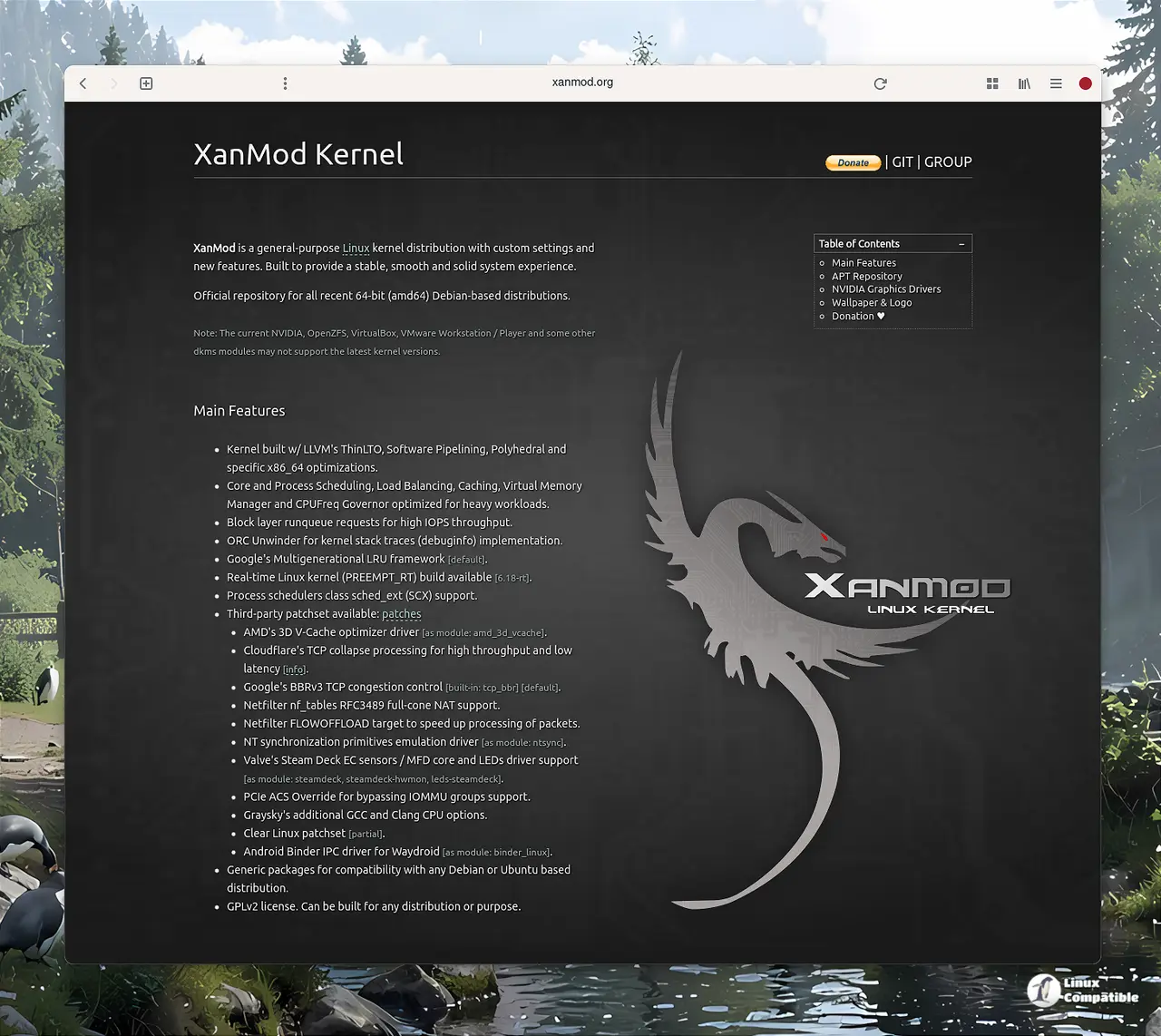
XanMod has been maintained since 2015 by Alexandre Frade, and it bills itself as "a general-purpose Linux kernel distribution with custom settings and new features." The goal is a "stable, smooth and solid system experience," which is a fair amount of ground to cover in a kernel.
It packages prebuilt kernels for 64-bit Debian-based systems, ships under GPLv2, and lives behind an APT repo at deb.xanmod.org. It's hosted by ADMIN.NET.PL S.C., builds through GitLab, and posts updates to a Telegram group.
The interesting part isn't that it repackages upstream code. XanMod layers on a consistent set of tuning choices across every branch.
The compiler side builds with LLVM Software Pipelining, Polyhedral (Polly), and a pile of x86_64-specific optimizations. Then there's tuning for scheduling, load balancing, the virtual memory manager, and the CPUFreq governor. The block layer runqueue gets pushed toward high IOPS. Google's multigenerational LRU is the default memory management scheme now.
It also carries a real PREEMPT_RT build, plus support for the experimental sched_ext (SCX) scheduler class and a grab bag of third-party patchsets.
The patchset pileup
XanMod bundles patches that most distros leave out entirely. There's Cloudflare's TCP collapse handling for low latency, Google's BBRv3 congestion control as the default, and Netfilter changes including FLOWOFFLOAD for faster packet handling.
It also ships Steam Deck EC sensor drivers, PCIe ACS override to dodge IOMMU group restrictions, and Firelzrd's "le9uo" for clean-page protection under memory pressure. Graysky's extra CPU options, a partial Clear Linux patchset, and Canonical's Android Binder IPC driver round things out.
There's a whole tier system around CPU ages, by the way. The main branch targets x64v2 (circa 2009) and x64v3 (circa 2015). LTS adds back an x64v1 legacy tier for hardware roughly from 2003. The real-time build offers the same two modern tiers as main. An x64v4/AVX-512 option exists, though XanMod openly admits it delivers no kernel benefit. Worth skipping it if you see it.
What's actually new
Here's the honest version. The 21 September builds rest on upstream Linux 7.2.7 and 6.18.53, both signed off by Greg Kroah-Hartman. So the bulk of this update is a roll-up of upstream bug fixes, and plenty of them carry security weight.
The changelogs aren't short on substance. Multipath TCP gets fixes for bad byte-accounting and use-after-free on subflow reset. The x86 memory management side gets a batch of change_page_attr() fixes plus corrections for a user-space data loss bug tied to MADV_FREE.
The SMB/CIFS client alone picked up a heap overflow fix, one-byte out-of-bounds reads, file-type corruption bugs, refcount leaks, and short READ validation. That's a notably large haul for a stable release.
Elsewhere: media codec drivers get new bounds checks on AV1 and HEVC tile counts, the SCSI qla2xxx driver clears up list corruption and link-speed reporting, and several filesystems (XFS, f2fs, ntfs, erofs) get hardened. Networking, BPF, Bluetooth, and the graphics drivers all get their share of use-after-free and leak fixes too.
Installing it
The official route is the APT repo. You register the PGP key, add the source line for your codename, then update and install. The command for the modern CPU build runs:
sudo apt update && sudo apt install linux-xanmod-x64v3
You'll want the build dependencies if you compile external modules:
sudo apt install --no-install-recommends dkms libelf-dev clang lld llvm
Supported codenames are extensive, spanning bookworm through trixie and forky on Debian, and noble, plucky, and a bunch of Ubuntu codenames on the Ubuntu side. If you'd rather not touch your sources.list at all, prebuilt .deb files sit on SourceForge and install with dpkg -i. Confirm you're actually on the new kernel with cat /proc/version after rebooting.
One caveat worth repeating before you push this to anything important. XanMod notes that NVIDIA, OpenZFS, VirtualBox, and VMware Workstation/Player DKMS modules may not yet support the latest kernels. So the container that has worked for two years might not build its modules tomorrow. Flag that before a Friday afternoon upgrade.
The NVIDIA drivers
Separately, XanMod maintains an NVIDIA driver repo built to work with its LLVM kernels. The production branch sits at 595.99.02 (595 Series), while the new-feature branch has climbed to 610.57.04 (610 Series).
Both are the open (-open) variants. You enable the non-free component of the repo, then install with something like sudo apt install nvidia-driver-595-open.
Head here to the XanMod website for the full install instructions.


