XanMod released three coordinated kernel updates on September 14, 2026, across its MAIN, LTS, and RT branches, matching upstream Linux 7.2.6 and 6.18.52 exactly. This is a security and stability-heavy point release, with roughly 1,800 commits in the mainline build and about 1,490 in the LTS pair. The mainline line centers on a major ksmbd/SMB security overhaul, while the LTS build hands AMD users new power-management knobs like raw EPP writes and plants an early seed of 802.11bn UHR WiFi support. Debian and Ubuntu users can install via XanMod's APT repository, though they should watch for DKMS module compatibility issues with newer kernels.
XanMod Releases Mainline, LTS, and RT Kernels in One Coordinated Batch
The September 14 update tracks upstream Linux 7.2.6 and 6.18.52 exactly, and brings a big SMB security overhaul plus fresh AMD power-management knobs.
On September 14, 2026, the XanMod project shipped all three of its build branches at once. That's the headline, and it's the less-common thing to see. Most kernel tweak projects stagger their mainline, long-term support, and real-time releases over a week or more. XanMod lined them up instead: 7.2.6 for MAIN, 6.18.52 for both LTS and RT, all stamped the same day.
The versions aren't exotic. Both sit at the same upstream point releases you'd pull from kernel.org, 7.2.6 stable and 6.18.52 longterm, matching those upstream releases down to the date. What XanMod layers on top is its usual mix of tuning, patches, and CPU-optimized compilation. Think of it as the same tree with a heavier suspension.
This is a stability- and security-heavy update, not a feature milestone. The MAIN build carries roughly 1,800 commits. The LTS build about 1,490. Most of that is hardening and bug fixing. Networking, the in-kernel SMB server (ksmbd), filesystems, GPU drivers, and Bluetooth are the busiest areas.
Mainline: a heavy ksmbd and networking pass
If there's one place to look in the 7.2.6 MAIN release, it's the SMB server. ksmbd got a large batch of hardening, which is roughly 40 commits touching encryption handling, session lifecycle, and protocol validation.
You get SMB3 request replay support, decryption-failure disconnection logic, and bounds checks on ACL walks and write offsets. The release also expires SMB sessions when Kerberos tickets lapse and frees preauth sessions on teardown. In practice that's the kind of work that keeps a network-facing server from doing something embarrassing.
The networking wave that rides along is cut from the same cloth. A coordinated fix clamps quantum and MTU values across the fair-queueing schedulers to prevent signed-overflow soft lockups. It touches fq, sfq, codel, fq_codel, and sch_htb, plus a handful of drivers. Add in TCP hardening, rejecting non-zerocopy devmem tx and fixing urgent-data corruption on retransmit, and this is clearly a release for boxes running on real loads.
AMD power management takes center stage in the LTS build
The LTS and RT branches share the 6.18.52 base, and the centerpiece there is genuinely useful: AMD power management. The amd-pstate / cpufreq work adds raw EPP writes, a new user-facing capability, along with dynamic energy-performance preference and a platform-profile class. There's a concurrency fix around the driver lock and a set of corrections for EPP behavior in performance mode.
For someone who actually tweaks CPU frequency targets by hand, raw EPP writes are the concrete win here. It's the kind of control that usually means editing vendor tools or waiting a couple of point releases.
Other feature seeds in this build: an initial 802.11bn "UHR" WiFi support entry (early next-gen sub-1 GHz work), RDMA query-port-speed verbs, and a chunk of new Bluetooth and hardware chip support, including MediaTek's MT6639 and MT7902. WiFi remains the single largest area at roughly 110 commits, overwhelmingly the mt76 driver family.
What XanMod actually is
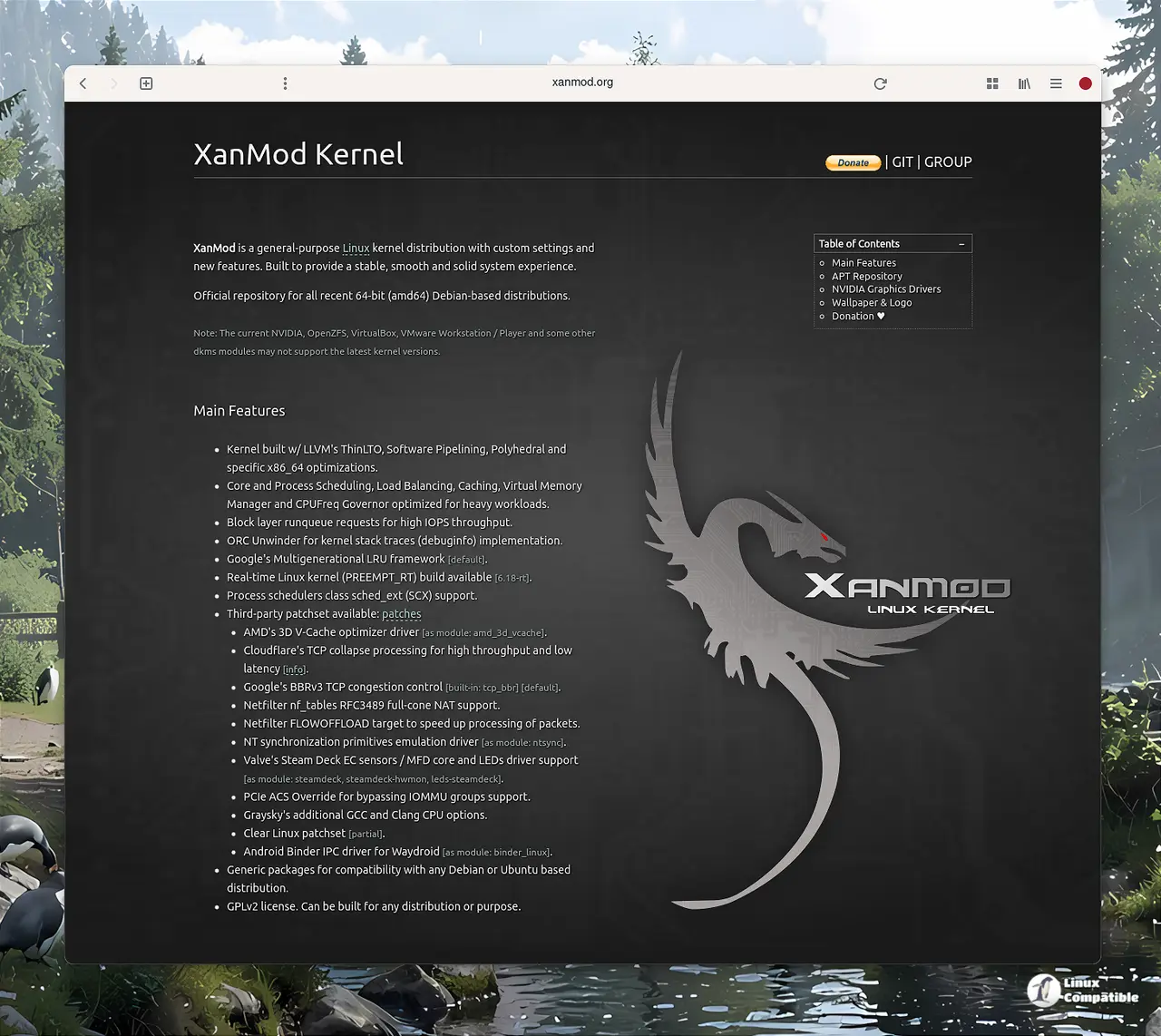
For the uninitiated, XanMod isn't vanilla Linux. It's a downstream build maintained since 2015 by Alexandre Frade, layered with scheduling tweaks, tuned memory management, block-layer IOPS tuning, and LLVM-based compilation with extra x86_64 optimizations. It ships Google's multigenerational LRU by default, plus a PREEMPT_RT real-time build and sched_ext (SCX) user-space scheduler support.
The third-party patchset is where it gets interesting. You're getting Cloudflare's TCP collapse processing, Google's BBRv3 congestion control, Netfilter flowoffload, Valve's Steam Deck EC sensor driver, PCIe ACS override, and Canonical's Android Binder IPC driver, all in one package. The pitch is "build once, tuned for modern CPUs," aimed at desktop and gaming users who want extra tuning without compiling from scratch.
It's a reasonably compelling tradeoff, though there's friction. The prebuilt packages cover 64-bit Debian-based distros via APT, and the builds are split by x86-64 psABI level, v1 for legacy hardware, v2 for roughly 2009-era CPUs, v3 for Haswell and newer. Pick the wrong one and you won't boot. There's a check script at dl.xanmod.org to sort it out.
Keep in mind that the installation is standard APT boilerplate. You register the PGP key, add the repo, then install the build matching your CPU:
sudo apt update && sudo apt install linux-xanmod-x64v3
Build dependencies for external modules are a separate step:
sudo apt install --no-install-recommends dkms libelf-dev clang lld llvm
Reboot and verify with cat /proc/version.
The project also maintains a separate NVIDIA driver repo, currently at the 595.99.02 production branch and 610.57.04 new-feature branch. One caveat worth flagging: the project says its current NVIDIA, OpenZFS, VirtualBox, and VMware DKMS modules "may not support the latest kernel versions." Hit a module mismatch and watch for upstream driver updates before assuming the kernel is to blame.


