XanMod ships 7.2.9 and 6.18.55 kernels built on the freshest Linux stable code
The performance-kernel project shipped three builds across its MAIN, LTS, and RT branches, all rebuilt on the latest upstream stable code.
XanMod just pushed new point releases across all three of its main branches. Each one rebuilds the freshest upstream Linux stable code and layers on the project's usual performance tuning. As of this week that means 7.2.9-xanmod1 for the MAIN line, 6.18.55-xanmod1 for LTS, and 6.18.55-rt-xanmod1 for real-time.
The question people usually ask about XanMod is dead simple. Why replace a working kernel at all? The answer involves a kernel that does the exact same core jobs as upstream Linux, just with a handful of tuning knobs already turned past where most distros dare to go.
What XanMod is and why it exists
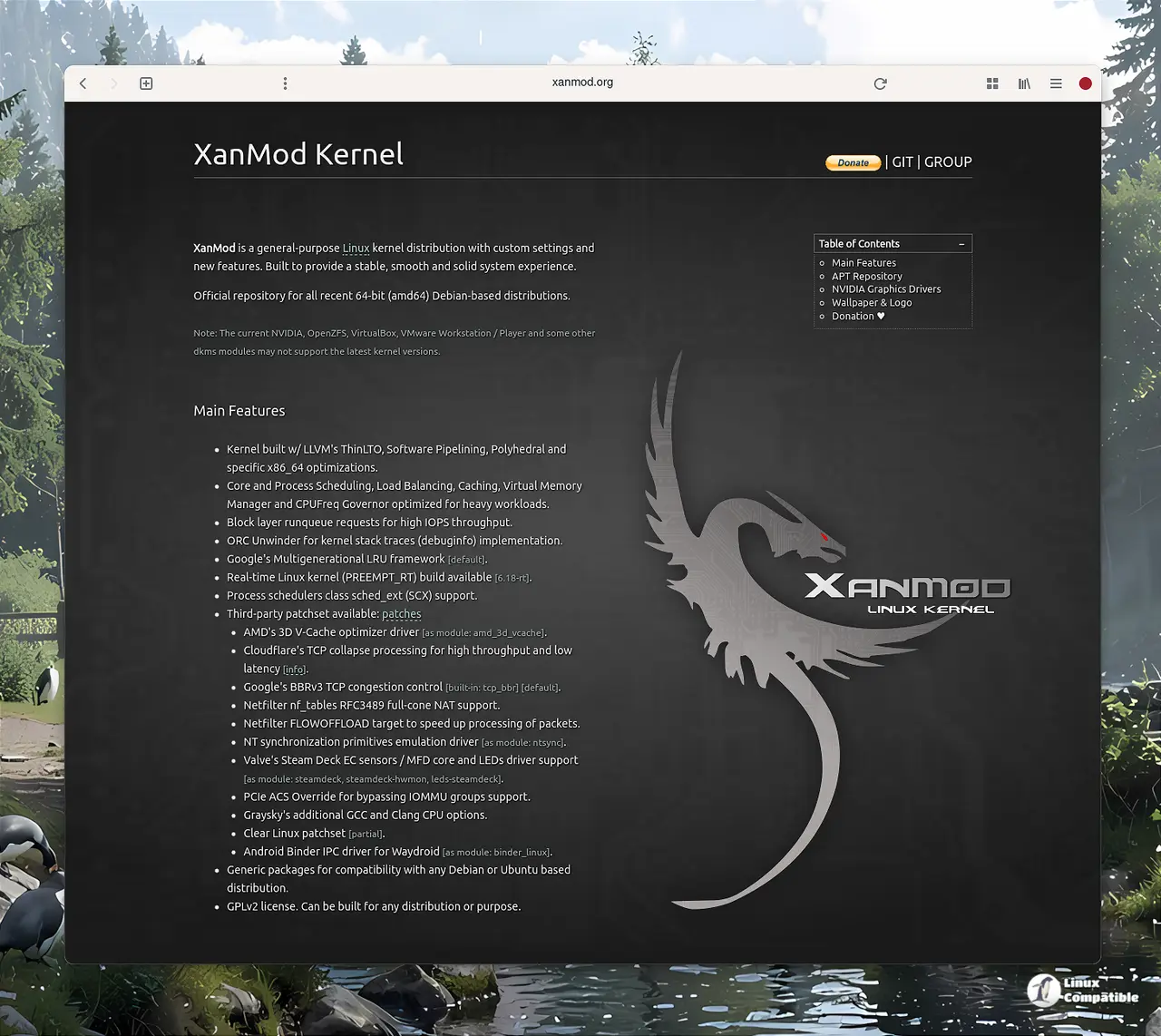
XanMod is a third-party kernel kept running by Alexandre Frade since 2015. It's released under GPLv2, which means anyone can rebuild it for any purpose. The project takes upstream source, applies a curated patchset, rebuilds, and hands you prebuilt packages. You don't compile anything. You don't read a forty-page config checklist.
Frade describes the goal plainly: "a stable, smooth and solid system experience." The target audience is desktop users, gamers, and power users who want new features without the usual hands-on-the-kernel grind. It's x86-64 only, distributed as amd64 packages for Debian, Ubuntu, and the derivatives stacked on top of them.
Now, the default kernel most distros ship is configured for broad hardware compatibility and conservative stability. That's the right call for most people. It just isn't ideal if you're chasing latency under a gaming or compiling workload. XanMod fills exactly that gap.
What changed in 7.2.9 and 6.18.55
Read the changelogs and you'll find something reassuring. These releases are overwhelmingly correctness and hardening updates. The commits run on the usual steady drip of use-after-free fixes, out-of-bounds reads, reference leaks, and data races. Many trace back to syzbot, the automated fuzzer that has quietly patched more of Linux than any single maintainer can claim credit for.
The biggest chunks land in virtualization. KVM got a heavy pass across x86, arm64, RISC-V, and s390, which makes sense given how central hardware virtualization has become. Networking followed, with fixes touching nearly every subsystem. The filesystem layer got XFS hardening plus some SMB client work.
There's also a GPU driver cluster touching amdgpu, i915, and Nouveau. Intel's i915 picked up a laptop-specific quirk limiting eDP rate on the HP Pavilion Plus 14, which is the exact kind of detail that only surfaces once someone's display actually misbehaves. Head here to the GitLab release pages if you want the raw commit-level detail.
The things that make XanMod XanMod are still intact. The builds ship with LLVM software pipelining, Polly polyhedral analysis, and extra x86-64 flags. It retunes the scheduler, load balancing, memory manager, and CPUFreq governor. BBRv3 and Cloudflare's TCP tweaks ship enabled by default.
You also get sched_ext support and a dedicated PREEMPT_RT build. On top of that come the usual community patches: Netfilter nf_tables full-cone NAT, FLOWOFFLOAD, PCIe ACS Override, and even a Steam Deck EC sensor driver. A fun detail if you're running a handheld, otherwise ignore it.
If you want to match a build to your hardware, XanMod offers four x86-64 variants. There's the legacy x86-64 reaching back to a Pentium 4, then x86-64-v2, x86-64-v3 for Haswell and newer plus AMD Zen, and x86-64-v4 with AVX-512. Keep in mind that v4 offers no real kernel benefit, so don't chase it.
For most desktop and gaming machines the LTS x64v3 build is the sensible default. It balances freshness with the long-term support window that keeps production problems away. Grab x64v2 only if your CPU predates 2009. Take RT only if you genuinely need real-time scheduling, otherwise you pay a latency cost for a feature you never invoke.
Getting it installed stays as painless as XanMod makes it. You register the PGP key, add the official APT repo, install a kernel matching your CPU, and reboot. The supported codenames include bookworm, trixie, noble, plucky, and a handful of Debian names you've probably never heard of.
Build out-of-tree modules? There's a separate toolchain package. NVIDIA users get a matching driver repo with both a production and a newer feature branch. Rather skip the repo entirely? Standalone .deb packages sit on SourceForge.
Head here to the XanMod website for more information.


