VKD3D 2.2 Adds First-Class Floating-Point Semantics to DX12 Games on Linux
The DX12-to-Vulkan translation library ships a day ahead of Wine 12.0 and will fold into the next generation of Proton builds.
VKD3D 2.2 went out today and though it is a background library most gamers will only ever meet through Proton, it quietly does the kind of work that flips a title from "runs but looks subtly wrong" to "runs correctly." The release is mostly about shaders now respecting exactly what a DX12 game asks of the floating-point pipeline instead of the library guessing.
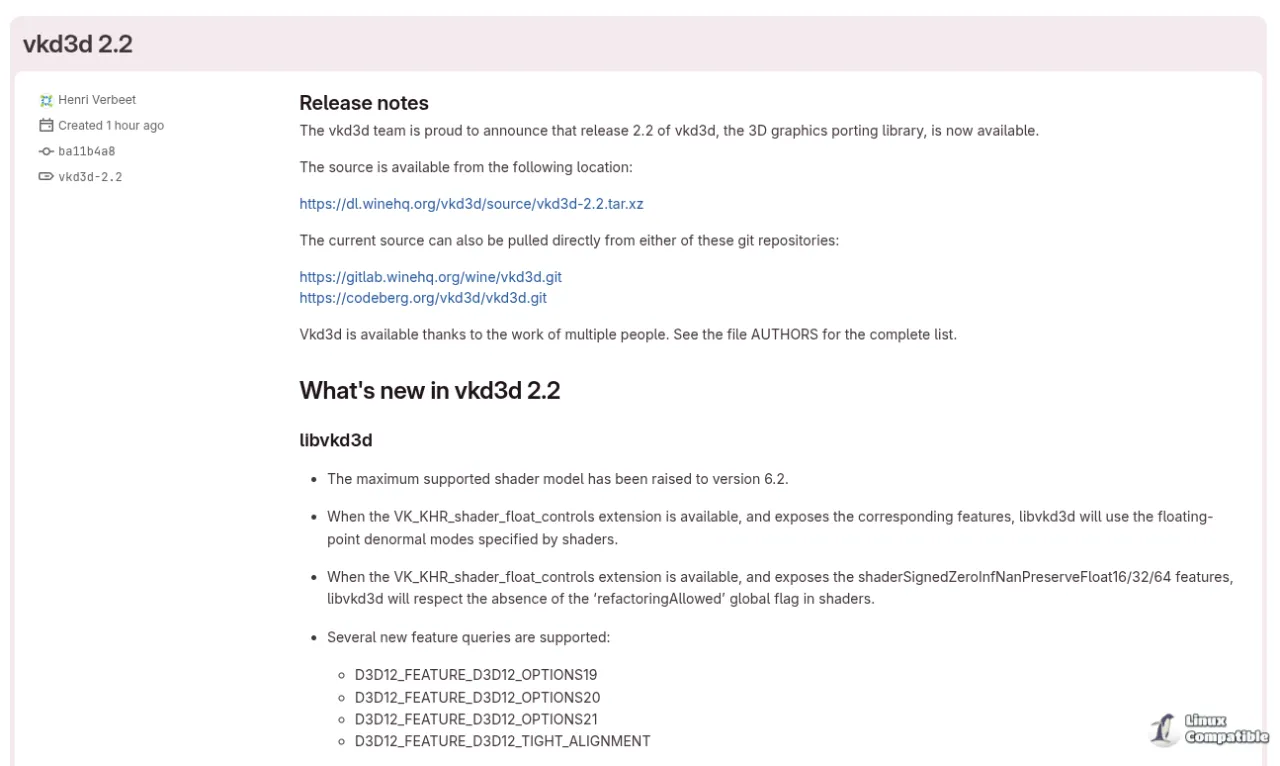
You might not recognize the name VKD3D, and arguably that's the point. It is a porting library that translates Microsoft's Direct3D calls, DX12 foremost, into Vulkan so Windows games will run on Linux. DXVK covers the older Direct3D 9 through 11 titles; VKD3D handles the modern stuff, which has been the dominant PC API for years now. Two versions exist: the upstream project maintained by the WineHQ community here, and Valve's vkd3d-proton fork, which ships inside Steam Play.
Timing. VKD3D 2.2 landed a single day before Wine 12.0 enters its release-candidate cycle in December, with stable 12.0 aimed at early 2027. So 2.2 will be folded into mainline Wine and, indirectly, into the next round of Proton and GE-Proton builds heading into the new year. As of right now its effects won't show up on your Linux gaming rig until that cycle actually lands.
Commit weight. On paper, 2.2 looks smaller than its predecessor. Roughly 271 commits across 12 contributors since 2.1, with Henri Verbeet of CodeWeavers doing the bulk of it at 75. Giovanni Mascellani came in second with 65, and the remainder was split among a wider-than-usual field — Elizabeth Figura clocked 50, Francisco Casas 42, Shaun Ren 27. It still rides on a small core of dedicated maintainers, but more contributors landed multi-commit chunks than usual.
Shaders that know what they want
The headline for 2.2 is floating-point fidelity. For the first time the shader compiler can honor a shader's declared intent around contraction and reordering, gated on the Vulkan float-controls extension. Two halves to it.
Denormals, numbers smaller than the normal range, are cheap to ignore on most GPUs but still semantically meaningful, so 2.2 now applies the denormal modes a shader asks for. More important is the refactoringAllowed flag. HLSL uses it to tell the compiler it may freely reorder floating-point math, since those operations aren't associative and exact results are impossible to guarantee anyway. When a shader leaves that flag out, demanding strict IEEE behavior, vkd3d now respects the absence, but only if the GPU exposes the matching signed-zero/inf/nan-preserve features. On older hardware it falls back to setting the flag itself rather than emitting wrong results, which is the sensible call.
Keep in mind that this last piece is exactly the "runs but looks slightly off" territory the library has historically skated through.
Shader model support also climbs, from 6.1 to 6.2, a minor bump but relevant for titles leaning on the incremental wave intrinsics and refined resource descriptors. Four new feature queries land too, including D3D12_TIGHT_ALIGNMENT, which lets apps ask how tightly the driver will pack resources in memory. That can meaningfully cut VRAM waste, especially on AMD hardware where alignment padding has been a source of bloat for ages.
And on the HLSL completeness front, which is where most of the visible work landed, a batch of features modern authors take for granted got implemented from scratch: namespaces, isfinite(), GetDimensions() for RWTexture UAVs, the .mips[][] operator, and integral attribute expressions. Shaun Ren did much of that legwork.
Reflection catches up, and the legacy path gets tidy
Reflection was clearly lagging, and 2.2 tries to close the gap. GetNumInterfaceSlots(), a reflection method that was simply missing, now exists on both the D3D12 and D3D11 interfaces, sample counts are recorded in reflection metadata, and a new global-flags scan lets callers query whether a shader is even safe to compile as-is. That matters because broken reflection can make a shader "compile" yet fail the moment the engine tries to read it.
The legacy SM1-3 bytecode path got a bigger treatment than you'd expect from a minor bump. Figura built a proper disassembler, added diagnostic warnings for invalid modifiers and usages, and stripped dozens of long-dead opcodes from the intermediate representation. Cleaner old code is just less likely to harbor latent bugs.
Downstream, the story is a little more indirect. vkd3d-proton, Valve's fork where most Linux gamers actually meet this code, has run ahead of upstream for a while and its version numbering has diverged entirely, sitting on the 3.x line now with GE-Proton shipping v3.1. Still, 2.2's tight-alignment and denormal work maps neatly onto problems vkd3d-proton has already been attacking, and Valve later added the VK_MESA_image_alignment_control extension to go at the same VRAM bloat. Either way, there's a clear through-line even if the two projects don't share version numbers.
Getting the standalone build is straightforward if you want it. It's a standard autotools project: bootstrap, configure, make, install, with SPIRV-Headers, Vulkan-Headers 1.3.228 or newer, Perl, and libjson-perl as dependencies. Most people won't need to, since you'll typically get it bundled through Proton or GE-Proton rather than compiling from source. The code is LGPL 2.1 or later, and the tarball plus a Codeberg mirror are already up.
That's the thing worth tracking. The library is here today, but its work won't reach the Proton builds most people actually run until the Wine 12.0 cycle lands. For anyone chasing stubborn DX12 titles on Linux, though, it's a quietly good step in the right direction.
Head here to the release announcement.


