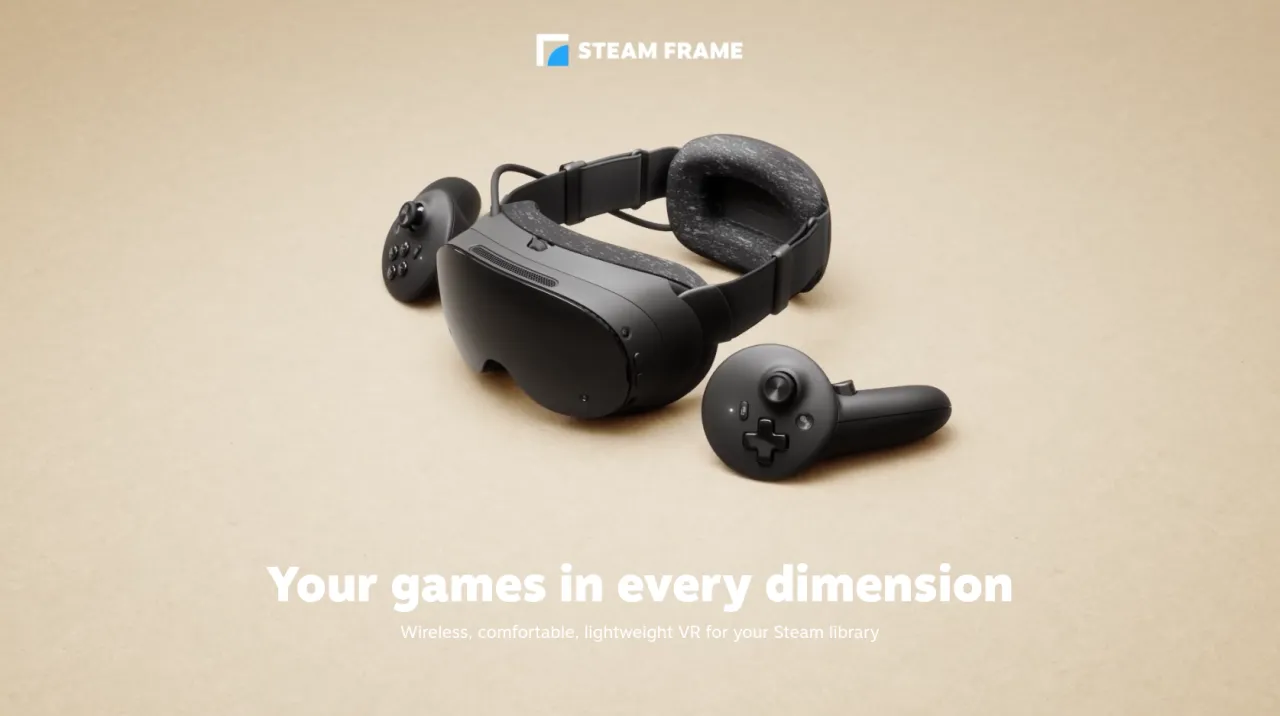
Valve has pushed SteamOS 0.4.2 (Beta) for the Steam Frame, its third OS update since the headset's September 14 launch, tightening audio reliability, connection stability (including a fix for "protocol error 17"), and proximity detection. The polish pass bundles the SteamVR 2.18.1 runtime and arrives alongside a dongle troubleshooting script aimed at making streaming work on third-party Linux distros. The Frame itself is a streaming-first, standalone VR headset powered by a Snapdragon 8 Gen 3, priced at $1,059 for 256GB and $1,299 for 1TB. Buyers are still waiting on shipped units through Valve's reservation system, and the dongle experience on non-SteamOS Linux remains a known rough edge.
Valve pushes SteamOS 0.4.2 Beta for Steam Frame with streaming fixes
The third OS update since the headset's launch tightens streaming, connection, and face-detection reliability, shipping to buyers who mostly haven't received their units yet.
Three days after 0.4.1 landed, Valve pushed SteamOS 0.4.2 (Beta) for the Steam Frame into the beta update channel. The Steam Store post is as terse as these things get. It does, though, land at a busy moment: the headset launched on September 14, and thousands of buyers are still waiting on a unit that Valve hasn't shipped.
Think of 0.4.2 as a polish pass. The headline changes target streaming: better audio reliability, better connection reliability, and a fix for a failure class Valve calls "protocol error 17." That's the kind of wireless VR dropout that's plagued the space for years, and it's one the company has been aiming at specifically. There's also another refinement to the proximity sensor, the logic that decides whether the headset is actually sitting on your face. It bundles SteamVR 2.18.1, the runtime Valve has been tweaking in parallel for Linux users.
A weekly cadence for a launch backlog
Read in isolation, 0.4.2 looks thin. It's really the third step in an update sequence, and the shape of that sequence tells you where Valve stands.
The company pulled the covers off SteamOS 0.3.0, the first public build, on September 18. That one was mostly about keeping freshly launched hardware alive: faster charging while the unit sleeps, better controller tracking when haptics are on, a fix for a garbled-audio mic bug, and a couple of motion-smoothing tweaks.
Then 0.4.1 arrived on September 26, and it leaned into features. Spectator view got smoothed by default, a "Dominant Eye" setting landed, and Valve fixed the dashboard recentering itself for no good reason plus the keyboard that wouldn't show up during streaming. It also overhauled that same proximity sensor model that 0.4.2 now polishes once more.
The pattern is a launch-bug backlog chewed through at a weekly clip. That pace makes sense for a brand-new platform. It also lines up with the "quite rough" early-adopter reports.
Hardware, pricing, and the waiting game
The Frame is a streaming-first headset, and the dongle is the whole point. It ships with a plug-and-play Wi-Fi 6E adapter that gives streaming its own dedicated 6GHz link. Reporters who spent time with the unit at Valve said they detected no perceptible lag. One of the headset's two Wi-Fi 7 radios carries the stream while the other stays on your home network, with Multi-Link Streaming routing data across every connection at once.
The specs hold up too. A 4nm Snapdragon 8 Gen 3 (ARM64) pairs with 16GB of unified LPDDR5X, double the Quest 3's memory, driving dual 2160×2160 LCDs under pancake lenses. At 185g for the frontbox it beats a Quest 3 on weight, though a battery strap pushes that toward 440g.
It's also standalone, which is a lot to ask of one headset. That Snapdragon runs the Steam library on-device via Proton and FEX for x86 translation, plus Lepton for Android apps. The "Great on Frame" catalog hit 130 titles as of September 11, though most are flatscreen picks like Balatro and Hollow Knight: Silksong rather than native VR. That detail says a lot about where the platform actually lives.
At $1,059 for 256GB, the Frame is arguably pricier than you'd expect for a headset that leans so hard on a PC to do the heavy lifting. The 1TB kit asks $1,299, and both bundles include the Steam Frame Controllers, that Wi-Fi 6E adapter, and a copy of Half-Life: Alyx. The 45W power supply is a separate $29 buy, but any Steam Deck charger or 45W+ USB-C adapter works if you'd rather skip it. You can stack on more from there: an ergonomic kit for $59, a replacement kit for $49, and a color Arcturus Vision camera for $149.
Valve ran this as a reservation lottery, not a normal preorder. Signups closed on September 17 at 10:00 AM Pacific, the lists got shuffled once, and purchase emails rolled out in waves starting September 18. Direct shipping covers the US, Canada, the UK, the EU, and Australia, with Japan, Taiwan, and Hong Kong going through distributor KOMODO. Reservations showed up on eBay within hours, some asking up to $2,000, which is why Valve leaned on its usual anti-reseller talking points.
Still rough around the edges. Shipping timelines for waitlisted buyers remain unpublished, resale persists despite Valve's no-transfer terms, and the headset launched without any marquee first-party VR exclusive. Its real launch title is, effectively, the entire Steam catalog over a wireless link.
If you're tempted by 0.4.2, only step into the Beta channel if you're comfortable testing unfinished software. The build rolls back through Settings > System > System Update Channel. For streaming from a Linux desktop, make sure you're at least on SteamOS 3.9 with a 7.2 kernel, latest GPU drivers, a set regulatory domain, and the rtw89 driver in place, or run Valve's dongle troubleshooting script before poking at things by hand. Valve's own caveat is that there's "no one-size fits-all solution" across Linux distros, so the dongle experience on non-SteamOS machines is still a gamble.
Head here to the Steam news post for the full changelog.


