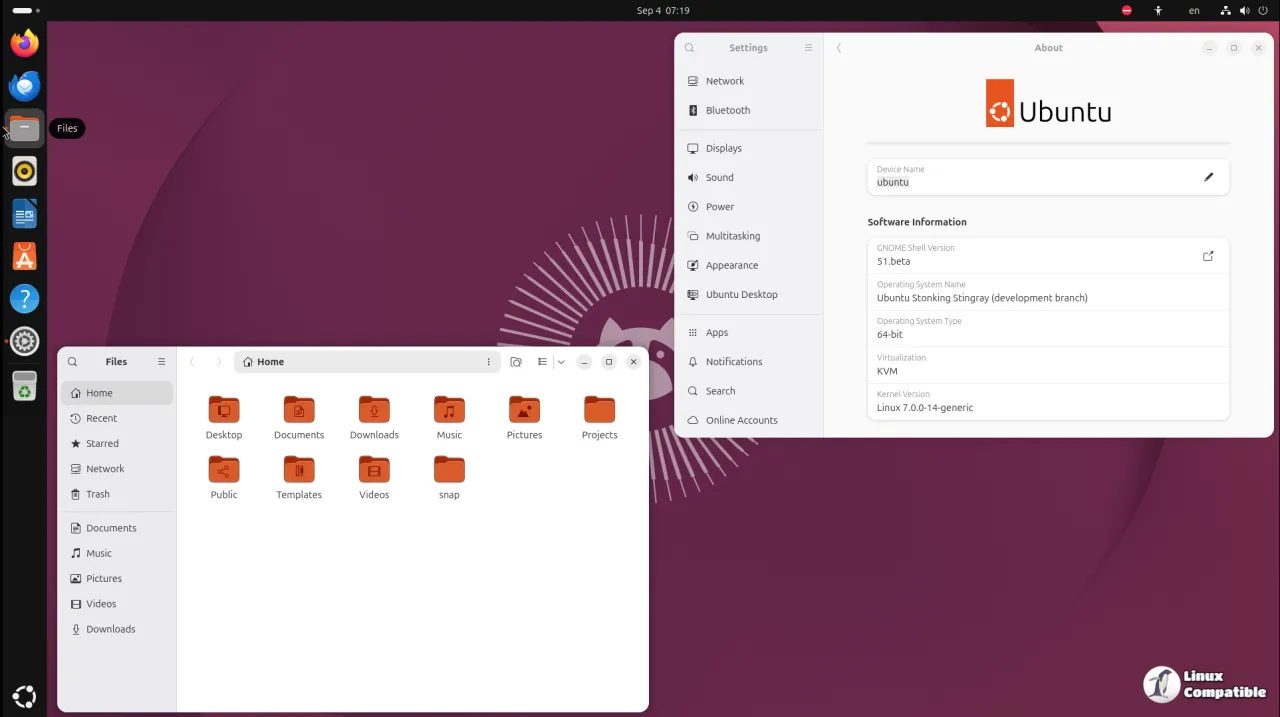
Ubuntu has released its first official RISC-V desktop images for Ubuntu 26.10 "Stonking Stingray," bringing GNOME and XFCE experiences to riscv64 hardware. The experimental images run on SpacemiT's K3 development board, powered by the X100 core with official support arriving with the October 15 release. Two builds are available now on cdimage.ubuntu.com, though the XFCE minimal version is recommended for QEMU emulation since GNOME takes 30+ minutes to load. This milestone closes a years-long gap for RISC-V as a desktop architecture, following Canonical's RVA23 profile cutoff that forced the ecosystem toward faster silicon.
Ubuntu ships its first official RISC-V desktop images
Ubuntu has finally given RISC-V a desktop, and it's running on a Chinese chip built for exactly this moment. Canonical unveiled the first riscv64 desktop images for Ubuntu 26.10 "Stonking Stingray," officially supported on the SpacemiT K3 development board. A full desktop that amd64 and arm64 users take for granted was, until now, noticeably absent from RISC-V.
There was a reason for the delay. RISC-V server and cloud images showed up years ago, but anyone wanting to actually run a GUI on RISC-V was on their own. The bottleneck wasn't effort so much as silicon. Early RV64GC boards handled servers fine. They made for a lousy desktop.
Keep in mind that the picture changed once hardware caught up. The K3 is built around SpacemiT's X100 core, an RVA23-compliant chip that can cluster up to 64 cores. Canonical started demanding the RVA23 profile with Ubuntu 25.10 in October 2025, quietly dropping the older, weaker boards. That policy was engineered to push the ecosystem toward faster silicon, and the K3 is the payoff.
Downloadable now, and the board behind it
Two experimental riscv64 images are already live on cdimage.ubuntu.com. The first is the standard Ubuntu Desktop with GNOME, which Canonical says delivers "a nice performant desktop experience" on real K3 hardware.
The second is an Xubuntu Minimal build based on XFCE. It exists for practical reasons rather than taste. The GNOME desktop can take 30 or more minutes to load under QEMU emulation. XFCE's minimal image is far more livable inside a VM.
Both are explicitly experimental and unsupported. Canonical wants Launchpad bug reports, and a few desktop pieces are still finishing off. The App Center, the Prompting Client, and some other snaps haven't been bootstrapped for RISC-V yet.
The K3 comes in two documented form factors: a Pico-ITX development board and a CoM260 module on a carrier board. Both boot from USB, install to internal UFS or an NVMe drive, and expose a serial console for headless installs.
There's a wrinkle, though. Boards typically ship with Bianbu OS and stale firmware, so flashing comes first. The Pico-ITX uses a dedicated FDL flashing button, while the CoM260 needs you to short a recovery pin on the debug header while it powers on. Canonical ships an experimental host-side script for the job:
curl https://raw.githubusercontent.com/canonical/spacemit-k3-flash-firmware/refs/heads/main/flash-k3-firmware.sh | bash
Be honest with yourself about the "experimental" label here. Canonical asks for bug reports on the GitHub repo. Skip SpacemiT's all-in-one vendor images if you want official support, since those run a non-upstream kernel with vendor patches bolted on.
The real story behind two links
On the surface this is a modest announcement. Two images, one board, and still a week until the official 26.10 release. It's early: firmware flashing is manual and flagged experimental, and you'll probably stare at a loading screen for a few minutes under QEMU. Don't mistake that for a finished desktop.
Behind the links there's a fair amount of plumbing. Canonical says closing the gap "took a joint effort from the Foundations and Desktop teams, with a fair amount of plumbing in between." The livecd-rootfs pipeline needed a more generic way to handle device trees. The kernel team cherry-picked display patches for the K3. The installer's Flutter-based UI now runs on a riscv64 build of Flutter 3.44.0.
A detail worth following: the person who filed the upstream Flutter RISC-V pull request, flutter/flutter#178712, is the very same Vincent Haudiquet who wrote this announcement. That single engineer's work reaches the image pipeline, the GUI toolkit, and the kernel, and the desktop UI you'd actually touch depends on that upstream change landing. Those livecd-rootfs fixes were also pushed back to Ubuntu 26.04 via SRU, though official K3 support on 26.04 still hasn't shown up.
It's arguably the most ambitious desktop push the RISC-V ecosystem has seen yet. Hardware has matured fast. Alibaba's Xuantie C950 hit 3.2 GHz on a 5nm node in March 2026, with EE Times claiming benchmarks that rivaled Intel or Arm. Framework ships a RISC-V mainboard laptop, and SpacemiT's own Muse Book has quietly put the K1 chip into a notebook. Chinese companies are clearly driving a lot of this momentum.
Canonical's effort flowing upstream matters beyond its own users. Those same changes benefit the whole RISC-V software ecosystem, not just Ubuntu's own installs. If you want to try it yourself, the QEMU route needs a host running Ubuntu 25.10 or later, since RVA23S64 emulation requires QEMU 10.1 or newer. Head here for the QEMU guide and here for the official K3 install docs, and report what you find back on Launchpad.


